
Marin-Épagnier
On the land of Marin-Épagnier, on Lake Neuchâtel, lies the La Tène site, which gave its name to the European late Iron Age.
Entry based on 16 sources · Our method · Reusable text (CC BY-SA)
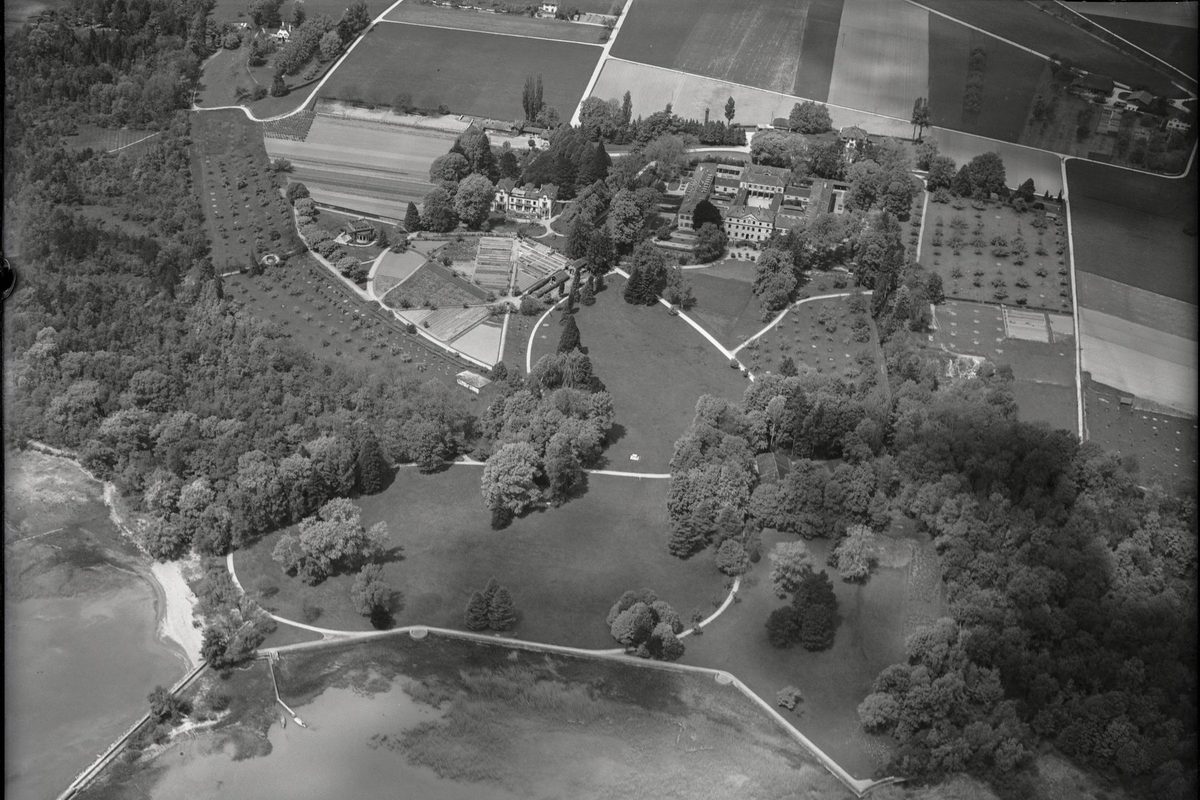
Origin of the name Marin-Épagnier
The name joins two villages, separate municipalities until they united in 1888. Épagnier appears in 1163 as « Espagnie ». The deed is said to be a gift by the knight Pierre d'Épagnier to the abbey of Hauterive. Marin follows in 1179 as « Marens » (formerly also Marins or Mareins). It is linked to mal arena (« poor shore »), the Roman personal name Marianus or a pre-Roman name Marincus. Épagnier may come from the Old French « espaille » (bush, scrub), like Épagny or Épalinges. None of these explanations is established.[1][8]
Founding of Marin-Épagnier
No founding charter or founder is known for Marin and Épagnier. Their land, on Lake Neuchâtel at the mouth of the Thielle, has been occupied since prehistory: between Épagnier and Préfargier there are three Neolithic and two Bronze Age lakeside settlements. At Bourguignonnes and Chevalereux lie a Hallstatt period settlement and Late La Tène rectangular enclosures. The La Tène site, which gave its name to the late Iron Age, lies within the municipal territory. The village community of Marin was formed in the 14th century. Marin and Épagnier belonged to the castellany of Thielle and to the parish of Saint-Blaise (Épagnier since 1888). United in 1888 as the municipality of Marin-Épagnier, they formed the municipality of La Tène with Thielle-Wavre from 2009 to 2024 and, in 2025, the municipality of Laténa with Enges, Hauterive and Saint-Blaise.[1][5][8][10][12]
History of Marin-Épagnier
around 3500 BC. The lakeside village of Marin-Les Piécettes, from the late Cortaillod culture, has two rows of houses at right angles to the shore and a tall, narrow building on an artificial mound. Excavated from 1998 to 2002, it is listed as of national importance.[7]
Bronze Age. Two Bronze Age lakeside settlements are added to the three known Neolithic settlements between Épagnier and Préfargier.[8]
Hallstatt period. A settlement is established at Bourguignonnes and Chevalereux, where Late La Tène rectangular enclosures are also known.[8]
around 658 BC. Construction at La Tène of the so-called « Desor » bridge, dated by dendrochronology. It was long attributed to the Roman period.[12]
mid-3rd century BC. A Celtic bridge is built at La Tène. It is destroyed in the mid-1st century BC.
1163. First mention of Épagnier, as « Espagnie ».[1][8]
1179. First mention of Marin, as « Marens ».[8]
1362. Count Louis of Neuchâtel reportedly leases to the community of Marin a meadow called « La Planche de Mozon ».[1]
14th century. The village community of Marin is formed. Marin and Épagnier belong to the castellany of Thielle until 1848.[1][8]
1756-1838. A calico printing works (printed cotton cloth) operates in Marin-Épagnier.[8]
1848. On 27 December the Maison de santé de Préfargier, founded and funded by Auguste-Frédéric de Meuron (1789-1852), opens. The first patient is admitted on 2 January 1849.[3]
1857. In November the fisherman Hans Kopp, who was collecting objects for Friedrich Schwab, discovers the La Tène site.[12]
1860-1948. Various small businesses settle: watchmaking, polishing rouge and leather goods.[8]
1870. After this date Gottlieb Bühler's company operates gravel pits.[8]
1888. Marin and Épagnier unite as the municipality of Marin-Épagnier. Épagnier henceforth belongs to the parish of Saint-Blaise.[1][8]
1901. Marin-Épagnier gets a station on the Neuchâtel-Bern line.[8]
1903. Adolf de Martini founds a car factory at Saint-Blaise, on the boundary with Marin-Épagnier. The Cité Martini, a group of thirty workers' dwellings, is built in 1905-1906 on Marin's territory.[10][13]
1907-1917. Official excavations at La Tène, led by William Wavre and, from 1909, by Paul Vouga.[12]
1958. Start of industrial growth; later arrivals include the Migros distribution centre (from 1960), Ebauches Electroniques SA (1971, later EM Microelectronic) and Metalor (1983).[8]
1975. Opening of the Saint-Blaise-Le Landeron section of the A5 motorway, which speeds up industrial development.[8]
1989. Marin-Épagnier hosts one of the two school centres (regional secondary school) of the Bas-Lac area.[8]
1996. The Maison de santé de Préfargier is listed as a historic monument.[3]
1 January 2009. Marin-Épagnier and Thielle-Wavre merge to form the municipality of La Tène.[5][8]
26 November 2023. The voters of La Tène, Hauterive, Saint-Blaise and Enges approve the merger of their municipalities by more than 72 %.[9]
1 January 2025. La Tène merges with Enges, Hauterive and Saint-Blaise to form the municipality of Laténa. Marin-Épagnier becomes one of its localities.[9][10]
Population of Marin-Épagnier
Sources and references: [8]
| 1850 | 331 |
| 1900 | 627 |
| 1950 | 953 |
| 1970 | 2'540 |
| 2000 | 3'611 |
| 2008 | 4'131 |
Families of Marin-Épagnier
Dardel. Recorded at Le Pâquier from 1402 and at Villiers in 1457, the family appears in Saint-Blaise in 1513, when Jean, of Villiers, is granted the concession for the mills there. Three of his sons found the main branches. Nicolet starts the Marin branch, Blaise that of the Dardel-dit-Munier and Huguenin the patrician branch of Neuchâtel. Georges-Alexandre (1775-1863), a captain in the service of the English East India Company, marries a Swedish countess and is ennobled by the King of Sweden in 1810.[16]
Burgher families before 1800. D'Epagnier, Dardel and de Dardel, Davoine, Decreuze-dit-Dupoil and Jeanhenry, with no precise date.[15]
In the 19th century. The Kuntzer, from Germany, open the list in 1863, followed in 1874 by the Speiser, also German. Then come the Wicky of Escholzmatt LU (1888), the Perrottet of Vully-le-Bas FR (1891), the Perrier of Sainte-Croix VD and the Simonet of Galmiz FR (1893), the Pellet of Vully-le-Bas FR (1894) and the Pfeiffer from Germany (1899).[15]
Show more families (1)
From 1901 to 1962. Fourteen entries. Italian families are the most numerous: Corsini (1923), Reggiori (1928), Longhi (1931), Giai-Levra (1939) and Siliprandi (1961). The Verpillot arrive from France in 1914, the Walentiny from Yugoslavia in 1947. The others are Swiss: Otter of Aedermannsdorf SO (1911), Pache of Epalinges VD (1928), Luder of Höchstetten BE (1934), Thévenaz of Bullet VD (1938), Vessaz of Chabrey VD (1944), Decrauzat of Diesse BE and Fischer of Sigriswil BE (1947). The list closes with the Siliprandi in 1961.[15]
Notable people of Marin-Épagnier
Auguste-Frédéric de Meuron (1789-1852). Born into an aristocratic Neuchâtel family, he leaves for Paris in 1809, then trains in England, New York and Lisbon. Settled in Bahia, Brazil, from 1817, he founds the snuff factory Meuron & Cie there in 1819, which makes his fortune. Back in Europe in 1837, he chooses the "pré Fargier" at Marin for the asylum he funds alone and places under a foundation endowed with 100'000 francs.[4]
Economy of Marin-Épagnier, past and present
Martini cars. The Martini works, on the edge of Marin, built about 3'600 cars in thirty years. Nineteen survive in museums or private collections. The Steiger brothers bought it in 1924 and it closed ten years later. FAEL SA, a maker of water heaters and heating equipment, took over its premises.[13]
Historic sites in Marin-Épagnier
The La Tène archaeological site. At the mouth of the Thielle, this site gave its name to the La Tène culture, the European late Iron Age. A Celtic bridge of the mid-3rd century BC, destroyed in the mid-1st century BC, and the « Desor » bridge, dated to around 658 BC, are known there. The main collections are held at the Laténium in Hauterive and the Musée Schwab in Bienne. Cultural property of national importance.[12][14]
The Cité Martini. Group of thirty workers' dwellings (ten rows of three) built in 1905-1906 in the Heimatstil by the architects Prince and Béguin for the staff of the Martini factory. It is listed in the Federal Inventory of Swiss Heritage Sites (ISOS).[13]
The Maison de santé de Préfargier. Psychiatric hospital founded and funded by Auguste-Frédéric de Meuron, opened on 27 December 1848, one of the first to do without chains and bars. Listed as a historic monument in 1996. Cultural property of national importance.[3][14]
La Tène beach. Sandy beach on Lake Neuchâtel, reportedly next to the archaeological site of the same name.
Remains in Marin-Épagnier
The La Tène finds. The site, discovered in 1857, was worked after the first Jura water correction by Émile Vouga, officially excavated from 1907 to 1917 by William Wavre and then Paul Vouga, and again in 2003. Paul Vouga counted 2'479 objects in 1923. By 2011 there were over 4'500, spread across some thirty museums.[12]
The bridges of La Tène. The Celtic bridge, built in the mid-3rd century BC and destroyed in the mid-1st century BC, and the « Desor » bridge, long attributed to the Roman period but dated by dendrochronology to around 658 BC, show the importance of this crossing of the Thielle.[12]
The lakeside village of Marin-Les Piécettes. Village of the late Cortaillod culture, around 3500 BC. The 1998-2002 excavations uncovered two rows of houses at right angles to the shore, an access path traced over 110 metres and, on an artificial mound 5 by 25 metres, a tall, narrow building interpreted as a meeting place or sanctuary. The site is listed as of national importance.[7]
Lakeside settlements and enclosures. Between Épagnier and Préfargier lie three Neolithic and two Bronze Age lakeside settlements. At Bourguignonnes and Chevalereux, a Hallstatt period settlement and Late La Tène rectangular enclosures.[8]
Protected heritage in Marin-Épagnier
Cultural property of national significance (A objects in the PCP inventory)[14]
- Clinique de Préfargier, maison de santé et son parc
- Les marais d'Epagnier, ensemble de sites néolithiques - Moyen Age
Sources
- Edunet.ch, Village de Marin-Epagnier (archives de classes, histoire locale)
- Edunet.ch, Les automobiles Martini
- Fondation de Préfargier, La Maison de santé de 1849 à aujourd'hui
- Fondation de Préfargier, Auguste-Frédéric de Meuron
- Confédération suisse (Fedlex), Fusion Marin-Épagnier/Thielle-Wavre au 1er janvier 2009, création de La Tène (no OFS 6461)
- Localcities.ch, Commune de La Tène (population 2023)
- Université de Neuchâtel, Institut d'archéologie et des sciences de l'Antiquité, Marin-Les Piécettes
- Historisches Lexikon der Schweiz, « Marin-Epagnier »
- Commune de Laténa, « Fusion »
- Dictionnaire historique de la Suisse, « Saint-Blaise (NE) »
- État de Neuchâtel, arrêté du 4 février 2026 homologuant le recensement cantonal de la population au 31 décembre 2025
- Dictionnaire historique de la Suisse, « La Tène (site archéologique) » (Gilbert Kaenel, remanié le 19.02.2014)
- Office fédéral de la culture, Inventaire fédéral des sites construits (ISOS), « Cité Martini » (Marin-Epagnier), 03.2008
- Office fédéral de la protection de la population, Inventaire suisse des biens culturels d'importance nationale et régionale, liste du canton de Neuchâtel (état au 1.1.2026)
- Register of Swiss Surnames, 3rd edition (1989), search Commune "Marin-Épagnier", Canton NE
- Historical Dictionary of Switzerland (HDS), article "Dardel" (Myriam Volorio Perriard), version of 20.02.2017 (German version)
Published by Sébastien Jörg ·
Other villages near Marin-Épagnier
Missing information, or do you have a source? Suggest a correction or addition. Every submission is checked before it's published.
Suggest a change