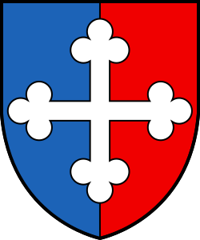
Saint-Maurice
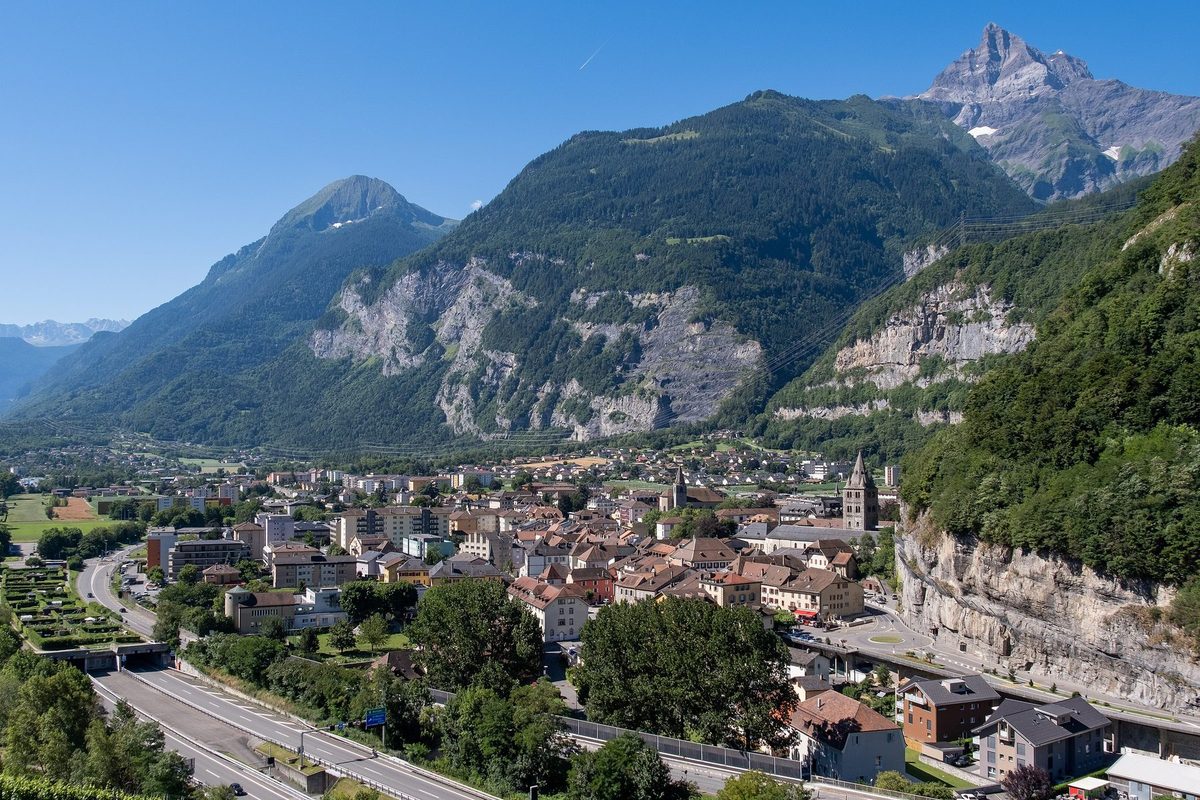
Origin of the name Saint-Maurice
Around 200 an inscription names the place in the form « Acaun[ensis quadragesimae] Gal[liarum] ». It was then known as « Agaune » or « Acaunum ». In the 11th century it took the name Saint-Maurice, in honour of the martyr saint. This form appears in 1003. The etymology of Acaunum has not yet been explained.[1]
Founding of Saint-Maurice
Saint-Maurice lies on the left bank of the Rhône, at the foot of a cliff and upstream of a narrow gorge, on the unavoidable route to Italy over the Valais passes. Bronze Age remains have been found at the foot of the rock. In Roman times Agaune was a customs post where the « fortieth of the Gauls » was levied, a tax of about 2.5 %. A water sanctuary dedicated to the Nymphs is likely. Tradition places here the martyrdom of Saint Maurice and his companions of the Theban Legion. Bishop Theodore had a basilica built in their honour, which became a much frequented place of pilgrimage. Then Sigismund, the future king of the Burgundians, founded the abbey of Saint-Maurice there and endowed it with many territories. The town then developed around the abbey and the passage through the gorge. Today it includes the hamlets of Epinassey and Les Cases. Evionnaz and Vérossaz once belonged to it, and Mex has joined it.[1]
History of Saint-Maurice
around 200. First mention of the place, in the form « Acaun[ensis quadragesimae] Gal[liarum] »: Agaune is a Roman customs post where the « fortieth of the Gauls » is levied.[1]
286-310. Reign of Maximian, under which tradition places the martyrdom of Saint Maurice and his companions of the Theban Legion.[1]
360-370. Bishop Theodore has a basilica built in honour of the martyrs. The place becomes a much frequented pilgrimage.[1]
515. Sigismund, the future king of the Burgundians, founds the abbey of Saint-Maurice and endows it with many territories.[1]
523. Invasion by the Franks, followed by that of the Lombards in 574 and of the Saracens in the mid-10th century.[1]
888. The Welf Rudolph is crowned king of Burgundy in the abbey.[1]
1003. First mention of the name Saint-Maurice.[1]
1034. The Chablais passes to Savoy. Saint-Maurice forms a castellany with Monthey, whose castellan settles in Saint-Maurice around 1300.[1]
around 1170. First mention of the burghers. By 1275 at the latest the community elects two syndics.[1]
1317. Count Amadeus V of Savoy confirms the franchises of the town, surrounded by walls from the 13th century.[1]
1475. Lower Valais comes under the rule of the seven dizains. Until 1798 Saint-Maurice is the centre of the governorship of the same name.[1]
1476. Construction begins on the castle guarding the gorge, which had become the border with Bernese territory. It is completed in 1646 with the extension of the living quarters.[1]
1611. The Capuchins settle in the town. Their friary and chapel date from 1640.[1]
1693. A fire ravages the town and causes the stored gunpowder to explode. The castle is partly destroyed.[1]
1810-1814. Saint-Maurice is a sub-prefecture of the French department of Simplon.[1]
1822. The Council of State grants the separation of Vérossaz and Evionnaz.[1]
1831. Fortification of the gorge begins, continued in 1848, 1859 and 1892. Saint-Maurice becomes one of the three pillars of the National Redoubt.[1]
1860. Arrival of the railway, which makes Saint-Maurice an important marshalling yard.[1]
1863. Opening of the Grotte aux Fées (Fairy Grotto).[1]
1995. The fortifications are decommissioned and have since become a tourist site.[1]
2013. Merger with the municipality of Mex.[1]
Population of Saint-Maurice
Sources and references: [1][2]
| 1798 | 830 |
| 1850 | 1'224 |
| 1900 | 2'162 |
| 1950 | 2'728 |
| 2000 | 3'596 |
| 2013 | 4'516 |
| 2020 | 4'515 |
| 2025 | 4'652 |
Historic sites in Saint-Maurice
Abbey of Saint-Maurice. Founded in 515 by Sigismund at the cult site of the Theban martyrs, it is the most important religious institution of the town. With its treasury it attracts pilgrims and tourists. The college attached to it is attested from the Middle Ages and linked to the State of Valais by an agreement in 1806.[1]
Parish church of Saint-Sigismond. A parish since at least the mid-12th century, it succeeds a 6th- or 7th-century funerary chapel dedicated to Saint John. The present building dates from 1715. Morcles depended on it until the Reformation (1529).[1]
Castle. Built from 1476 to guard the gorge, which had become the border with Bernese territory, completed in 1646 with the extension of the living quarters, then partly destroyed in the fire of 1693.[1]
Bridge over the Rhône. The first bridge over the Rhône upstream of Lake Geneva, it has existed since the 12th century and, together with the gorge, made it possible to control trade and defend the town.[1]
Notre-Dame-du-Scex. Church clinging to the cliff, whose present building dates from the 18th century, on remains of an 8th-century building.[1]
Chapel of the Martyrs at Vérolliez. Chapel dedicated to the martyrs, whose present form dates back to the 18th century.[1]
Grotte aux Fées. Cave opened to the public in 1863, which has since attracted tourists along with the abbey and its treasury.[1]
Hôpital Saint-Jacques. Hospice founded in the 10th century, still in existence.[1]
Remains in Saint-Maurice
Bronze Age remains. Bronze Age remains have been found at the foot of the rock.[1]
Roman spring catchment. The catchment of the spring at the foot of the rock is probably Roman. A water sanctuary dedicated to the Nymphs is likely.[1]
Fortifications of the gorge. Works built in stages in 1831, 1848, 1859 and 1892, which made Saint-Maurice one of the three pillars of the National Redoubt. Decommissioned in 1995, they have become a tourist site.[1]
Legends of Saint-Maurice
The martyrdom of the Theban Legion. According to tradition, Saint Maurice and his companions of the Theban Legion were martyred at Agaune under the reign of Maximian (286-310). In their honour Bishop Theodore had a basilica built around 360-370, and in the 11th century the place took the name Saint-Maurice.[1]
Sources
- Dictionnaire historique de la Suisse, « Saint-Maurice (commune) » (Gaëlle Bourguinet Eggs, version du 10.11.2021)
- Office fédéral de la statistique (OFS), STATPOP, chiffres provisoires au 31.12.2025, via citypopulation.de
- geo.admin.ch, recherche de lieux (coordonnées)
Localities of the municipality with a page
Other villages near Saint-Maurice
Missing information, or do you have a source? Suggest a correction or addition. Every submission is checked before it's published.
Suggest a change