Saint-Oyens
Saint-Oyens takes its name from an oratory founded by the Jura abbey of Saint-Claude, formerly Saint-Oyend. The village is due to join Gimel on 1 January 2027.
Entry based on 8 sources · Our method · Reusable text (CC BY-SA)
Origin of the name Saint-Oyens
The first written mention, in 1139, gives the form «Sancto Eugendo». The name comes from an oratory founded by the abbey of Saint-Claude and refers to Saint Oyend (Eugendus in Medieval Latin). The inhabitants are nicknamed the Covas or Covaillons. In Vaud patois the «cova» is said to be the holder for the whetstone used to sharpen scythes.[4][5]
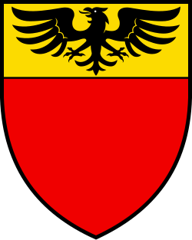
Coat of arms of Saint-Oyens
Gules, a chief Or charged with an eagle sable. The field is red. A yellow band fills the top and bears a black eagle. The commune created its arms in 1831. It took over the eagle of the lords of Cossonay-Prangins, overlords of the village until 1293, who bore one in their own arms.[7][4]
Founding of Saint-Oyens
The village owes its name, and probably its origin, to an oratory founded at an unknown date by the abbey of Saint-Claude (Saint-Oyend, in the Jura). In 1139 the local church of Saint-Maurice belonged to the abbey of Romainmôtier. A noble family bearing the village's name is mentioned from 1172 as vassals of the lordship of Mont-le-Vieux, and the village community held common property from 1389.[4][5]
History of Saint-Oyens
1139. First mention as «Sancto Eugendo». The church of Saint-Maurice belongs to the abbey of Romainmôtier.[4][5]
1172. A noble family of Saint-Oyens is mentioned as vassals of the lordship of Mont-le-Vieux.
1389. The community holds common property.
1401. A confraternity of the Holy Spirit is recorded.
Middle Ages. The church of Saint-Maurice becomes a chapel of ease of the church of Gimel.
1536-1798. Under Bernese rule Saint-Oyens belongs to the bailiwick of Morges. The church is left to decay.
1764. The village has 158 inhabitants.
1798. Saint-Oyens is assigned to the district of Aubonne.
1857. A fire strikes the village.[4][5]
1877-1878. The church is rebuilt.[4][5]
2000. The municipality has 237 inhabitants. Three quarters of the working population commute.
2005. A farming municipality (crops and livestock), with the primary sector providing 34% of jobs; residential development is growing.
2006-2008. The law on territorial organisation of 30 May 2006 abolishes the district of Aubonne. Since 1 January 2008 the municipality has been part of the district of Morges.[6]
2025. On 25 November the Vaud Grand Council approves the merger of Saint-Oyens with Gimel and Saubraz.[2]
2027. The merger is due to take effect on 1 January: the new municipality is named Gimel.[2]
Population of Saint-Oyens
Sources and references: [3]
| 1764 | 158 |
| 1850 | 239 |
| 1900 | 141 |
| 1950 | 140 |
| 1970 | 114 |
| 2000 | 237 |
| 2025 | 449 |
Families of Saint-Oyens
Citizen families before 1800. Six families, with no precise date: Dietrich, Fivaz, Grosjean, Martin, Renaud and Rochat.[8]
In the 19th century. The Du Martheray of Essertines-sur-Rolle VD, the Quiblier and the Stalder are entered with no precise date. Two families came from Germany: the Schmidt in 1848 and the Guntzburger in 1872.[8]
From 1901 to 1962. The Braghiroli, from Italy, were admitted in 1941. Three Bernese families followed: the Hurni of Kallnach in 1958, the Haldi of Saanen in 1959 and the Aebi of Wynigen in 1962.[8]
Economy of Saint-Oyens, past and present
Farmers, craftsmen and common land. According to the FAO, Saint-Oyens has four working farmers, a few small firms (joinery, carpentry, a garage, a blinds maker) and various self-employed people. A third of the land belongs to the commune, as forest and pasture. In the second half of the 19th century the new through road between Gimel and Essertines-sur-Rolle was built.[4][5]
Disasters and major events in Saint-Oyens
The fire of 1857. The fire destroyed practically the whole village.[4][5]
Historic sites in Saint-Oyens
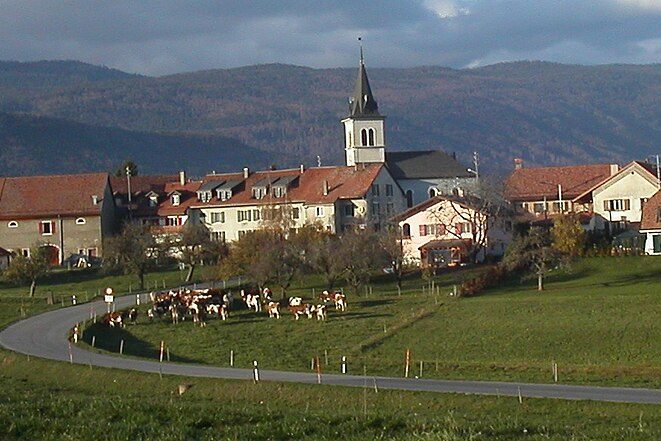
Church (temple) of Saint-Oyens. Former church of Saint-Maurice, attached in 1139 to the abbey of Romainmôtier and later a chapel of ease of Gimel. Left to decay in the Bernese period, it was completely rebuilt in 1877-1878.[4][5]
Old farmhouses. Several farmhouses in the municipality reportedly date from the 18th and 19th centuries.
Traditions and festivals in Saint-Oyens
The twinning of the Saint-Oyens. Saint-Oyens is twinned with three places of the same name: Saint-Oyen in the Aosta Valley, Saint-Oyen in the Tarentaise valley in Savoy, and the hamlet of Saint-Oyen in the commune of Montbellet in Saône-et-Loire. Each year a gathering brings together the inhabitants of the four places, hosted by each in turn.[4][5]
Village festivities. Besides 1 August, the commune organises the Harvest Festival, an outing and a meal for older residents, and the Easter Fountains with an egg hunt. The mixed choir, the shooting society, the youth society, the motorcycle club and the seniors' group shape village life.[4][5]
Sources
- Dictionnaire historique de la Suisse, « Saint-Oyens »
- Blick, « Vaud : le canton passe sous la barre des 300 communes », 25.11.2025
- Statistique Vaud, « Population résidante permanente au 31 décembre 2025 »
- Feuille des avis officiels du canton de Vaud, « Alphabet des communes vaudoises : Saint-Oyens »
- Commune de Saint-Oyens, « Historique de la commune »
- État de Vaud, communiqué du 12.07.2007, « Organisation des préfectures et adaptation au nouveau découpage territorial »
- IPI, Swissreg, emblems database: coat of arms of Saint-Oyens (no. 101438)
- Register of Swiss Surnames, 3rd edition (1989), search Commune "Saint-Oyens", Canton VD
Published by Sébastien Jörg ·
Other villages near Saint-Oyens
Missing information, or do you have a source? Suggest a correction or addition. Every submission is checked before it's published.
Suggest a change