Saint-Prex
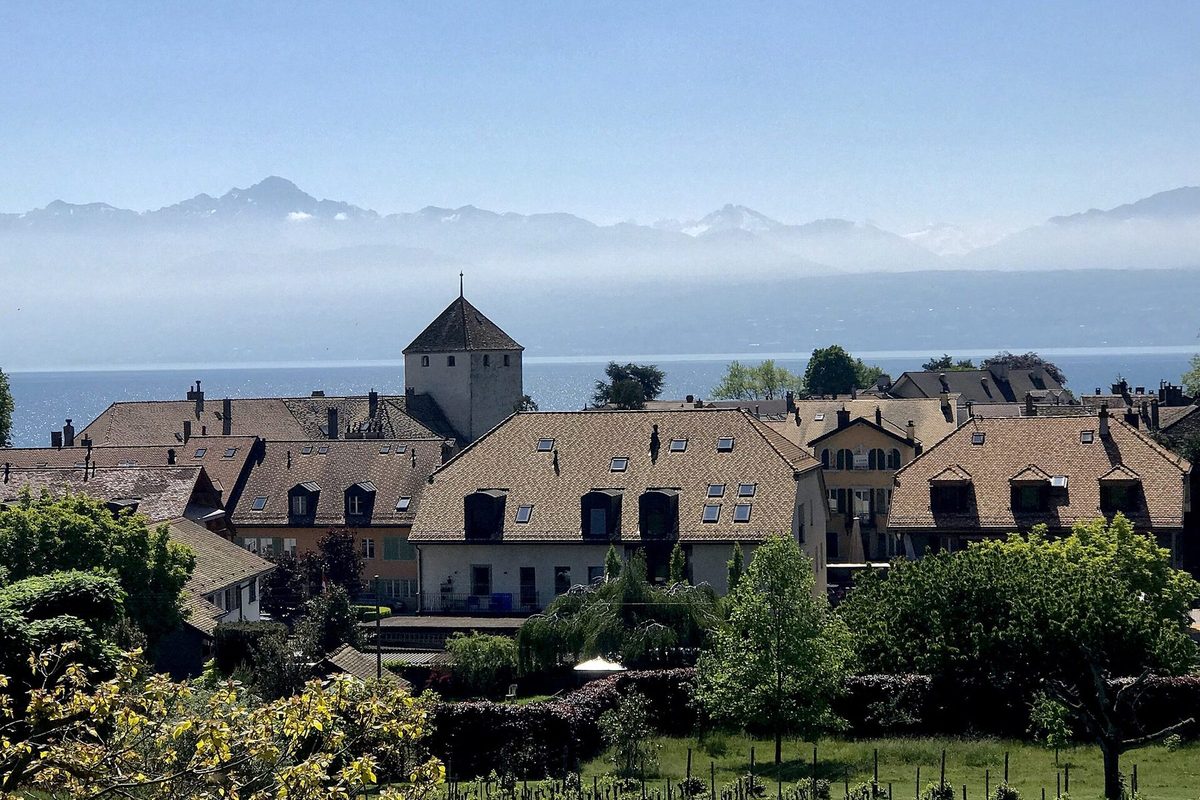
In 1234 the chapter of Lausanne moved the whole village to the shore of Lake Geneva and walled it in. The name comes from a bishop reportedly buried here in the 7th century.
Entry based on 12 sources · Our method · Reusable text (CC BY-SA)
Origin of the name Saint-Prex
Saint-Prex bears the name of Saint Protasius, bishop of Lausanne attested around 652, who is said to have been buried here in the mid-7th century. In 885 the place is called « Sanctus Prothasius ». « Prex » is the form Protais took in the local speech.[1]
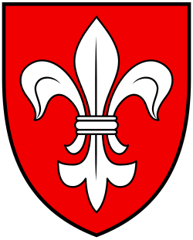
Coat of arms of Saint-Prex
Gules, a fleur-de-lis argent. A white fleur-de-lis stands out on a red field. These arms appear on a seal from the second half of the 17th century. In the early 20th century they were first given a black field, based on an unreliable document, then a blue one as well. In 1921 the authorities settled the matter: the town had belonged to the cathedral chapter of Lausanne throughout the Middle Ages, so it took the chapter's old colours, white and red.[6][7]
Founding of Saint-Prex
Saint-Prex was born twice. A first village formed around the tomb of Saint Protasius, on a site already occupied in Roman times, as the Roman funerary structures found beneath the church show. In 1234 the cathedral chapter of Lausanne, lord of the place, had it moved to the lakeshore. The chapter fortified it and gave it a castle and a harbour: the present town dates from this move.[1][2]
History of Saint-Prex
Roman period. Roman funerary structures beneath the church.[1]
5th-6th century. Burgundian or Germanic cemetery at Le Vieux Moulin.[1]
mid-7th century. Saint Protasius, bishop of Lausanne, is said to be buried at Saint-Prex.[1]
885. First mention, as « Sanctus Prothasius ». A lord named Béginold gives the chapel, with the hamlet of Drassy, to the bishopric of Lausanne, with the consent of Rudolf, count and later king of Burgundy.[1][4]
Before 1200. The chapter of Lausanne, lord of the place, is represented here by a mayor, usually a knight or squire. The first known, Turumbert, dies before 1200.[4]
1234. The chapter of Lausanne moves the village to the lakeshore and fortifies it, with a castle and a harbour.[1][2]
16th century. The brothers Pierre and Claude de Bougy-Millon, who hold the mayoralty, cede part of it to the chapter with some of their property.[4]
1536. Bernese conquest; Saint-Prex is attached to the bailiwick of Morges and the Reformed parish of Etoy.[1][2]
1764. The town has 295 inhabitants.[1]
1850. The town has 528 inhabitants.[1]
Around 1900. The commune, with the hamlet of Sur la Ville and several estates such as Fraid'Aigue and Hollandia, has 142 houses and 882 Protestants of Etoy parish. The little town still looks like a walled place, with remains of its wall, a gate on the landward side and, to the east, part of a tower said to have belonged to the castle of the mayors. The vineyard yields a red sold as Salvagnin, and a large sawmill works at Le Battiau. A station, a landing stage and a mail coach to Etoy and Aubonne link the town.[4]
1911. Henri Cornaz founds the Saint-Prex glassworks.[1]
1966. The glassworks joins the Vetropack group.[1]
2000. The municipality has 4'210 inhabitants.[1]
Population of Saint-Prex
Sources and references: [1][3]
| 1764 | 295 |
| 1800 | 162 |
| 1850 | 528 |
| 1900 | 882 |
| 1920 | 1'364 |
| 1950 | 1'507 |
| 2000 | 4'210 |
| 2010 | 5'139 |
| 2025 | 5'922 |
Families of Saint-Prex
Citizen families before 1800. Bugnon, Colomb, Demont, Dépensaz, Dessaux, Duclos, Friche, Gex, Lambercy, Mandrot, Morand and Warnery appear with no precise date. The oldest entry is that of the Messeiller, in 1490. The Mercier of Penthéréaz VD were admitted in 1790.[8]
In the 19th century. The Staiger are entered with no precise date. In 1821 five families were admitted: the Eindiguer from Germany, the Pfeuti and the Pfeuty of Guggisberg BE, the Salzmann and the Zeender of Köniz BE. Then came the Berguer of Wattenwil BE (1822), the Haas (1823) and the Kramer (1840), from Germany, followed by the Labbé from France (1882), the Schadewitz from Germany (1885), the Contet from France (1896) and the Scaglia from Italy (1898).[8]
From 1901 to 1962. Twenty-nine entries. The Signorelli, from Italy, opened the series in 1920, followed by the Podlejska from Germany (1938), the Tretter (1942), the Pay (1945), the Masini from Italy (1950), the Landgraf from Czechoslovakia (1951) and the Gutowski from Poland (1954). From 1956 the entries multiplied, mostly families from Fribourg and Bern: in 1956 Birbaum of Bonnefontaine FR, Dupenloup from France, Grünenwald of St. Stephan BE, Guisolan of Progens FR (1956 and 1958) and Metzener of Schattenhalb BE, in 1957 Roubaty of Matran FR, in 1958 Maillard of Siviriez FR and Schneiter of Spiez BE, in 1959 Bieri of Schangnau BE and Probst of Finsterhennen BE. In 1960 came the Beutler of Buchholterberg BE, the Boiston of Semsales FR, the Hostettler of Guggisberg BE, the Sciboz of Treyvaux FR, the Weber of Golaten BE and the Wehrli of Wellhausen TG, and in 1961 the Boverat of Fiaugères FR, the Bühlmann of Guggisberg BE, the Haldi of Saanen BE, the Meille of Saint-Martin FR and the Thierrin of Cheiry FR. The last family entered, in 1962, was the Puhr, from Austria.[8]
Notable people of Saint-Prex
Jules Colomb (1816-1893). Born in Saint-Prex, this Radical farmer was syndic of his commune from 1869 to 1893. A member of the Vaud Grand Council and of the 1884 constituent assembly, he sat in the National Council from 1879 to 1893. He was also a lieutenant colonel.[9]
Eugène Bugnon (1842-1915). A farmer and winegrower in his native Saint-Prex, he was municipal secretary from 1868 to 1905 and then syndic from 1905 to 1910. A Radical member of the Vaud Grand Council (1893-1913), he sat in the National Council from 1906 to 1911.[10]
Henri Cornaz (1869-1948). Born in Faoug, this entrepreneur bought an estate in Saint-Prex in 1906 and opened a glassworks there in 1911. He then took over the glassworks of Semsales (1912) and Bülach (1917). A Radical member of the Vaud Grand Council from 1909 to 1929, he was syndic of Saint-Prex from 1921 to 1926.[11]
Catherine Colomb (1892-1965). Born in Saint-Prex, this novelist published Pile ou Face (1934) under the pseudonym Catherine Tissot, followed by Châteaux en enfance (1945), Les Esprits de la terre (1953) and Le Temps des anges (1962). Her work, noticed by Gustave Roud and Jean Paulhan, came to be recognised in French-speaking Switzerland as one of the most important of the second half of the century. She received the Rambert Prize in 1962.[12]
Economy of Saint-Prex, past and present
Market, estates and road. A market was created in 1223. In the 18th and 19th centuries farming grew and modernised under the impetus of large landowners from Morges or Geneva, such as the Pasche and Forel families, settled in Saint-Prex since the 16th century. With the new road from Lausanne to Geneva, built between 1762 and 1789, transport by lake lost its importance. The railway began stopping at Saint-Prex in 1859.[1]
The glassworks. Henri Cornaz founded the glassworks in 1911, north of the railway line. The population doubled by 1920. Unable to find the workforce it needed locally, the factory brought in workers from other regions, many from the canton of Fribourg and especially from Semsales. The town grew with the glassworks, which employed 250 people in 1980. By the end of the 20th century Saint-Prex had become a residential town.[1][7]
Firms, fields and vines. According to the FAO, nearly 386 firms have their head office in Saint-Prex, among them the glassworks, Ferring, Vale and Fischer Connectors. Of the commune's 549 hectares, 286 are farmland and 33 are under vines.[7]
Servagnin. According to the tradition reported by the FAO, Mary of Burgundy, who came to Saint-Prex to give birth to her daughter Margaret, had vine cuttings ("chapons") of "Salvagnin" brought in 1420 to thank the inhabitants for their welcome. The same tradition makes it the oldest planting of this grape variety in Switzerland, and 2020 marked its 600th anniversary. According to the same source, twenty growers, two of them in Saint-Prex, cultivate it on just over 7 hectares.[7]
Disasters and major events in Saint-Prex
The waste centre fire of 2020. On the night of 28 to 29 June 2020 the waste collection centre burned down, along with the premises of the environment and public spaces department and those of the water department.[7]
Historic sites in Saint-Prex
Fortified town. The town laid out in 1234 by the chapter of Lausanne on the lakeshore retains its plan and part of its fortifications.
Church. The church stands over Roman funerary structures and on the site associated with the tomb of Saint Protasius.[1]
Glassworks. Founded in 1911 by Henri Cornaz, it shaped the town's industrial history.[1]
Remains in Saint-Prex
Burgundian or Germanic cemetery of Le Vieux Moulin. Necropolis of the 5th-6th centuries.[1]
Roman funerary structures. Discovered beneath the church.[1]
Protected heritage in Saint-Prex
Cultural property of national significance (A objects in the PCP inventory)[5]
- Eglise réformée Notre-Dame
Cultural property of regional significance (B objects)[5]
- Château
- Manoir Forel
- Musée du verrier
- Porte de ville avec tour d'horloge et vestiges du rempart
Legends of Saint-Prex
The body of Saint Protasius. According to a tradition recorded in the 13th century in the Cartulary of Lausanne, the place was first called Basuges. Bishop Protasius, who died suddenly near Bière, is said to have been laid in a chapel at Basuges and buried there. The chapel then took his name, and later the village. More likely, the chapel was simply dedicated to him.[4]
Traditions and festivals in Saint-Prex
The Abbaye de l'Union. Among the more than thirty local societies, the Abbaye de l'Union celebrates its bicentenary in 2026. The old town also hosts the P'tit Marché and, every other year, the Saint-Prex sur les Quais event.[7]
Sources
- Dictionnaire historique de la Suisse, « Saint-Prex »
- Dictionnaire historique de la Suisse, « Vaud »
- Statistique Vaud, « Population résidante permanente au 31 décembre 2025 »
- Dictionnaire géographique de la Suisse, tome IV (Neuchâtel, Attinger)
- Federal Office for Civil Protection (FOCP), Swiss Inventory of Cultural Property (PCP), list for the canton of Vaud (as of 1.1.2026)
- IPI, Swissreg, emblems database: coat of arms of Saint-Prex (no. 101458)
- Official Gazette of the Canton of Vaud (FAO), "Alphabet des communes vaudoises: Saint-Prex"
- Register of Swiss Surnames, 3rd edition (1989), search Commune "Saint-Prex", Canton VD
- Dictionnaire historique de la Suisse, « Colomb, Jules », version du 03.08.2005
- Dictionnaire historique de la Suisse, « Bugnon, Eugène », version du 26.10.2004
- Dictionnaire historique de la Suisse, « Cornaz, Henri », version du 11.08.2005
- Dictionnaire historique de la Suisse, « Colomb, Catherine », version du 03.08.2005
Published by Sébastien Jörg ·
Other villages near Saint-Prex
Missing information, or do you have a source? Suggest a correction or addition. Every submission is checked before it's published.
Suggest a change