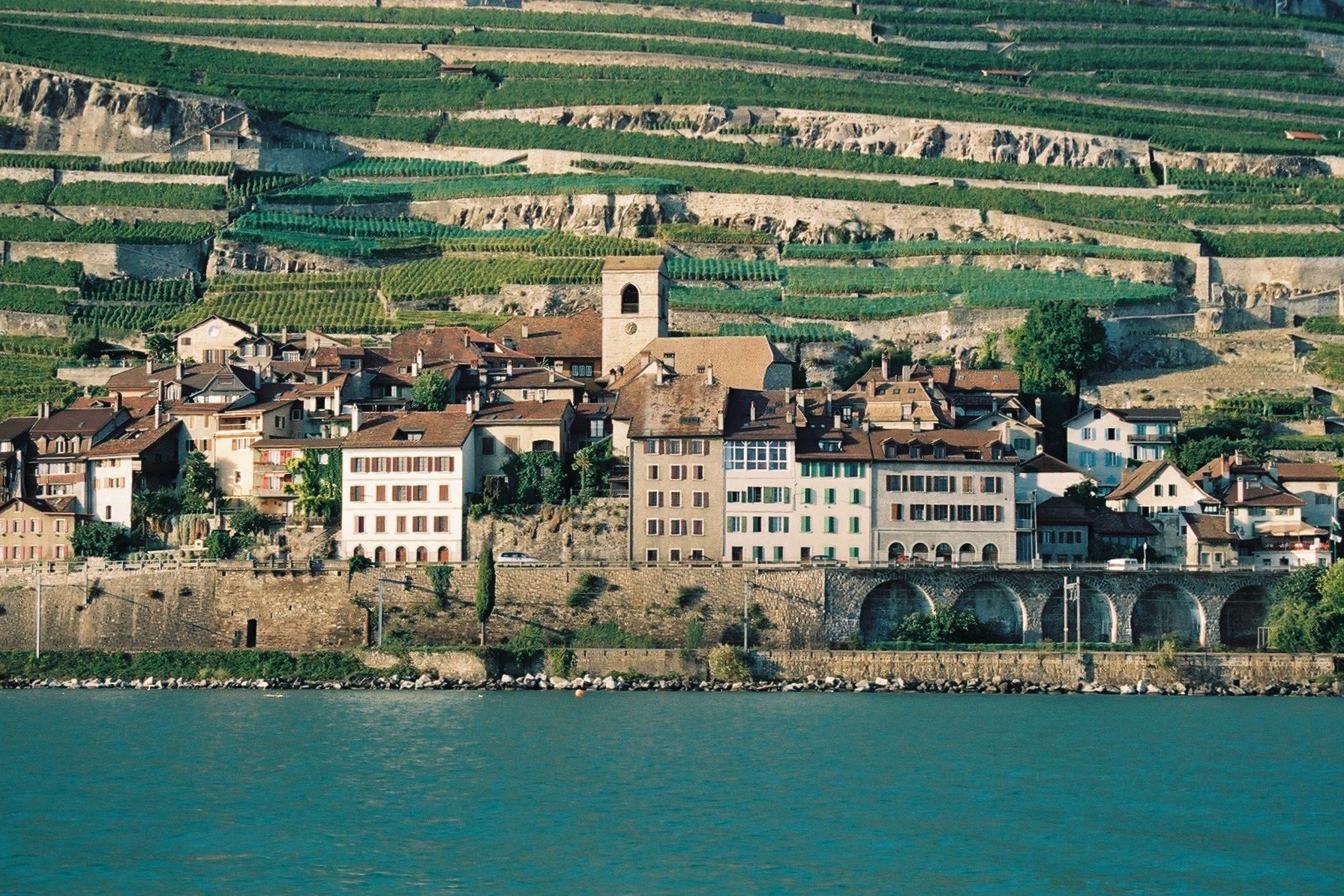
Saint-Saphorin (Lavaux)
The church of Saint-Saphorin stands on a 1st-century Gallo-Roman building that became a Christian mausoleum in the 5th century and a church in the 7th. The wine village grew up around it.
Entry based on 19 sources · Our method · Reusable text (CC BY-SA)
Origin of the name Saint-Saphorin (Lavaux)
The first known mention, in 1138, gives the form « de Sancto Sufforiano ». The name comes from the church dedicated to Saint Symphorian, which gave its name to the village. The ancient settlement is also said to have been called « Glerula » (from the Latin « glarea », gravel), which became « Glérolles » in the Middle Ages.[3][9][11]
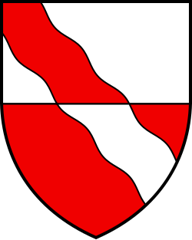
Coat of arms of Saint-Saphorin (Lavaux)
Per fess argent and gules, a bend wavy counterchanged. The shield is divided horizontally, white above and red below. A wavy band crosses it diagonally, from top left to bottom right. It is red on the white part and white on the red part. These are the arms of the former large community, which lasted until the end of the Ancien Régime. They appear on a 17th-century seal and the modern commune has kept them.[15][16]
Founding of Saint-Saphorin (Lavaux)
The site has been occupied since Roman times: a secular Gallo-Roman building of the 1st century AD was converted in the 5th century into a Christian mausoleum, rebuilt after a rockfall, then transformed in the 7th century into a church dedicated to Saint Symphorian, around which the village grew. The place came early under the bishopric of Lausanne. The founding of the church by Bishop Marius is a legend. Saint-Saphorin was long the centre of a large parish and municipality that also included Chexbres, Rivaz and Puidoux, which separated from it at the beginning of the 19th century.[7]
History of Saint-Saphorin (Lavaux)
1st century. Secular Gallo-Roman building on the site of the present church.[7]
47. Milestone of Emperor Claudius, evidence of the Roman road.[7][11]
5th century. The Roman building is converted into a Christian mausoleum, then rebuilt after a rockfall.[7]
563. The original village is said to have been destroyed by the Tauredunum rockfall.
7th century. Transformation into a church dedicated to Saint Symphorian (Carolingian capitals).[7]
8th century. The church is a parish church.
1138. First known mention (« de Sancto Sufforiano »). The same year, Les Faverges are given to the Cistercian abbey of Hauterive.[2]
around 1150. The Bishop of Lausanne has a keep built at Glérolles to guard a narrow stretch of the Lausanne-Vevey road. The keep is sometimes dated to the mid-13th century instead.[9][10]
14th century. The Bishop of Lausanne acquires Glérolles castle.
1424. Plaid général of Saint-Saphorin of 4 May 1424.
1455. Founding of a hospital.
1491. Communal tile works at Puidoux, in operation until the early 19th century.
around 1517-1521. Construction of the present church (also dated to 1520), at the initiative of Bishop Sébastien de Montfalcon, completed by 1530 at the latest. It is adorned with a stained-glass window bearing the bishop's portrait.[7]
1536-1798. Saint-Saphorin belongs to the Bernese bailiwick of Lausanne. The municipality is run by two councils of 18 and 36 members.
1734. Chexbres becomes a separate parish.
1798. Assigned to the district of Lavaux, until 31 December 2007.[13]
1808. Chexbres becomes a municipality; Puidoux and Rivaz follow in 1810.
1840-1845. Construction of the cantonal road.
1860-1861. Construction of the railway line. Road and railway destroy the medieval character of the lower village.
1869. The estates of Les Faverges (Hauterive abbey) and Ogoz (Humilimont) pass to the Collège Saint-Michel, then to the State of Fribourg in 1963.
2000. The parish of Saint-Saphorin once again covers the four municipalities of Saint-Saphorin, Chexbres, Rivaz and Puidoux.
2007. « Lavaux, vignoble en terrasses » is inscribed on the UNESCO World Heritage List.[4]
2008. The new territorial division comes into force: Saint-Saphorin is part of the district of Lavaux-Oron.[13]
2016. In September the village joins the association « Les plus beaux villages de Suisse ».[12]
Population of Saint-Saphorin (Lavaux)
Sources and references: [5]
| 1764 | 211 |
| 1850 | 357 |
| 1880 | 404 |
| 1900 | 410 |
| 1950 | 315 |
| 1970 | 245 |
| 2000 | 348 |
| 2025 | 393 |
Families of Saint-Saphorin (Lavaux)
Citizen families before 1800. Twenty-one families appear with no precise date: Bron, Chappuis, Chevalley, Corboz, Cossy, Degruffy, Desgraz, Forney, Genton, Gerbex (of Epesses VD), Goumoëns, Joseph, Magnin, Maulaz, Morel, Morel Fatio, Palley, Rogivue, Ruchonnet, Samson and Vullyamoz-Dupont. Two entries are dated: the Philippon in 1469 and the Leyvraz in 1558.[17]
In the 19th century. A single entry: the Le Comte, from Italy, in 1819.[17]
From 1901 to 1962. Twelve entries. The Rosay, from France, opened the list in 1915. Then came the Papa from Italy (1924), the Rosenzweig from the Soviet Union (1929), the Lamunière of Geneva (1932), the Del Boca from Italy (1943) and the Zipper from Austria (1949). The 1950s brought the Revel (1954) and the Pirro (1957), both from Italy, as well as the Savioz (1955). Next were the Bernet of Grindelwald BE (1958) and the Pachoud of Granges (Veveyse) FR (1960). The last entered, in 1962, were the Hügli of Gampelen BE.[17]
Notable people of Saint-Saphorin (Lavaux)
Jean Villard-Gilles (Montreux 1895 - Saint-Saphorin 1982). Until his death he lived in a small house in Saint-Saphorin, where he entertained his friends. With one of them, Jacques Brel, he sometimes shared a "partie de cave", a session in the wine cellar.[18][16]
Economy of Saint-Saphorin (Lavaux), past and present
Vines. According to the FAO, winegrowing remains the main activity in Saint-Saphorin. Since 1961 the commune has owned its own vineyard, the Domaine de la St-Germandaz, of about 12'000 m². The same source mentions contract vineyard workers (vignerons-tâcherons), a craft workshop, a tasting room and two restaurants.[16]
Disasters and major events in Saint-Saphorin (Lavaux)
The tsunami of 563. A tradition reported by the commune holds that the settlement of Glérolles was devastated and wholly destroyed by the waters of the Tauredunum rockfall. Glérolles castle dates this Lake Geneva tsunami to 563: in its account, the old village of Glérolles was then reborn under the name of Saint-Saphorin.[11][9]
Historic sites in Saint-Saphorin (Lavaux)
Saint-Symphorien church. Present church built around 1517-1521 (another dating gives 1520) on the remains of older churches and of a Gallo-Roman building, adorned with a stained-glass window bearing the portrait of Bishop Sébastien de Montfalcon, the last Bishop of Lausanne before the Reformation. Rebuilt in Flamboyant Gothic style in the early 16th century, it is, together with the parsonage, a cultural property of national importance.[2][3][7][8]
Glérolles castle. Castle on the lakeshore, within the municipality. The Bishop of Lausanne is said to have built a keep here around 1150 (or in the mid-13th century), a date that is not confirmed. The bishop acquired the castle in the 14th century. Nicknamed the « Chillon de Lavaux », it was reportedly converted into a residence in the 19th and 20th centuries.[2][9][10]
Les Faverges and Ogoz. Wine estates overlooking the village: Les Faverges, given in 1138 to the Cistercian abbey of Hauterive, and Ogoz, owned by Humilimont, passed to the Collège Saint-Michel in 1869, then to the State of Fribourg in 1963.[2]
Wine-growing village. Wine-growing remains the main activity of Saint-Saphorin, in the heart of the Lavaux vineyards inscribed on the UNESCO World Heritage List in 2007. The lower village lost its medieval character with the cantonal road (1840-1845) and the railway (1860-1861).[4]
Remains in Saint-Saphorin (Lavaux)
Gallo-Roman remains under the church. Beneath the church lie the remains of a Gallo-Roman building of the 1st century AD, which became a Christian mausoleum in the 5th century and then a church in the 7th century, with Carolingian capitals.[7]
Gallo-Roman temple, altar and milestone. The ancient heritage includes a Gallo-Roman temple (fanum), an altar to Fortuna and a milestone of Emperor Claudius dated AD 47.[7]
Protected heritage in Saint-Saphorin (Lavaux)
Cultural property of national significance (A objects in the PCP inventory)[14]
- Église réformée Saint-Symphorien et cure
Cultural property of regional significance (B objects)[14]
- Château de Glérolles avec partie habitation, partie rurale, tour ouest, remise, bûcher et fontaine
- Église réformée Saint-Symphorien, villa gallo-romaine
Legends of Saint-Saphorin (Lavaux)
Bishop Marius, founder of the church. A tradition attributes the founding of the church of Saint-Saphorin to Bishop Marius; it is a legend.
Traditions and festivals in Saint-Saphorin (Lavaux)
The Offenbach festival. Founded in 2004, the festival takes place every three years in the village and combines opera with wine. After the 2016 edition, the sixth was postponed three times, because of the Fête des Vignerons and then Covid, and was announced in August 2022.[19]
Sources
- Dictionnaire historique de la Suisse, « Saint-Saphorin (Lavaux) »
- Lavaux Patrimoine mondial, « Les principaux monuments »
- Montreux Riviera, « St-Saphorin Church »
- UNESCO, Centre du patrimoine mondial, « Lavaux, vignoble en terrasses »
- Statistique Vaud, « Population résidante permanente au 31 décembre 2025 »
- geo.admin.ch, Répertoire des localités (swisstopo)
- Inventaire fédéral des biens culturels (PBC), fiche 6489 « Église réformée Saint-Symphorien et cure », texte de la Société d'histoire de l'art en Suisse
- Office fédéral de la protection de la population, géodonnées de l'inventaire PBC, objet 6489 (catégorie A)
- Château de Glérolles, « Notre histoire »
- Swisscastles, « Le château de Glérolles »
- Commune de Saint-Saphorin (Lavaux), « Origines »
- Office du tourisme du canton de Vaud, « St-Saphorin, membre des Plus beaux villages de Suisse »
- État de Vaud, communiqué du 12.07.2007, « Organisation des préfectures et adaptation au nouveau découpage territorial »
- Federal Office for Civil Protection (FOCP), Swiss Inventory of Cultural Property (PCP), list for the canton of Vaud (as of 1.1.2026)
- IPI, Swissreg, emblems database: coat of arms of Saint-Saphorin (Lavaux) (no. 101994)
- Official Gazette of the Canton of Vaud (FAO), "Alphabet des communes vaudoises: Saint-Saphorin (Lavaux)"
- Register of Swiss Surnames, 3rd edition (1989), search Commune "Saint-Saphorin (Lavaux)", Canton VD
- Le Courrier (Lavaux-Oron), "Jean Villard Gilles – Une biographie artistique", 20 May 2020
- Le Courrier (Lavaux-Oron), "Sixième édition du Festival Offenbach de St-Saphorin", 25 August 2022
Published by Sébastien Jörg ·
Other villages near Saint-Saphorin (Lavaux)
Missing information, or do you have a source? Suggest a correction or addition. Every submission is checked before it's published.
Suggest a change