Corseaux
At En Seyton, graves from 3650-3380 BC held up to seven burials each. On the lakeshore, Le Corbusier built the Villa « Le Lac ».
Entry based on 11 sources · Our method · Reusable text (CC BY-SA)
Origin of the name Corseaux
The village is mentioned in 1179 as « de Corsal ». Other early forms are reportedly attested: « Corsaly » (1100), « Corjal » (1147), « Corsial » (around 1147-1163) and « Corsel » (around 1200). The name is said to come from the Latin « cursus », « elongated piece of land », with the suffix « -ale »: Corseaux would thus mean a place of terraced vineyards.[1]
Coat of arms of Corseaux
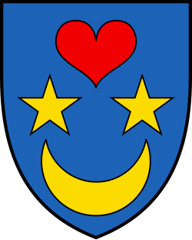
Azure, two mullets Or in fess, in base a crescent of the same and in chief a heart gules. On a blue field, two yellow stars sit side by side across the middle of the shield. A yellow crescent lies below them and a red heart above. The arms were made official in 1930. The heart comes from the old arms of Corsier, the parish to which Corseaux belonged. It already appears on a shield on the 1583 bell of Corsier church.[9][10]
Founding of Corseaux
Who founded Corseaux remains unknown. Yet the site has been inhabited since the Neolithic, as a lakeside settlement at Creux de Plan and a necropolis from the end of the Middle Neolithic at En Seyton show. In the Middle Ages Corseaux was subject to the bishop of Lausanne and belonged to the general commune (parish) of Corsier, together with Chardonne and Jongny.[1]
History of Corseaux
3650-3380 BC. Necropolis of En Seyton: Chamblandes-type stone cist graves, reused for successive burials.[1]
1179. Mention as « de Corsal ».[1]
Middle Ages. Corseaux is subject to the bishop of Lausanne and belongs to the general commune of Corsier.[1]
1453. First mention of the chapel of Saint-André, an annex of Corsier.[1]
1497. Consecration of the chapel of Saint-André.[1]
1536-1798. Under Bernese rule Corseaux belongs to the bailiwick of Lausanne. The village holds two seats on the Council of Twelve and four on the Council of Twenty-Four of the general commune of Corsier.
1608. Village statutes, preserved.[1]
1798. Creation of the political municipality, attached to the district of Vevey.[1]
1816. Division of property upon separation from Corsier.[1]
1841. Construction of a school building. Others follow in 1905, 1960 and 1983.[1]
1898. Concession for the Vevey-Chardonne-Mont-Pèlerin funicular, whose construction is spurred by the growth of regional tourism from 1900. Corseaux becomes a popular resort.[1]
1910. Nearly half the inhabitants work in winegrowing and agriculture (about 5% in 2000).[1]
1921. A prehistoric lakeside settlement is located at Creux de Plan, not excavated.[1]
1923-1924. Construction of the Villa « Le Lac », designed by Le Corbusier.[1][2]
1930. Construction of a lido, bought back by Vevey in 1977.[1]
1939. Atelier De Grandi, built by the architect Alberto Sartoris.[4]
1942. The municipality buys the Dubochet house, former home of the Tavel family.[1]
1963-1975. Excavation of 27 Neolithic graves at En Seyton.[1]
1 January 2008. New district boundaries come into force: Corseaux belongs to the district of Riviera-Pays-d'Enhaut.[3][6]
2016. The Villa « Le Lac » is inscribed on the UNESCO World Heritage List together with 16 other works by Le Corbusier.[2]
Population of Corseaux
Sources and references: [1][6]
| 1764 | 254 |
| 1798 | 420 |
| 1850 | 311 |
| 1900 | 456 |
| 1950 | 1'221 |
| 1990 | 2'146 |
| 2000 | 2'079 |
| 2025 | 2'326 |
Families of Corseaux
Citizen families before 1800. Dubuis, Gaudard, Visinand and Volet, without a precise date.[11]
In the 19th century. The Monnard family, without a precise date. Then the Schneeberger family (from Ursenbach BE) obtains citizenship in 1820. In 1846, 7 families obtain citizenship at the same time: the Boutay, Burnat, Chaudet and Delapraz families, the Hürsch dit Cerf family (from Zofingen AG), the Montet family (from Blonay VD) and the Prenleloup family (from Cossonay VD).[11]
From 1901 to 1962. 23 registrations. Several families come from abroad: from Italy (Albertone in 1930, Bianchi in 1936, Degaudenzi in 1953 and Allegra in 1962), from Germany (Walter in 1912), from Bulgaria (Milde in 1927), from Austria (de Lalancy in 1930), from the Soviet Union (Gortchacow in 1936) and from France (Voisin in 1939). From Switzerland come the Bächtold family from Schleitheim SH, the Pellaton family from Travers NE, the Portmann family from Schüpfheim LU and the Pulver family from Rüeggisberg BE (1956), the Rieben family from Rüschegg BE, the Wyssa family from Galmiz FR and the Zahnd family from Rüschegg BE (1957), the Chautemps family from Vully-le-Bas FR and the Valiton family from Miécourt JU (1958), the Perisset family from Vauderens FR and the Zwahlen family from Saanen BE (1959), the Treuthardt family from Zweisimmen BE (1960), the Fleisch family from Calfreisen GR (1961) and the Gilgen family from Rüeggisberg BE (1962). The last registrations date from 1962 (Allegra and Gilgen).[11]
Notable people of Corseaux
Hugues Cuénod. The tenor was born in Corseaux.[10]
Le Corbusier. The architect built the Villa "Le Lac" on the lakeshore for his parents.[10][2]
Carl Schuricht, Graham Greene, James Hadley Chase, James Mason and Patrick McGoohan. The musician Carl Schuricht, the writers Graham Greene and James Hadley Chase and the British actors James Mason and Patrick McGoohan lived in Corseaux.[10]
Economy of Corseaux, past and present
Wine growing. Vines cover about a fifth of the territory. Corseaux is part of the Lavaux vineyard, listed as a UNESCO World Heritage site in 2007. The municipal council promotes wine tourism and activities around the vines.[10]
Businesses and shops. Corseaux has more than 160 businesses on its register. The number of shops with a street front, on the other hand, has fallen sharply.[10]
Historic sites in Corseaux
Villa « Le Lac » (Petite Maison). Small lakeside house designed by Le Corbusier, built in 1923 or 1924 (date uncertain). It belongs to the Fondation Le Corbusier. Since 1 January 2013 the Association Villa « Le Lac » Le Corbusier has managed its opening to the public. It is one of the 17 works by Le Corbusier inscribed on the UNESCO World Heritage List in 2016. Cultural property of national importance (federal PCP inventory).[1][2][5]
Chapel of Saint-André. Attested from 1453 and consecrated in 1497, it was an annex of the church of Corsier. After the Reformation it was used only occasionally for worship and served as a school and town hall.[1]
Atelier De Grandi. House and studio built in 1939 by the architect Alberto Sartoris for the painter Italo De Grandi (1912-1988), brother of the painter Vincent De Grandi (1916-2010). The building now houses a museum devoted to the two brothers. Cultural property of regional importance (federal PCP inventory).[4][5]
Dubochet house. Former home of the Tavel family, bought by the municipality in 1942.[1]
Remains in Corseaux
Neolithic necropolis of En Seyton. Between 1963 and 1975, 27 graves dated to 3650-3380 BC were examined. The dead lay in a crouched position on their left side, in stone cists of the Chamblandes type whose lids almost reached the surface. Some graves, reopened several times, successively received three to seven individuals. Ornaments of stone or bone buttons, lignite beads, pendants of Mediterranean shells. A breastplate of about thirty boar tusk plates sewn onto a garment. Two small petrified bags containing red ochre and white lead. These finds shed light on the transition from individual to multiple burial.[1]
Lakeside settlement of Creux de Plan. A prehistoric lakeside settlement was located in 1921 at Creux de Plan, but has not been excavated.[1]
Protected heritage in Corseaux
Cultural property of national significance (A objects in the PCP inventory)[8]
- Villa Le Lac
Cultural property of regional significance (B objects)[8]
- Villa De Grandi, construite par Alberto Sartoris
Traditions and festivals in Corseaux
The Revue de Corseaux. Every two years the Revue de Corseaux stages a show.[10]
Lè Corsacu. The Corsalins and Corsalines are also called "Lè Corsacu", the bum-scrapers (écorche-culs).[10]
Village festivities. The calendar includes a village festival in June, a 1 August brunch, a pumpkin festival and Advent windows. From Easter to October the Chalet de Mivy hosts families and associations for country parties.[10]
Sources
- Patrick Moinat, Elisabeth Salvi, « Corseaux », Dictionnaire historique de la Suisse (DHS), version allemande du 11.08.2005
- Villa « Le Lac » Le Corbusier, « Information »
- État de Vaud, communiqué du 12.07.2007, « Organisation des préfectures et adaptation au nouveau découpage territorial »
- « Corseau, un atelier, quatre créateurs », Le Courrier, 21.06.2018
- Office fédéral de la protection de la population, Inventaire suisse des biens culturels d'importance nationale et régionale, liste du canton de Vaud (état au 1.1.2026)
- Statistique Vaud, « Population résidante permanente au 31 décembre 2025 »
- geo.admin.ch, Répertoire des localités (swisstopo)
- Federal Office for Civil Protection (FOCP), Swiss Inventory of Cultural Property (PCP), list for the canton of Vaud (as of 1.1.2026)
- IPI, Swissreg, emblems database: coat of arms of Corseaux (no. 101636)
- Official Gazette of the Canton of Vaud (FAO), "Alphabet des communes vaudoises: Corseaux"
- Register of Swiss Surnames, 3rd edition (1989), search Commune "Corseaux", Canton VD
Published by Sébastien Jörg ·
Other villages near Corseaux
Missing information, or do you have a source? Suggest a correction or addition. Every submission is checked before it's published.
Suggest a change