Vevey
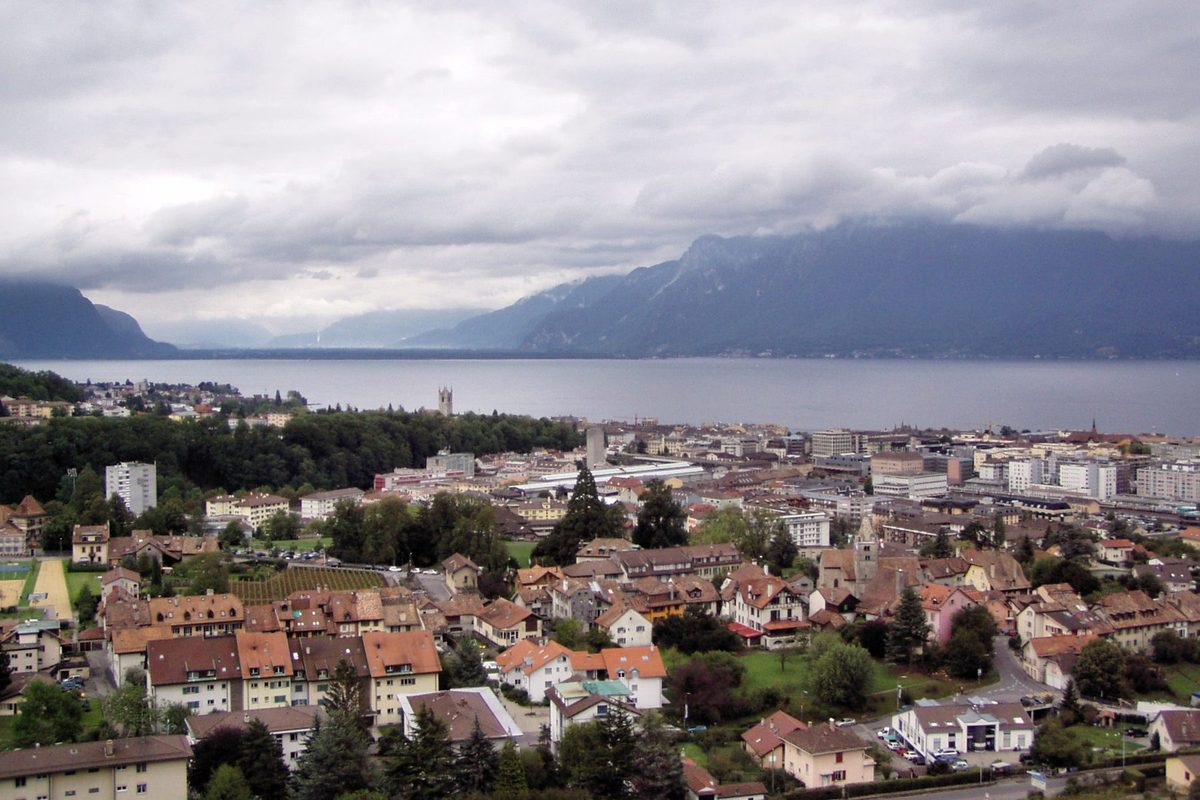
Daniel Peter developed milk chocolate here in 1875: once a Roman vicus on the Great St Bernard road, Vevey is also home to the Fête des Vignerons since 1797 and to Nestlé's headquarters.
Entry based on 18 sources · Our method · Reusable text (CC BY-SA)
Origin of the name Vevey
The name appears around 280 as "Vibisco", then as "Uiueisi" in 998 and "Viveys" in 1220. The old German name is "Vivis". The name « Vevey » has no secure explanation. A Latin "Bivis vicus", the village where two roads meet, has been suggested, as has a river name "uiuis", but neither hypothesis is established.[1]
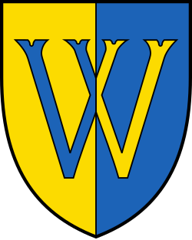
Coat of arms of Vevey
Per pale Or and azure, two letters V interlaced counterchanged. The shield is divided vertically, yellow on the left and blue on the right. Two interlaced Vs cross it, blue on the yellow half and yellow on the blue half. Vevey had its own banner, mentioned in 1395, whose colours gave the town its arms. In the 16th century these were a plain per pale Or and azure. The two Vs only appear in 1603, on a bell of the church of Saint-Martin. Both versions coexisted until the end of the Ancien Régime, after which the newer one prevailed.[13][12]
Founding of Vevey
Vevey has no known founder. People lived on the site from the Neolithic, and a Celtic cemetery has been uncovered there. In Roman times a settlement interpreted as a vicus grew up thanks to its position on the Great St Bernard road, on the shore of Lake Geneva. In the Middle Ages several lords shared the place, notably the Blonay and Oron families. It then came under Savoy, and Count Amadeus VI granted it a charter of liberties.[1]
History of Vevey
Neolithic. Neolithic occupation at the site of Creux de Plan.[1]
450-200 BC. Celtic cemetery, discovered in 1901.[1]
Roman period. Growth of a settlement (vicus) on the Great St Bernard road, on the lakeshore.[1]
around 280. First mention of the place, in the form "Vibisco".[1]
998. The name appears in the form "Uiueisi".[1]
12th century. First mention of the church of Saint-Martin.[1]
Middle Ages. The place develops under the authority of several lords, including the Blonay and Oron families.[1]
1370. Count Amadeus VI of Savoy grants the town a charter of liberties.[1]
from 1496. Rebuilding of the church of Saint-Martin.[1]
1536. During the conquest of Vaud, possession of Vevey is disputed between Bern and Fribourg. The town comes under Bernese rule and the church of Saint-Martin is given over to Reformed worship.[1]
1764. The town has 3'350 inhabitants.[1]
1797. First Fête des Vignerons, organised by the Confrérie des vignerons (winegrowers' brotherhood).[1]
1808. Construction of the Grenette, the grain hall on the Place du Marché.[1]
1819. Founding of the Cailler chocolate factory in the neighbouring commune of Corsier-sur-Vevey.[1]
1843. Henri Nestlé, an assistant pharmacist in Vevey since 1839, sets up his own business there. He is the future founder of the company that bears his name.[4]
1848-2004. Operation of a tobacco factory.[1]
1850. The town has 5'201 inhabitants.[1]
1861-1862. Arrival of the railway.
1875. Daniel Peter develops milk chocolate in Vevey.[3]
1888. An electric tramway goes into service.[1]
1897. Founding of the Musée Jenisch.[1]
1900. Opening of the Vevey-Chardonne-Mont-Pèlerin funicular. The town has 13'664 inhabitants.[1]
1937. Launch of Nescafé, developed by the chemist Max Morgenthaler.[5]
1985. Opening of the Alimentarium, a food museum founded by Nestlé.[1]
1995. The giant fork is installed in the lake in front of the Alimentarium.[6]
2016. The Fête des Vignerons is inscribed by UNESCO on the list of the Intangible Cultural Heritage of Humanity.[7]
2019. Most recent edition of the Fête des Vignerons (18 July-11 August).[8]
Population of Vevey
Sources and references: [1][2]
| 1764 | 3'350 |
| 1798 | 3'300 |
| 1850 | 5'201 |
| 1900 | 13'664 |
| 1950 | 14'264 |
| 2000 | 16'202 |
| 2025 | 20'179 |
Families of Vevey
Citizen families before 1800. Vevey has 574 citizen families, including 85 entries from before 1800. Fifteen families appear with no precise date, among them the de Blonay and the Peter. The others were admitted between 1596 and 1794: 33 came from other Vaud communes, 17 from France and 2 from Savoy. The Cailler, from Daillens VD, became citizens in 1683.[14]
Notable people of Vevey
Françoise-Louise de Warens (Vevey 1699 - Chambéry 1762). In 1713 she married Sébastien-Isaac de Loys, a member of the Council of Vevey, whom she divorced in 1727. In 1725 she took over the management of a silk stocking factory. Having fled to Savoy, she renounced Protestantism in 1726 and became the protector of Jean-Jacques Rousseau.[15]
Vincent Perdonnet. It was at his initiative that the streets of Vevey were renamed in 1839.[1]
Jacques Edouard Couvreu. In 1840 he built the Château de l'Aile, in the Gothic Revival style, on the site of an old building.[1]
Henri Nestlé (Frankfurt am Main 1814 - Glion 1890). An assistant to a Vevey pharmacist, he set up on his own there in 1843. In 1867 he developed his infant cereal and within a few months set up a factory to mass-produce it. Having become a citizen of Vevey the year before, he handed his firm over to three local businessmen in 1875.[4]
Fanny Jenisch. The widow of a Hamburg senator. The museum that bears her name was founded in 1897 thanks to her bequest.[1]
Ernest Ansermet (Vevey 1883 - Geneva 1969). Conductor. From 1915 he led the subscription concerts in Geneva, then toured with the Ballets Russes until 1923. In 1918 he gave the premiere of Ramuz and Stravinsky's L'Histoire du soldat in Lausanne and founded the Orchestre de la Suisse romande in Geneva, which he led until 1967. Vevey, Geneva and Lausanne made him an honorary citizen.[16]
Economy of Vevey, past and present
Market and transit. By the 15th century Vevey was already an important market town. Under the Ancien Régime the town lived from transit, held four fairs a year and was a market for hides and leather from Valais and Fribourg. The Veveyse carried timber and drove mills along a diversion canal. The landing stages were built between 1853 and 1873.[1][12]
The refugees' trades. From 1685 nearly 700 French refugees arrived after the revocation of the Edict of Nantes. They introduced hat making, tanning, watchmaking and tobacco. Isaac Chenebié printed the Messager boiteux almanac from 1707, and David Doret opened a marble workshop with his father in 1733. Watchmaking did not survive the end of the Ancien Régime.[1][12]
Tobacco, engineering and chocolate. In 1890 tobacco employed 800 people. The Rinsoz & Ormond factory, active from 1930 to 2004, goes back to the business founded by Bernard Lacaze in 1848. In 1842 Benjamin Roy set up the Ateliers de constructions mécaniques de Vevey, known in particular for their turbines. The Cailler chocolate factory, founded in 1819 in Corsier-sur-Vevey, became Peter-Cailler-Kohler in 1911 and merged with Nestlé in 1929. Nestlé has its world headquarters in Vevey, with 1'600 employees in 2010. The crisis of the 1990s hit the town hard. In 1999 it launched the label "Vevey Ville d'Images", devoted to graphic arts and communication.[1][12]
Rail and hotels. The station on the Simplon line was completed in 1862. From 1888 an electric tram linked Vevey, Montreux and Chillon, replaced by a trolleybus in 1958. The lines to Chamby and to Châtel-Saint-Denis followed in 1902 and 1904. The hotels included the Trois-Couronnes (1842), the Grand-Hôtel (1867) and the Hôtel du Lac (1868), alongside many guesthouses. The town recorded 136'200 overnight stays in 1936, 232'000 in 1960 and 113'600 in 2010.[1]
Disasters and major events in Vevey
The looting of 1475 and the fire of 1476. During the Burgundian Wars the town was looted several times in 1475, then set on fire the following year.[1]
The fires and floods of 1676 to 1732. Fire struck Vevey in 1676, 1688 and 1732, and floods in 1701 and 1726. Following these disasters, the nine gates of the town wall partly disappeared.[1]
Historic sites in Vevey
Church of Saint-Martin. Mentioned from the 12th century and rebuilt from 1496, it overlooks the town and has been used for Reformed worship since the Reformation.[1]
Place du Marché and Grenette. A vast square on the lakeshore that hosts the major editions of the Fête des Vignerons. The Grenette, the former grain hall, dates from 1808.[1]
Fête des Vignerons. Organised by the Confrérie des vignerons since 1797, four to five times a century, it celebrates the work of the vineyards. It has been on UNESCO's Intangible Cultural Heritage list since 2016.[1][7]
Musée Jenisch. Fine arts museum founded in 1897.[1]
Alimentarium and the fork in the lake. Food museum opened in 1985 by Nestlé, which has its headquarters in Vevey. The giant fork planted in the lake in 1995 has become an emblem of the town.[1][6][9]
Château de l'Aile. Historic mansion on the lakeshore, a landmark of the town's waterfront.[1]
Remains in Vevey
Celtic cemetery. Discovered in 1901, this cemetery dated to 450-200 BC shows a Celtic presence long before the Roman settlement.[1]
Protected heritage in Vevey
Cultural property of national significance (A objects in the PCP inventory)[11]
- Alimentarium, Musée de l'alimentation
- Archives historiques de Nestlé
- Bâtiment administratif Nestlé SA
- Château de l'Aile
- Cour au Chantre
- Eglise catholique Notre-Dame
- Eglise orthodoxe
- Eglise réformée Saint-Martin
- Hôtel de Ville, ancien hôpital, tour Saint-Jean et fontaine
- Hôtel des Trois-Couronnes
Show the other 4
- La Grenette et Place du Marché
- Musée de la Confrérie des Vignerons
- Musée Jenisch (Musée des Beaux-Arts, Cabinet cantonal des estampes)
- Musée suisse de l'appareil photographique
Cultural property of regional significance (B objects)[11]
- Ancien bâtiment administratif Nestlé (Musée de l'alimentation)
- Ancien Hôtel Moser et parc
- Archives communales
- Bibliothèque municipale
- Château bernois
- Collège
- Collège de la Veveyse
- Ecole du Clos
- Eglise anglaise
- Eglise Sainte-Claire
Show the other 12
- Fontaine du Guerrier (Martin)
- Galerie du Rivage (ancien marché couvert)
- Gare
- Hôtel du Lac
- Immeuble locatif (à l'emplacement de l'ancien bâtiment du pressoir de la Part-Dieu)
- Maison de la Part-Dieu
- Maison Le Castel (Mme de Warens)
- Musée historique de Vevey
- Salle del Castillo (ancien nom: Casino du Rivage)
- Temple de Gilamont
- Théâtre municipal
- Tour et fontaine de l'Horloge
Legends of Vevey
The sprite of the Boillet tower. According to the town archives quoted by Cérésole, a «mischievous spirit» was the talk of Vevey around 1551. It haunted the Boillet tower, behind today's rue du Simplon, playing all kinds of pranks and making a racket. The council decided to have every opening of the tower walled up, so that it could not get back in if it was outside, nor get out if it was inside.[10]
Traditions and festivals in Vevey
The Fête des Vignerons. The Confrérie des vignerons, first mentioned in 1647, brings together vineyard owners who have the work in their vines inspected. From 1772 it rewarded the best winegrowers. Its festival, recorded from 1648 and then called the "pourmenade" or "Bravade", needed the bailiff's permission in the 18th century. After the first public crowning in 1797, it returned in 1819, 1833, 1851, 1865, 1889, 1905, 1927, 1955, 1977 and 1999, the last of these with nearly 5'000 performers.[17]
The Saint Martin's fair. Every year, on the second Tuesday of November, the Saint Martin's fair fills the town centre. Its 550th edition was celebrated in 2019.[12]
The Clara Haskil Competition. Since 1963 the Clara Haskil International Piano Competition has been held every two years in Vevey. It is named after the pianist Clara Haskil (Bucharest 1895 - Brussels 1960), who lived in Switzerland from 1942 until her death.[18]
Sources
- Dictionnaire historique de la Suisse, « Vevey (commune) » (Claude-Alain Paratte et Elisabeth Salvi, version du 03.01.2015)
- Statistique Vaud, « Population résidante permanente au 31 décembre 2025 »
- Dictionnaire historique de la Suisse, « Peter, Daniel » (Gilbert Marion, version du 04.03.2009)
- Neue Deutsche Biographie, « Nestlé, Henri » (Albert Pfiffner, NDB 19, 1999)
- Musée national suisse, blog, Gabriel Heim, « History of coffee: the invention of Nescafé » (2018)
- Alimentarium, « La plus grande fourchette du monde devant l'Alimentarium »
- État de Vaud, communiqué du 01.12.2016, « Le Canton de Vaud salue l'inscription de la Fête des Vignerons au patrimoine culturel immatériel de l'UNESCO »
- État de Vaud, actualité du 11.08.2019, « Une Fête des Vignerons 2019 déjà dans la légende »
- Nestlé Singapour, « Nestlé worldwide »
- Alfred Cérésole, Légendes des Alpes vaudoises, ill. Eugène Burnand, Lausanne, 1885, p. 34-35
- Federal Office for Civil Protection (FOCP), Swiss Inventory of Cultural Property (PCP), list for the canton of Vaud (as of 1.1.2026)
- Official Gazette of the Canton of Vaud (FAO), "Alphabet des communes vaudoises: Vevey"
- IPI, Swissreg, emblems database: coat of arms of Vevey (no. 102014)
- Register of Swiss Surnames, 3rd edition (1989), search Commune "Vevey", Canton VD
- Historical Dictionary of Switzerland (HDS), article "Warens, Françoise-Louise de"
- Historical Dictionary of Switzerland (HDS), article "Ansermet, Ernest"
- UNESCO, intangible cultural heritage, nomination file for the Fête des Vignerons in Vevey (document 30788)
- Cantonal and University Library of Lausanne, Patrinum, record "Haskil, Clara, musicien, 1895-1960"
Published by Sébastien Jörg ·
Other villages near Vevey
Missing information, or do you have a source? Suggest a correction or addition. Every submission is checked before it's published.
Suggest a change