La Tour-de-Peilz
A new town founded in 1282 by Count Philip I of Savoy, La Tour-de-Peilz houses the Swiss Museum of Games in its castle. Gustave Courbet died here in exile in 1877.
Entry based on 11 sources · Our method · Reusable text (CC BY-SA)
Origin of the name La Tour-de-Peilz
The place appears in 1163 in the form "Turre" (the tower), then in 1229 as "Pel" and in 1294 as "Turrim de Peilt". The name thus combines a tower with a place called "Peilz". The most widespread hypothesis links the latter to a Latin family name, Pellius, based on Roman finds at the locality of En Peilz, but it is not confirmed. The old German name is "Vivis zum Thurn".[1]
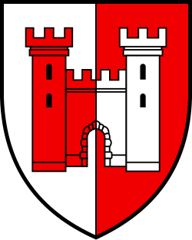
Coat of arms of La Tour-de-Peilz
Per pale argent and gules, a castle counterchanged. The shield is split vertically, white on the left and red on the right. A castle spans it, red on the white half and white on the red half. The oldest known commune seal dates from the 17th century and already shows a very similar shield. The motto "Dieu est ma tour et ma forteresse" is inscribed on the church tower above the clock face.[7][8]
Founding of La Tour-de-Peilz
The territory was acquired by Peter II of Savoy between 1248 and 1255, who had a castle built there. In 1282 Count Philip I of Savoy founded a new town with liberties on this spot, at the eastern edge of the lands of the bishop of Lausanne. The castle was enlarged between 1282 and 1288. The town remained small, squeezed between Vevey and Montreux.[1][3]
History of La Tour-de-Peilz
Roman period. A milestone and traces of Roman settlement show that the site was occupied.[1]
1163. First mention, in the form "Turre".[1]
1248-1255. Peter II of Savoy acquires the territory and has a castle built.[1]
1282. Count Philip I of Savoy founds a new town with liberties.[1]
1282-1288. The castle is enlarged; the town receives a wall, first in wood (1284), then in masonry (1288).[1]
1476. During the Burgundian Wars, the Bernese plunder the town and burn the castle.[1]
1536-1798. The place belongs to Bernese bailiwicks.[1]
1749 (or 1747). Jean Grésier acquires the remains of the castle and partly restores it, or perhaps rebuilds it. Its two round towers are said to date partly from the Savoyard period.[1][3]
1764. The town has 638 inhabitants.[1]
1766-1770. The harbour is remodelled.[1]
1850. The town has 1'035 inhabitants.[1]
31 December 1877. Death in La Tour-de-Peilz of the painter Gustave Courbet, in exile in Switzerland since 1873.[4]
1900. The town has 2'417 inhabitants.[1]
1979. The commune acquires the castle.[1][3]
1987. The Swiss Museum of Games opens in the castle.[1][3]
2000. The town has 10'230 inhabitants.[1]
Population of La Tour-de-Peilz
Sources and references: [1][5]
| 1764 | 638 |
| 1798 | 778 |
| 1850 | 1'035 |
| 1900 | 2'417 |
| 1950 | 5'015 |
| 2000 | 10'230 |
| 2025 | 13'053 |
Families of La Tour-de-Peilz
Citizen families before 1800. Bény, Calame, Courlet, Desclouds, Despland, Doge, Dragaz, Grangier, Michaud, Michel, Ormond and Vodoz, with no precise date, as well as the Chastellain of Vevey VD, the Curchod of Dommartin VD and the Richon of Saint-Légier VD. Four families are admitted in the 18th century: the Rochat of L'Abbaye VD in 1737, the Ansermet, from France, in 1742, the Gétaz of Château-d'Oex VD in 1751 and the Trottet of Ecoteaux VD in 1773.[11]
In the 19th century. Balmat and de Traz soit Détraz, with no precise date, like the Bovet of Neuchâtel NE, the Bovon of Château-d'Oex VD, the Du Fresne and the Mamin of Blonay VD, the Guex of Saint-Légier VD and the Tornier of Vevey VD. Two families from Germany are entered in 1812 (Gross) and 1849 (Sillig). The end of the century brings the Comte (1888) and the Commend (1898) from France, then the Felli (1896) and the Colombo (1899) from Italy.[11]
From 1901 to 1962. 79 entries. The first, in 1905, is that of the Kratzer of Aeschi bei Spiez BE. The year 1956 alone accounts for 29. Thirteen entries concern families from Italy, such as the Pedroli (1914, 1915 and 1916) and the Felli (1916, 1917 and 1919), four concern families from Germany and two families from France. The Costomeno, entered in 1951, come from Greece. The last entries, in 1962, are those of the Ceranini, Giovannoni and Sobrero, from Italy, and of the Haefeli of Schmiedrued AG.[11]
Notable people of La Tour-de-Peilz
Gustave Courbet (died La Tour-de-Peilz 1877). The painter spends his last years at the Villa Bon-Port, where he dies on 31 December 1877. In 1875 he gives the commune a bust.[8]
Jacques Piccard (Brussels 1922 - La Tour-de-Peilz 2008). Son of the physicist Auguste Piccard. In 1960 he descends with Don Walsh to the bottom of the Mariana Trench. He builds the mesoscaph Auguste Piccard, which takes 33'000 passengers beneath Lake Geneva during Expo 64, then studies Swiss lakes. He dies at his home on Lake Geneva, in La Tour-de-Peilz.[9]
Gertrude Montet Girard. Pioneer of women's suffrage, from the late 1950s secretary of the Association vaudoise pour le suffrage féminin. A Radical, she sits in the National Council from 1974 as the first woman from Vaud to do so, and dies in 1989. In 2022 the commune names its busiest pedestrian walkway after her, near the avenue de la gare.[10][8]
Economy of La Tour-de-Peilz, past and present
Vines, fields and lake. In the 19th century the town lived mainly from wine, farming and the lake. A few mills and sawmills stood along the Ognonnaz. In 1644 the burghers received the eastern moat of the harbour.[1][8]
Chocolate and Nestlé. Industrial growth began in 1917 with the arrival of the Peter, Cailler, Kohler chocolate factory. Nestlé Switzerland moved its headquarters to La Tour-de-Peilz in 1978. An extension was to create 700 jobs there by 2014.[1][8]
The station and commuters. Opened in 1861 on the Simplon line, the station shaped the town's growth. In 2000 more than three quarters of working residents worked outside the commune.[1]
Visitors and museum. The Le Rivage guesthouse was built in 1864. In 2024 the Swiss Museum of Games welcomed nearly 30'000 visitors, a record.[8]
Disasters and major events in La Tour-de-Peilz
The sack of 1476. During the Burgundian Wars, mountain men from the upper Simmental, led by a Bernese aristocrat, massacred the population and burned the town. The chapel of Saint-Théodule was partly destroyed. It was probably the most painful episode in the commune's history.[1][8]
Historic sites in La Tour-de-Peilz
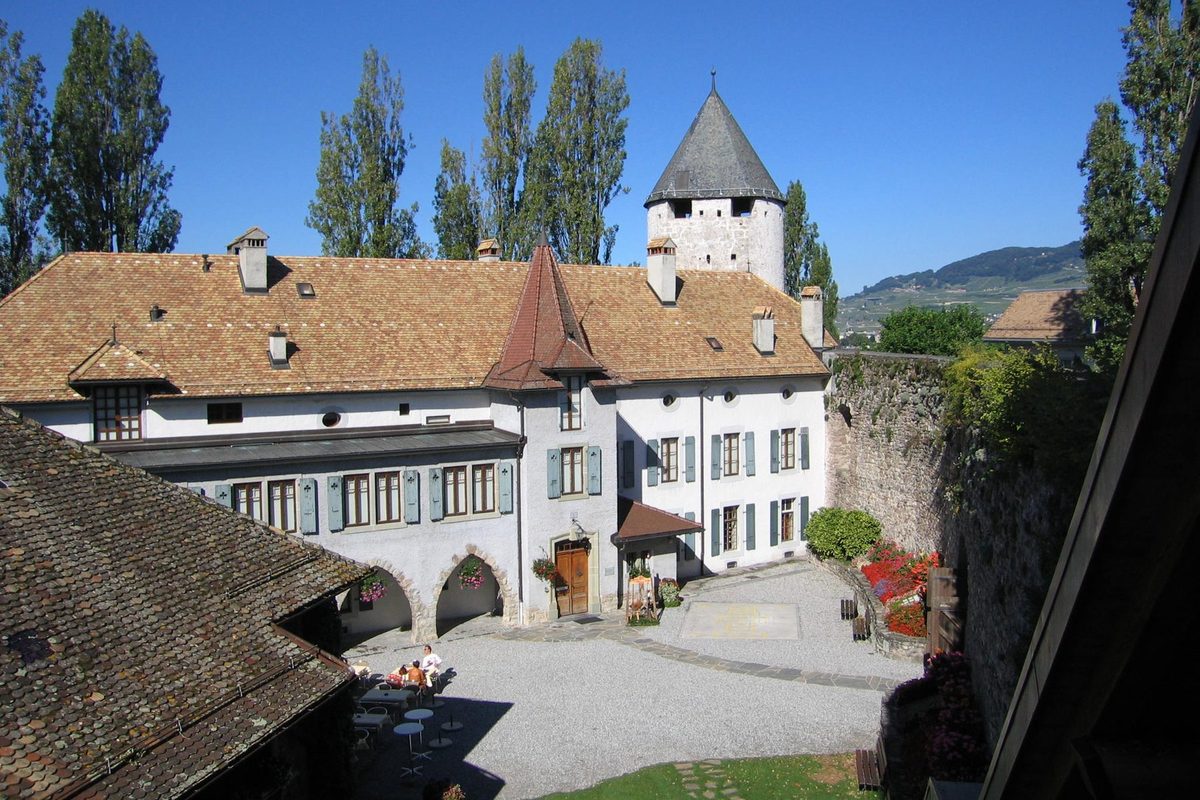
Castle and Swiss Museum of Games. Built by Savoy in the 13th century, it was partly restored from 1749, or rebuilt from 1747 (the dates vary). It has belonged to the commune since 1979 and has housed the Swiss Museum of Games since 1987. Castle and museum are cultural properties of national importance.[1][2][3]
Church of Saint-Théodule. Former chapel built in 1307, enlarged and turned into a Reformed church in 1792-1796. Its north wall is said to incorporate the former town rampart. Cultural property of regional importance.[1][2]
Helvetia Fountain. Fountain decorated with the «Helvetia» (1875), an allegorical sculpture by Gustave Courbet, who spent his last years in the town.[4]
Villa Kenwin. Villa listed as a cultural property of national importance.[2]
Harbour. Harbour on Lake Geneva, remodelled between 1766 and 1770.[1]
Remains in La Tour-de-Peilz
Savoyard towers of the castle. The castle's two round towers are said to date partly from the Savoyard period (13th century). They reportedly survived the destruction and the 18th-century rebuilding, though this is not certain.
Protected heritage in La Tour-de-Peilz
Cultural property of national significance (A objects in the PCP inventory)[6]
- Château, habitation et dépendance, pavillon, tours, remparts et fossés
- Le Musée Suisse du Jeu
- Villa Kenwin
Cultural property of regional significance (B objects)[6]
- Château de la Becque avec communs, écurie, poulailler et fontaine
- Château de Sully
- Eglise réformée Saint-Théodule
- Ensemble résidentiel de Bellaria: quatre villas
- La Doges (Maison de maître avec son rural, sa tour, ses pavillons d'entrée, son orangerie et son logement du jardinier, sa fontaine, son portail et son parc)
- La Faraz, maison de maître, parc avec bassin et grotte
- Résidence Rive-Reine avec annexe
Traditions and festivals in La Tour-de-Peilz
The Société des Mousquetaires. The town has more than 80 local societies. The Société des Mousquetaires celebrates its 450th anniversary in 2024.[8]
The Boéland festivities. The inhabitants bear the official nickname Boélands. The commune's events include the Pain des veuves, the Youth Festival and, every two years, the Mérites boélands.[8]
Sources
- Elisabeth Salvi, « Tour-de-Peilz, La », Dictionnaire historique de la Suisse (DHS), version du 25.02.2014
- Office fédéral de la protection de la population, Inventaire suisse des biens culturels d'importance nationale et régionale, liste du canton de Vaud (état au 1.1.2026), La Tour-de-Peilz : château (A, n° 06499), Musée suisse du jeu (A, n° 10680), villa Kenwin (A, n° 06502), église Saint-Théodule (B, n° 14619)
- Lausanne Tourisme, « Le Château de La Tour-de-Peilz »
- Musée Jenisch Vevey, dossier de presse de l'exposition « Courbet dessinateur », 8 octobre 2019
- Statistique Vaud, « Population résidante permanente au 31 décembre 2025 »
- Federal Office for Civil Protection (FOCP), Swiss Inventory of Cultural Property (PCP), list for the canton of Vaud (as of 1.1.2026)
- IPI, Swissreg, emblems database: coat of arms of La Tour-de-Peilz (no. 101911)
- Official Gazette of the Canton of Vaud (FAO), "Alphabet des communes vaudoises: La Tour-de-Peilz"
- swissinfo.ch, "Deep sea adventurer Jacques Piccard is dead", 1 November 2008
- Radio Lac, "La Tour-de-Peilz rend hommage à Gertrude Montet Girard", 27 June 2022
- Register of Swiss Surnames, 3rd edition (1989), search Commune "La Tour-de-Peilz", Canton VD
Published by Sébastien Jörg ·
Other villages near La Tour-de-Peilz
Missing information, or do you have a source? Suggest a correction or addition. Every submission is checked before it's published.
Suggest a change