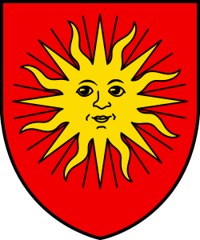
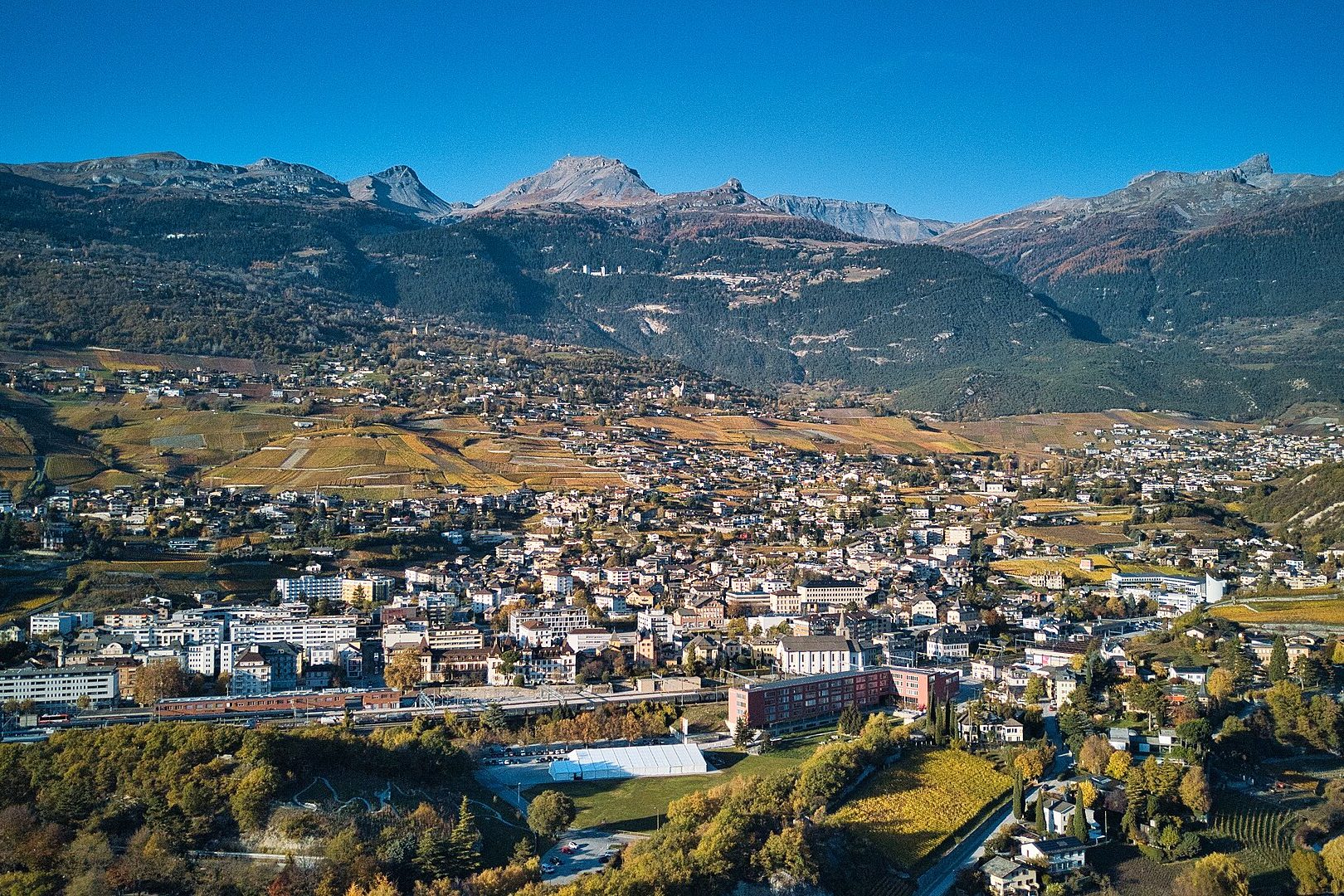
Sierre
Origin of the name Sierre
The form « Sidrium » appears around 800, in a 12th-century copy referring to the year 515. « Sirro » follows in 1179 and « Syder » in 1393. In German the town is called « Siders ». The name may come from the Latin « scirpus » or « sirus », the rushes that grew between the arms of the Rhône, but this is only a hypothesis.[1][3]
Founding of Sierre
The hill of Géronde was frequented from the Neolithic to the Early Middle Ages, and the first attested settlement, at Grands-Prés, dates from the 5th-4th centuries BC. The Romans built no real town. Instead there were independent estates of notables, such as that of the duumvir Caius Cominus Chius, chief magistrate of the civitas Vallensium. Sierre enters history as a « curtis », an estate that the Burgundian king Sigismund bequeathed to the abbey of Saint-Maurice. A lordship of the bishopric of Sion from the 11th century, it was then spread over three fortified sites, Géronde, the Vieux-Sierre and Plantzette. Once they were destroyed, the inhabitants moved to Plan-Sierre. Today the municipality brings together the town, Noës, Muraz and Granges.[1]
History of Sierre
5th-4th centuries BC. First attested settlement at Grands-Prés (a hearth structure).[1]
5th century. Building of the church of Saint-Martin on Géronde, whose remains date from this period. The chapel of Saint-Félix was built there in the 5th or early 6th century.[1]
515. Sigismund, King of the Burgundians, bequeaths the « curtis » to the abbey of Saint-Maurice.[1]
11th century. Sierre becomes a lordship of the bishopric of Sion, administered by vidames and mayors.[1]
1179. Mentioned as « Sirro ».[1]
1293. First castellans at the head of the episcopal lordship.[1]
1331. The parish centre moves to the chapel of Notre-Dame du Marais, in Plan-Sierre.[1]
mid-14th century. Destruction of the castles of Géronde, Vieux-Sierre and Plantzette. The inhabitants settle at Plan-Sierre. Only the castle of Goubing, owned by the lords of Granges, survives.[1]
1559. Plan-Sierre is divided into four quarters: Villa, Monderèche, la Salla and Glarey.[1]
1620. A town hall is built.[1]
1687. Consecration of the church of Sainte-Catherine.[1]
1799. Occupation by French and Vaud troops, who set up their headquarters in Sierre.[1]
1839-1840. Sierre hosts the Upper Valais government during the conflicts between conservatives and liberals.[1]
1868. Arrival of the railway.[1]
1908. Opening of the Sierre-Montana-Vermala funicular. Building of the Château Mercier.[1]
1914. Sierre separates from the large burgher community of the Contrée de Sierre.[1]
1929. Opening of the rolling mills on the municipality's territory.[1]
1972. Merger with Granges, approved by the Grand Council on 22 June and in force on 1 October.[1][2]
1996. Arrival of the A9 motorway.[1]
2007. Creation of the Sierre/Crans-Montana agglomeration to manage tourism and mobility.[1]
Population of Sierre
Sources and references: [1][8]
| 1802 | 724 inhabitants |
| 1850 | 875 inhabitants |
| 1900 | 1'833 inhabitants |
| 1950 | 7'161 inhabitants (excluding Granges) |
| 2000 | 14'317 inhabitants (including Granges) |
| 2025 | 18'060 |
Historic sites in Sierre
Hill and lake of Géronde. The hill of Géronde has yielded finds from the Neolithic to the Early Middle Ages, including a gold signet ring of Graifarius. The remains of the church of Saint-Martin there date back to the 5th century. The lake of Géronde is a former arm of the Rhône. The convent has been occupied since 1935 by Bernardine sisters from Collombey. Its Gothic choir is said to have been consecrated in 1500.[1][4]
Notre-Dame du Marais. Chapel in Plan-Sierre built in 1310, which became the parish centre in 1331, was remodelled in 1422 and enlarged in 1524 by Ulrich Ruffiner. The nave was rebuilt in 1721.[1][3][5]
Church of Sainte-Catherine. Parish church consecrated in 1687, shortly after the old parish of Villa was abolished.[1]
Château des Vidomnes. Castle built around 1490 by the de Chevron family, on Rue du Bourg in the heart of the historic centre. It was later lived in by the de Montheys and de Courten families, among others.[3][6]
Château de Villa. Residence built in the 16th century by the de Platea family and enlarged in the 17th century by the de Preux. Roman remains were found nearby. It houses one of the two sites of the Valais Museum of Vine and Wine (opened in 1992), the other being in Salgesch.[1][3][7]
Château Mercier. Château de Pradegg, built in 1908 by the architect A. Chabloz for Jean-Jacques Mercier, owned by the State of Valais since 1991.[1][3]
Remains in Sierre
Goubing tower. The only castle of Sierre to survive the destruction of the mid-14th century. It belonged to the lords of Granges.[1]
Roman remains. Remains of estates of notables under the chapel of Saint-Ginier, near the Château de Villa, near the church of Sainte-Croix (small terraced bath complex and workshop), at Grands-Prés near Muraz and on Géronde. Two altars, one dedicated to Mercury, and five epitaphs have been found.[1]
Ruin of the castle of Vieux-Sierre. The Vieux-Sierre was one of the three fortified sites destroyed in the mid-14th century, before the inhabitants moved to Plan-Sierre.[1]
Legends of Sierre
The serpent of Géronde. A young goatherd from Sierre, Théodulon, heard weeping in a cave near Lake Géronde. There he found Riborey's daughter, cursed by her father for refusing to marry a man from the Val d'Anniviers. To free her and win her treasure, he had to kiss her in her three forms, serpent, toad and dragon. At the last kiss the boy turned his head away. The cave vanished, and misfortune struck his family.[10]
The brigand's stone. In the Pfyn-Finges forest, beside the road to Leuk, a boulder split in two is called the «brigand's stone». A murderer who robbed travellers tried to dash a child's head against it. The stone opened to let the child escape, and the brigand broke both his wrists.[11]
Sources
- Dictionnaire historique de la Suisse, « Sierre (commune) » (François Wiblé, David Rey, version du 02.05.2013)
- Ville de Sierre, « 50 ans fusion Sierre-Granges », brochure infoSierre
- Office fédéral de la culture, ISOS, « Sierre » (commune de Sierre, 2e version, 03.1998)
- Dictionnaire historique de la Suisse, « Géronde » (François Huot, version du 14.11.2005)
- Sierre-Anniviers Tourisme, « Church of Notre-Dame des Marais »
- Sierre-Anniviers Tourisme, « Castle des Vidomes »
- Association des musées suisses (museums.ch), « Musée du Vin / Weinmuseum Sierre »
- Office fédéral de la statistique (OFS), STATPOP, chiffres provisoires au 31.12.2025, via citypopulation.de
- geo.admin.ch, recherche de lieux (coordonnées)
- Solandieu, Légendes valaisannes, 1919, « Le serpent de Géronde »
- Ch. Souvairan, Les légendes du Val d'Anniviers, 2e éd., Delachaux et Niestlé, 1928, « La pierre du brigand »
Localities of the municipality with a page
Other villages near Sierre
Missing information, or do you have a source? Suggest a correction or addition. Every submission is checked before it's published.
Suggest a change