Trey
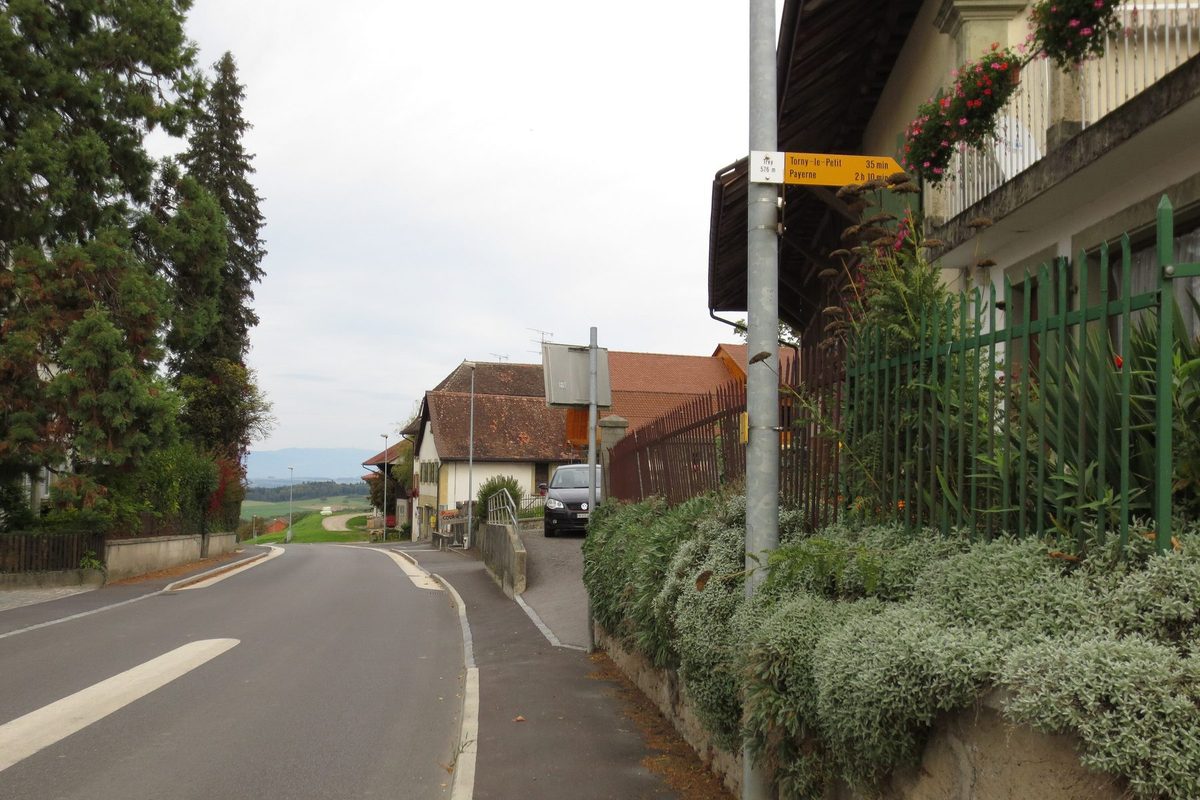
Street village in the Broye valley, between Payerne and the Fribourg border, inhabited since prehistory and long known for its Cornamusaz institute.
Entry based on 7 sources · Our method · Reusable text (CC BY-SA)
Origin of the name Trey
First written mention: «Treis» in 1142/1146. Other forms are reportedly recorded later: «Trees» in 1213, «Treys» in 1254 and «Treyz» in 1311. What «Trey» means is still not known.[1]
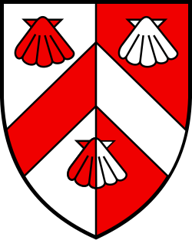
Coat of arms of Trey
Per pale argent and gules, a chevron between three escallops, all counterchanged. The shield is divided vertically, white on the left and red on the right. A chevron and three scallop shells lie on it, red on the white half and white on the red half. The chevron and shells come from the arms of the de Trey family. They are set on the colours of Payerne, to show that the village belonged to the monastery of Payerne.[5][3]
Founding of Trey
Neither a founding date nor a founder is known. The site was occupied long before the Middle Ages: a prehistoric settlement, Bronze Age and La Tène graves and a Roman-period settlement have been found there. In the Middle Ages, the village depended on the priory of Payerne and was administered by a mayor (mestral). A de Trey family appears in the 12th century. The municipality comprises the street village of Trey, on the road from Payerne to Romont, and the hamlet of Granges-sous-Trey, on the road from Lausanne to Bern, on the right bank of the Broye.[1]
History of Trey
prehistory. Prehistoric settlement; Bronze Age and La Tène graves have also been found.[1]
Roman period. Roman-period settlement.[1][3]
1142/1146. First written mention, in the form «Treis».[1]
12th century. The de Trey family appears. The village depends on the priory of Payerne and is administered by a mayor (mestral).[1]
1309. Start of the gradual break-up of the seigneury.[1]
1536. Start of Bernese rule; Trey belongs to the governorship (bailiwick) of Payerne until 1798. At the Reformation, the village moves from the parish of Torny-le-Petit to that of Granges.[1]
1664. Jacob de Trey sells the last fief to Jean-Louis Loys.[1]
1757-1759. Bern acquires the entire seigneury.[1]
1787-1788. Construction of the temple (or 1796).[1]
1798. The municipality is assigned to the district of Payerne, until the new districts came into force on 1 January 2008.[1][4]
1840-1845. Trey is made a parish for the first time.[1]
1864. Trey becomes a parish again, until 1925.[1]
1876. Opening of a railway halt at Granges-sous-Trey.[1]
1886. Opening of the Cornamusaz institute, a renowned boarding school for pupils from German-speaking Switzerland, active until 2001.[1][3]
1925. Trey is attached to the parish of Villarzel.[1]
1944. In December, during floods of the Broye, the dykes built during the correction of the river at the end of the 19th century reportedly gave way.
1964. Founding of a major horticultural business in the municipality.[1]
2001. Closure of the Cornamusaz institute.[1]
2008. The district of Broye-Vully, created by the new territorial division of Vaud, begins operating on 1 January.[4]
Population of Trey
Sources and references: [1][2]
| 1741 | 21 hearths (households) |
| 1764 | 176 inhabitants |
| 1803 | 236 inhabitants |
| 1850 | 460 inhabitants |
| 1900 | 442 inhabitants |
| 1950 | 338 inhabitants |
| 2000 | 232 inhabitants |
| 2010 | 257 inhabitants |
| 2020 | 301 inhabitants |
| 2025 | 305 inhabitants |
Families of Trey
De Trey. As lords of the place, the de Trey held the fief. Their castle was burned and destroyed in 1410. In 1664 Jacob de Trey sold the last fief to Jean-Louis Loys.[3][1]
Burgher families before 1800. Cornamusaz, Crausaz, de Crousaz, Estoppey, Fague and Pages, with no precise date.[7]
In the 19th century. The Caillet, of Maracon VD, with no precise date.[7]
Show more families (1)
From 1901 to 1962. Four entries: the Bruckmooser, from Germany, in 1911, the Laplace, from France, in 1934, the Rege-Volpe, from Italy, in 1951, and the Schafroth of Röthenbach im Emmental BE in 1958.[7]
Notable people of Trey
Charles Estoppey. A citizen of Trey, he sat in the National Council from 1852 to 1863, in the cantonal Council of State from 1866 to 1888 and in the Council of States from 1867 to 1888. Elected to the Federal Council in 1875, he declined the office.[3]
Jeannot De Crousaz. A judge at the cantonal court, he was a member of the Council of State from 1876 to 1883.[3]
Fritz Cornamusaz. A schoolteacher in the village, he founded a boarding school, the Institut Cornamusaz, in 1886. His son-in-law, Henri Jaccottet-Cornamusaz, later took it over.[3][1]
Auguste De Crousaz. Syndic (mayor), he sat in the cantonal parliament from 1949 to 1962.[3]
Christophe Keckeis. Chief of the Swiss Armed Forces from 2004 to 2007, he began his military career in 1966 as a pilot in the surveillance squadron. In Trey he chaired the General Council from 1979 to 1987. He died in May 2020.[3]
Economy of Trey, past and present
Fields, mills and cheese dairy. In the 19th century Trey's economy was essentially agricultural. Near Granges-sous-Trey, two mills used the power of the Trey stream. Around 1817 the Société de la Fruiterie built a cheese dairy. On the valley floor, Broye floods constantly threatened the passage, and the river was embanked in the 1880s. During the First World War, major reclamation and drainage works were carried out in the area. According to the FAO, a good half of the ten or so farms the village still had have disappeared.[6][3]
The greenhouses. A Bernese entrepreneur, in horticulture since 1934, set up a business in Trey. It has 56'000 m² of greenhouses and employs more than thirty people.[6]
Disasters and major events in Trey
The fire of 1 September 1837. The fire destroyed several houses in the village centre, along with livestock and belongings. Help came from the whole region, even from Nyon and Etoy. The farmhouses were rebuilt in a uniform way along the main road between Payerne and Romont. This ensemble earned Trey its place in the Federal Inventory of Swiss Heritage Sites (ISOS).[3]
Historic sites in Trey
Temple of Trey. Reformed temple built in 1787-1788 (or 1796), at the end of the Bernese period.[1][3]
Cornamusaz institute. Boarding school founded in 1886, renowned for taking in pupils from German-speaking Switzerland, closed in 2001.[1]
Granges-sous-Trey. Hamlet of the municipality on the right bank of the Broye, where a railway halt was opened in 1876.[1]
Remains in Trey
Archaeological site. Prehistoric settlement, Bronze Age and La Tène graves and a Roman-period settlement discovered on the territory of Trey.[1]
Le Château. Masonry remains at the place called Le Château, which may belong to a medieval motte.[1]
Sources
- Dictionnaire historique de la Suisse, « Trey »
- Statistique Vaud, « Population résidante permanente au 31 décembre 2025 »
- Feuille des avis officiels du canton de Vaud, « Alphabet des communes vaudoises : Trey »
- État de Vaud, communiqué du 12.07.2007, « Les préfètes et les préfets sont attribués aux nouveaux districts »
- IPI, Swissreg, emblems database: coat of arms of Trey (no. 101929)
- Federal Office of Culture, ISOS, "Trey", record no. 4696, 2nd version, September 2011
- Register of Swiss Surnames, 3rd edition (1989), search Commune "Trey", Canton VD
Published by Sébastien Jörg ·
Localities of the municipality with a page
Other villages near Trey
Missing information, or do you have a source? Suggest a correction or addition. Every submission is checked before it's published.
Suggest a change