Villarzel
Town that grew up around the Bishop of Lausanne's castle, of which only the tower survives, and where peace between the bishop and Louis II of Savoy-Vaud was signed in 1316.
Entry based on 8 sources · Our method · Reusable text (CC BY-SA)
Origin of the name Villarzel
The name appears in 1228 as «Vilarsel», then «Villarse levesque» in 1346-1347 and «Villarsel Levesque» in 1453, hence the nickname Villarzel-l'Évêque, recalling that the place belonged to the Bishop of Lausanne. The name is said to derive from Romance «villāre» (estate, hamlet) followed by the diminutive suffix «-ĭcellu», meaning «the small estate, the small hamlet», though this is uncertain. In Vaud patois the village is reportedly called «Velazî».
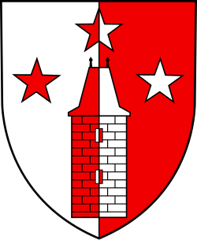
Coat of arms of Villarzel
Per pale argent and gules, a roofed tower accompanied by three mullets one and two, all counterchanged. The shield is white on the left and red on the right. It bears a roofed tower and three stars, which on each side take the colour opposite to the field.[6]
Founding of Villarzel
Villarzel owes its existence as a town to the temporal power of the Bishops of Lausanne. Bishop Berthold of Neuchâtel (1212-1220) had a castle (castrum) built here, which Bishop Saint Boniface (1231-1239) provided with fortifications. Around the castle a small castle town grew up, «la ville», centre of an episcopal castellany comprising Sédeilles, Cerniaz, Villars-Bramard, Rossens, Marnand and Granges. Together with the neighbouring castellany of Lucens, it formed a single block of episcopal territory surrounded by Savoyard possessions. The commune itself existed before its first written mentions in the 15th century.[2][3]
History of Villarzel
1212-1220. The Bishop of Lausanne, Berthold of Neuchâtel, has a castle (castrum) built at Villarzel.[2][3]
1228. First written mention of the name, as «Vilarsel».
1231-1239. Bishop Saint Boniface has fortifications built.[3]
1248. An episcopal castellan is mentioned for the first time. The office is sometimes held by the Villarzel family.[3]
1295. Conflict between Bishop Guillaume de Champvent and the lords of Villarzel, who refuse his overlordship. The castle is taken and burnt at the end of the 13th century or around 1300, an uncertain date.[2]
1316. Peace between the Bishop of Lausanne and Louis II of Savoy-Vaud, who had ravaged the episcopal lands, is signed at Villarzel.
1397. The castellany accounts for 7.2% of the population of the bishop's possessions and 5.5% of the revenues of the episcopal mensa.
1416. Villarzel is a filial of the parish of Granges. A late medieval chapel serves the place.
1444. The bishop grants the inhabitants common pasture rights for their pigs in the neighbouring forests, a source of later disputes.[2]
1536. Bernese conquest: until 1798 Villarzel remains the centre of a castellany within the bailiwick of Moudon.[2]
16th century. An inn is mentioned from at least the middle of the century. The castle tower is restored at the end of the century.
1622. Villarzel becomes a parish, including Rossens and Sédeilles.[3]
17th century. The castle town («la ville») loses its population to the village.[2][3]
1668. The male line of the lords of Villarzel dies out.[2]
1798. Villarzel is said to have joined the Vaud emancipation through its delegates Jonas Rossier and Frédéric Bersier. The commune is attached to the district of Payerne, which belongs to Fribourg from 1798 to 1803.
1910. The parish of Villarzel is reportedly the first in the canton where women may vote in the appointment of a pastor.
1954. Rodolphe Rubattel, a citizen of Villarzel, is President of the Confederation.[2]
2000. The parish of Villarzel is reunited with that of Granges.[3]
2006. Merger with Rossens and Sédeilles into the municipality of Villarzel.[3]
2008. With the new Vaud districts, Villarzel moves from the district of Payerne to that of Broye-Vully.[3]
Population of Villarzel
Sources and references: [3][4]
| 1677 | 36 hearths (households) |
| 1741 | 18 hearths (households) |
| 1764 | 167 inhabitants |
| 1850 | 358 inhabitants |
| 1900 | 296 inhabitants |
| 1950 | 226 inhabitants |
| 1990 | 158 inhabitants |
| 2000 | 190 inhabitants |
| 2025 | 522 inhabitants (municipality merged with Rossens and Sédeilles) |
Families of Villarzel
De Villarzel. Its genealogy begins with the knight Rodolphe, castellan of Villarzel around 1250-1254. In 1295 the lords of Villarzel went to war against Bishop Guillaume de Champvent. The family bore "de gueules au chef d'argent chargé d'un lambel à cinq pendants d'azur". Its last male member died in 1668.[2]
Citizen families before 1800. Bersier, Besson, Bize, Décorvet, Joliquin, Rossier and Rubattel, with no precise date. The de Miéville and the Demiéville, listed under two spellings, became citizens in 1676.[8]
In the 19th century. The Brandt, from Le Locle NE, with no precise date.[8]
Show more families (1)
From 1901 to 1962. Six entries: the Niggeler in 1933, the Katzki in 1939, the Pedroli (from Italy) in 1954. The last three families were entered in 1957: the Albiez from Germany, the Maeder of Ried bei Kerzers FR and the Schüpbach of Landiswil BE.[8]
Notable people of Villarzel
Rodolphe Rubattel. In 1954 Villarzel gave the Confederation a president, Rodolphe Rubattel.[2]
Economy of Villarzel, past and present
Milk and Gruyère. According to the FAO, thirteen farmers work the municipality's land. Their milk is made into Gruyère AOP at the cheese dairies of Villarzel and Châtonnaye, across the Fribourg border. The municipality works with Nestlé Waters in the regional ecological network of Henniez.[7]
Forests and craftsmen. The 114 hectares of municipal forest are entrusted to the Glâne-Farzin intercantonal forestry corporation, which manages more than 3'000 hectares. A few craftsmen, a market gardener, a cheese dairy and a restaurant in Sédeilles complete the picture. Villarzel no longer has a post office or a shop.[7]
Disasters and major events in Villarzel
The castle fire of 1476. Villarzel castle burns down. Only the tower and the chapel escape the flames, and the chapel is still used for worship.[7]
Historic sites in Villarzel
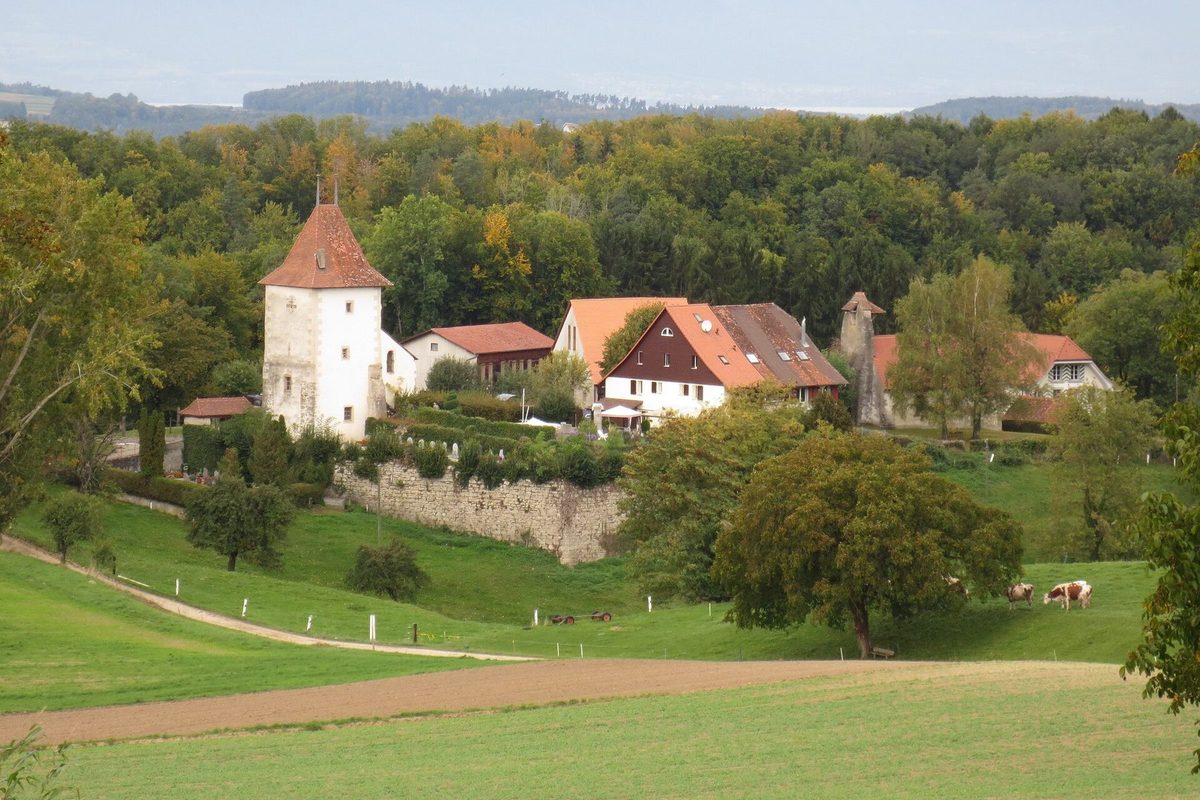
Castle tower. The only remnant of the episcopal castle built under Berthold of Neuchâtel (1212-1220) and fortified under Saint Boniface (1231-1239). It stood against the 13th-century curtain wall and was restored at the end of the 16th century. After the Bernese conquest it served as a granary and prison. It appears on the municipal coat of arms.[3]
Church. Church dedicated to Saint George, built shortly before 1450, later the Reformed church and parish church from 1622, when Villarzel was made a parish with Rossens and Sédeilles. According to communal tradition, a chapel is said to have escaped the castle fire around 1300 together with the tower.[3]
The town and the village. The former castle town, called «la ville», lost its population to the village in the 17th century. The village of Villarzel is listed in the Federal Inventory of Swiss Heritage Sites of national importance (ISOS).[3]
Rossens and Sédeilles. Former communes of the castellany of Villarzel, merged into the municipality in 2006. They have their own separate entries.[3]
Remains in Villarzel
Tower and 13th-century curtain wall. Of the episcopal castle, often fought over and partly burnt, only the tower that stood against the curtain wall survives. Restored at the end of the 16th century, it recalls the time when Villarzel was the seat of a castellany of the Bishop of Lausanne.
Former châtelards. Two «châtelards» (former earthwork fortifications) lay north of the town.
Protected heritage in Villarzel
Cultural property of regional significance (B objects)[5]
- Eglise réformée Saint-Georges
- Le Ressat, site fortifié médiéval
- Maison Bize avec fenêtres en triplet
- Villarzel, motte féodale
Sources
- Dictionnaire historique de la Suisse, « Villarzel »
- Commune de Villarzel, « Histoire de Villarzel »
- Office fédéral de la culture, ISOS, fiche n° 4701 « Villarzel »
- Statistique Vaud, « Population résidante permanente au 31 décembre 2025 »
- Federal Office for Civil Protection (FOCP), Swiss Inventory of Cultural Property (PCP), list for the canton of Vaud (as of 1.1.2026)
- IPI, Swissreg, emblems database: coat of arms of Villarzel (no. 101722)
- Official Gazette of the Canton of Vaud (FAO), "Alphabet des communes vaudoises: Villarzel"
- Register of Swiss Surnames, 3rd edition (1989), search Commune "Villarzel", Canton VD
Published by Sébastien Jörg ·
Localities of the municipality with a page
Other villages near Villarzel
Missing information, or do you have a source? Suggest a correction or addition. Every submission is checked before it's published.
Suggest a change