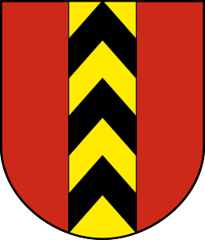
Valangin
A town with a regular layout founded by the Aarbergs between 1301 and 1330 at the foot of their castle, Valangin gave its name to the Valanginian, a geological stage described in 1853.
Entry based on 16 sources · Our method · Reusable text (CC BY-SA)
Origin of the name Valangin
First mentioned in 1241 as « de Valengiz ». The old German name is « Valendis ». The name is often explained by Latin vallis angina, « the narrow valley », but this is not certain. Another hypothesis sees in it the estate of a certain Volumnius (« Volumnianus »). The Valanginian, a geological stage described in 1853 by Édouard Desor, is named after the place.[1][13]
Founding of Valangin
Valangin lies at the northern entrance to the Seyon gorges and includes the hamlet of La Borcarderie and the estates of Bussy and Sorgereux. The site has been frequented since the Hallstatt period, as some ten burial mounds in the Bussy woods show. The castle, seat of the medieval lordship of Valangin, has yielded remains of a Romanesque tower of the 11th or 12th century. Its keep dates from the 13th century. The lordship is recorded around 1150, when Renaud de Valangin and his son Guillaume gave property to the abbey of Fontaine-André. From the early 13th century to 1517 it was held by the Aarberg-Valangin family. The present town, with its regular layout, was founded to a plan by the Aarbergs between 1301 and 1330, probably after the destruction of La Bonneville. Jean d'Aarberg granted it its first franchises in 1352. Citizenship, at first reserved for house-owning inhabitants of Valangin, was later granted throughout the lordship and beyond, until the burgher community was dissolved in 1852.[1][4]
History of Valangin
Hallstatt period. Some ten burial mounds are raised in the Bussy woods. They are excavated between 1920 and 1960.[1]
11th-12th century. A Romanesque tower, remains of which have been found, is built on the hilltop.[1]
around 1150. Renaud de Valangin and his son Guillaume give property to the abbey of Fontaine-André: the lordship of Valangin is recorded.[4]
early 13th century. The Aarberg-Valangin family, vassals of the bishop of Basel and rivals of the counts of Neuchâtel, hold the lordship, which they keep until 1517.[4]
1241. Oldest known written mention of the place name, in the form "de Valengiz".[1]
13th century. Construction of the castle keep.[1][7]
6 January 1296. First mention of the castle in an archival document.[4][7]
1296. Jean I and Thierry d'Aarberg temporarily cede the Val-de-Ruz and Valangin to the bishop of Basel, who undertakes to build a tower there. Rollin de Neuchâtel defeats the two brothers and the bishop.
1301-1330. The Aarbergs found the town on a regular plan below the castle, probably after the destruction of La Bonneville.[1]
1334. Construction of the Prisonnière tower.[7]
1352. Jean d'Aarberg grants the town its first franchises.[1][3][7]
15th-16th century. The walls are completed: in 1449-1450 the mountain people obtain the right to shelter behind the outer enclosure, which is thoroughly rebuilt in 1489-1493.[4]
1505. Consecration of the collegiate church of Saint-Pierre, built by Claude d'Aarberg and Guillemette de Vergy. Its chapter consists of a provost and six canons.[1][3][7]
1517. Death of Claude d'Aarberg. His widow, Guillemette de Vergy, has a new residential building and the entrance gate built at the castle.[4]
1531. The collegiate church is sacked. The adoption of the Reformation in 1536 ends the chapter. Valangin, which belonged to the parish of Engollon, then forms a parish with Boudevilliers.[1]
1552. René de Challant has the castle's north curtain wall rebuilt.[4]
1563-1564. Construction, opposite the collegiate church, of the so-called « house of Madame T. ».[3]
1565. Death of René de Challant, which marks the end of the major construction works carried out at the castle.
1592. Following a disagreement between heirs, the lordship of Valangin is attached to the county, then to the principality, of Neuchâtel.[1][3][4][7]
1601, 1701 and 1713. Successive collapses of castle towers, leading to the partial levelling of its outer wall.[4]
1747. An accidental fire ravages the castle during restoration work.[3][4][7]
1766. A calico-printing works (indiennes) is set up at La Borcarderie.[1][3]
1769-1772. Reconstruction of the castle, which gives it essentially its present-day silhouette: the north part is replaced by a terrace, the south wing is lowered by one storey.[4]
1789. Demolition of the Prisonnière tower.[4][7]
1806. Napoleon gives the principality of Neuchâtel, to which Valangin belongs, to Marshal Alexandre Berthier.[11]
1840-1841. The dilapidated nave of the collegiate church is demolished and half rebuilt: the church takes on a centralised plan with a lantern tower.[7]
1848. Valangin is assigned to the Val-de-Ruz district, to which it belongs until 2017.[1]
1852. Dissolution of the burghership of Valangin.[1]
1853. The geologist Édouard Desor describes the Valanginian, a geological layer named after the place.[1]
1894. The castle ceases to serve as a prison. The State grants its use to the Society of History and Archaeology, which sets up a regional museum there.[4][7]
1896-1916. Fitting-out work at the castle by the Historical Society (1896-1898), then restoration of the walls by the cantonal authorities (1900-1916).[4]
1901. A tramway links Valangin to Neuchâtel. It is replaced by a trolleybus from 1948 to 1968, then by the Neuchâtel-Cernier bus.[1]
1973. The Valangin bypass viaduct collapses during construction.[1]
1975. Opening of the bypass viaduct leading to the Seyon gorges.[1][7]
early 21st century. Valangin keeps a few farms and some small crafts. Most of the working population commutes.[1]
2005. Latest restoration of the collegiate church.[1][3]
2011. A single Reformed parish now covers the whole Val-de-Ruz.[1]
2016. On 5 June, the people of Valangin approve the merger agreement with Corcelles-Cormondrèche, Neuchâtel and Peseux.[12]
2017. Valangin joins the association "Les plus beaux villages de Suisse" (The most beautiful villages of Switzerland).[3]
2020 (date uncertain). Opening at the castle, perhaps in this year, of a medieval-inspired garden laid out in nine themed areas.
2021. On 1 January Valangin merges with Neuchâtel, Corcelles-Cormondrèche and Peseux and becomes a locality of the new municipality of Neuchâtel, which then has 44'411 inhabitants.[2][3][6]
Population of Valangin
Sources and references: [1][5][6]
| 1750 | 186 |
| 1850 | 418 |
| 1900 | 476 |
| 1950 | 427 |
| 2000 | 400 |
| 2010 | 409 |
| 2020 | 523 (cantonal census at 31.12.2020) |
Families of Valangin
Aarberg-Valangin. A branch of the house of Neuchâtel, the Aarberg-Valangin held the lordship from the early 13th century to 1517. They disputed the overlordship of the counts of Neuchâtel, which led to repeated conflicts. To support the growth of the small town and their own interests, they expanded the burghership of Valangin. Claude d'Aarberg, who died in 1517, was the last lord of the line.[15][1]
Citizen families before 1800. Two branches of the Tissot, the Tissot-dit-Choppia and the Tissot-dit-Sanfin, held citizenship with no precise date. Two families from elsewhere in the canton were registered in the 17th century: the de Perregaux, from Les Geneveys-sur-Coffrane, in 1647, and the de Montmollin, from Neuchâtel, in 1675.[16]
In the 19th century. The Giorgis, from Greece, were registered in 1860 and the Kilian in 1863. Towards the end of the century came the Bachmann from Amsoldingen BE and the Bonny from Chevroux VD (1896), then the Bijon, from France (1898).[16]
Show more families (1)
From 1901 to 1962. Sixteen registrations. The canton of Fribourg gave four: the Abriel from Domdidier (1901), the Charrière from Avry-devant-Pont (1910), then the Hurni from Fräschels and the Tinguely from Marsens (1938). Bern also gave four: the Kurz from Wahlern and the Lauener from Lauterbrunnen (1914), the Jaggi from Orpund (1920) and the Sauser from Sigriswil (1926). From Germany came the Ritz (1910 and 1918) and the Staudte (1916), from Italy the Aiassa (1923) and the Piana-Borci (1927). They were joined by the Maillat from Courtedoux JU (1926), the Graber from Langenbruck BL (1930) and the Bardet from Villars-le-Grand VD (1931). The last family registered, in 1942, was the Poggia, from Italy.[16]
Notable people of Valangin
Guillemette de Vergy. The widow of Claude d'Aarberg, she strongly opposed the introduction of the Reformation, imposed against her will in 1536. At the castle she built a new residential wing and the entrance gate. On her death in 1543 the lordship passed to her grandson René de Challant.[15][1]
René de Challant. Grandson of Guillemette de Vergy, he inherited the lordship in 1543 and brought the house of Challant to Valangin. During his rule, in 1562, the court of the Three Estates replaced the lord's hearings. He had the castle's northern curtain wall rebuilt, and his death in 1565 ended the major building works.[15][1]
Economy of Valangin, past and present
Mills and sawmills. The water of the Sorge and the Seyon drove sawmills and mills. Mills are recorded from the early 15th century. On the Siegfried map of 1875 many mills and sawmills still line the two rivers.[1][7]
A stop on the road. The little town had shops, hotels and restaurants tied to the carting trade between the lower and upper parts of the canton. The former Hôtel de la Couronne dates from 1767. The road over the Vue-des-Alpes was built between 1807 and 1812.[7]
Workshops and commuters. A bar-turning (décolletage) works was set up in the late 19th or early 20th century. At the start of the 21st century Valangin kept a few farms and some crafts, and most of its working residents commuted elsewhere.[7][1]
Historic sites in Valangin
The Castle of Valangin. Built on a rocky spur above the Seyon, the castle was the residence of the lords of Valangin from the 12th to the 16th century. It comprises a tall residential block with a corner tower, built between the mid-13th century and the turn of the 15th, and a double enclosure, the outer one reinforced by eleven half-moon bastions. A regional museum since 1894, after serving as a prison, it is listed as cultural property of national significance. Visitors can see the knights' hall, the early 16th-century kitchen, the Guillemette de Vergy room and the dungeons. A medieval-inspired garden presents nine themed areas.[3][7][8][9][10]
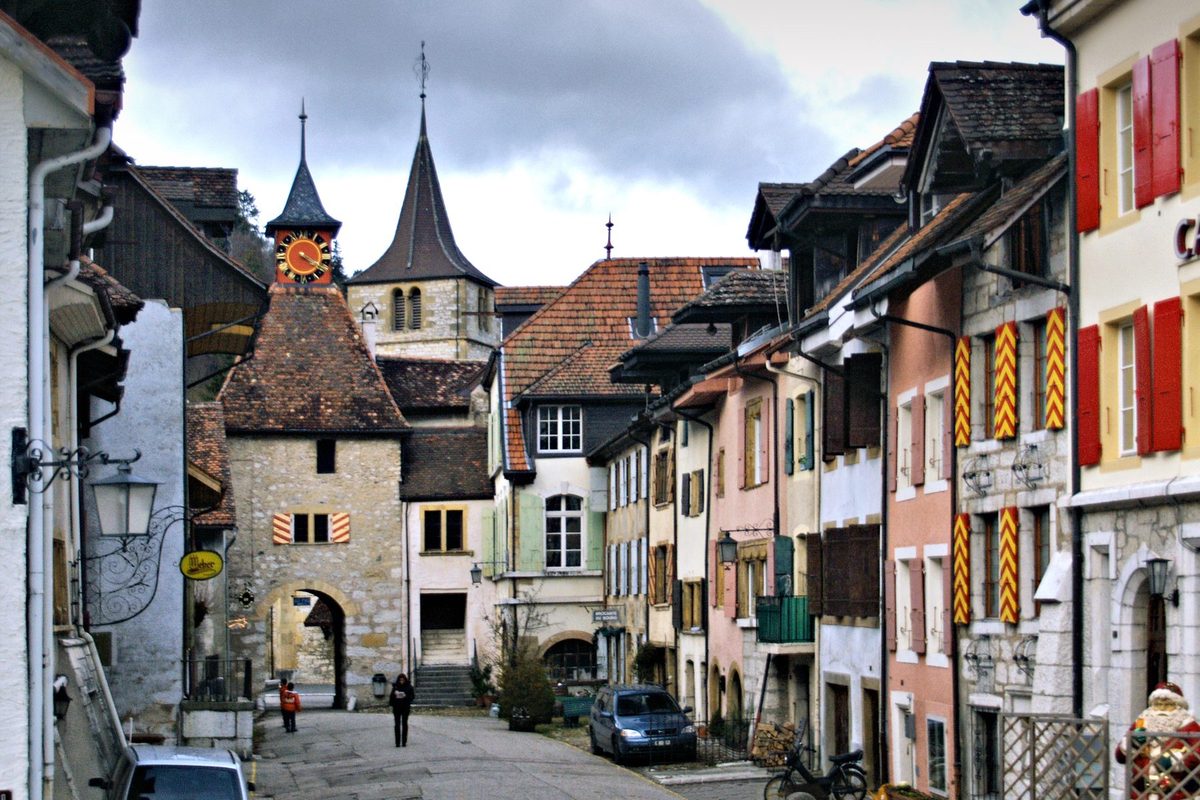
Le Bourg, the fortified old town. Founded on a regular plan between 1301 and 1330 below the castle, the compact town measures about 70 by 50 metres: a street lined with two rows of terraced houses, with a 16th-century extension. Its entrance is marked by a gate tower recorded from 1499, topped by a small bell turret with a clock (1710).[7]
The collegiate church of Saint-Pierre. Built by Claude d'Aarberg and Guillemette de Vergy and consecrated on 1 June 1505, it holds the funerary monument of its founders. Built outside the walls, in front of the gate tower, it lost its dilapidated nave, half rebuilt in 1840-1841: hence its centralised plan with a lantern tower, unusual in the region. Léo Châtelain restored it in 1908-1909 (stained glass by Clément Heaton). Its latest restoration dates from 2005.[1][3][7]
The house opposite the collegiate church. The so-called « house of Madame T. », built in 1563-1564 opposite the collegiate church, is run by an association and houses an exhibition gallery. The ISOS inventory describes on this site the Touchon house, a patrician residence rebuilt at the end of the 16th century, with a gabled front, a hexagonal stair tower and a door dated 1588. It is not yet certain whether they are the same house.[3][7]
The hamlet of La Borcarderie. Hamlet where a calico-printing works was set up in 1766. La Borcarderie is listed as cultural property of regional significance. The town of Valangin is listed in the Federal Inventory of Swiss Heritage Sites of national importance (ISOS).[1][3][7][8]
Remains in Valangin
Burial mounds of the Bussy woods. Some ten Hallstatt-period burial mounds were excavated here between 1920 and 1960. They form one of the richest Early Iron Age burial groups in the region.[1]
Remains of the first castle, 11th-12th century. Remains of a Romanesque tower of the 11th or 12th century were found at the castle.[1]
The castle dungeons. The castle dungeons, shown in the museum, recall its use as a prison until 1894.[4][9]
The outer enclosure. The 15th- and 16th-century outer enclosure linking the town to the castle is reinforced by eleven half-moon bastions. Several towers collapsed in 1601, 1701 and 1713.[4][7]
The town gate of the Bourg. The gate tower marking the entrance to the town is recorded from 1499. It is topped by a small bell turret with a clock of 1710.[7]
20th-century fortifications. Forts built during the Second World War house the Border Brigade 2 museum, run by the ProFortins association.[3]
Protected heritage in Valangin
Cultural property of national significance (A objects in the PCP inventory)[8]
- Château et ses fortifications
- Collégiale (temple)
Cultural property of regional significance (B objects)[8]
- Ancienne mercerie, maison à pan de bois
- Bussy
- La Borcarderie
- Le Sorgereux
- Musée du Château de Valangin
Legends of Valangin
The damned of the gallows. The Valangin gallows stood in the forest above the Seyon gorge, and people avoided the spot at night. Some folk from Auvernier going up to the fair before sunrise believed they were being chased there by a band of the damned dragging the chains of hell. They ran screaming all the way down to the town. In front of the church, their pursuers turned out to be four «magnins», travelling tinkers with baskets full of scrap iron. The tinkers swore they had slept under the gallows and only ran after them to stretch their legs.[14]
Sources
- Dictionnaire historique de la Suisse, « Valangin (commune) » (version du 24.09.2021)
- Ville de Neuchâtel, « Fusion avec Neuchâtel »
- Ville de Neuchâtel, page découverte « Valangin »
- swisscastles.ch, « Château de Valangin »
- État de Neuchâtel, arrêté du 10 février 2021 portant homologation des résultats du recensement cantonal de la population du 31 décembre 2020
- Ville de Neuchâtel, communiqué « Recensement : la population de Neuchâtel est stable » (11 février 2021)
- Office fédéral de la culture, ISOS, inventaire fédéral des sites construits d'importance nationale, fiche « Valangin » (n° 2717)
- Office fédéral de la protection de la population, Inventaire PBC des biens culturels d'importance nationale et régionale, liste du canton de Neuchâtel (état au 1.1.2026)
- Musées suisses (museums.ch), « Château et musée de Valangin »
- Jura & Trois-Lacs, « Valanjardin », jardin d'inspiration médiévale du château de Valangin
- Ville de Neuchâtel, « Repères historiques »
- Ville de Neuchâtel, Conseil communal, rapport d'information au Conseil général au sujet de la votation communale du 5 juin 2016 (fusion), 5 octobre 2016
- Association Chemins-Chouettes, « Villages vaudruziens : blasons, noms, surnoms »
- J.-H. Bonhôte, « Superstitions neuchâteloises », Musée neuchâtelois, 1864, p. 27
- Historical Dictionary of Switzerland (HDS/HLS), article "Valangin (seigneurie)" (Maurice Evard, version of 05.03.2014)
- Register of Swiss Surnames, 3rd edition (1989), search Commune "Valangin", Canton NE
Published by Sébastien Jörg ·
Other villages near Valangin
Missing information, or do you have a source? Suggest a correction or addition. Every submission is checked before it's published.
Suggest a change