Vaux-sur-Morges
In 1851 Vaux-sur-Morges put up a single building to house both its chapel and its municipal hall.
Entry based on 8 sources · Our method · Reusable text (CC BY-SA)
Coat of arms: Public domain, Wikimedia Commons
Origin of the name Vaux-sur-Morges
The place is mentioned after 1202 as «terra de Vallibus». It was simply called «Vaux» until 1920, then took the name Vaux-sur-Morges. The origin of the name is not explained in detail.
Coat of arms of Vaux-sur-Morges
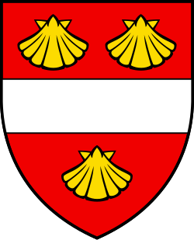
Gules, a fess argent between three escallops Or. On a red field, a white horizontal band crosses the shield, surrounded by three yellow scallop shells. The municipality adopted these arms in 1923.[6][5]
Founding of Vaux-sur-Morges
The site was inhabited in Roman times: remains of a Roman settlement have been found there, whose site was used as a cemetery in the early Middle Ages. In the Middle Ages the territory depended on the lordship of Monnaz. The municipality has no founder: it was formed from the union of two hamlets, Grand-Vaux and Petit-Vaux, at the end of Bernese rule.
History of Vaux-sur-Morges
Roman period. Roman settlement on the territory.
Early Middle Ages. The Roman site is reused as a cemetery.
after 1202. Mention of the «terra de Vallibus».
Middle Ages. The territory depends on the lordship of Monnaz.
1435. Vaux is listed, wholly or partly, among the places of the lordship of Vufflens.[2]
1539. Attached to the Bernese bailiwick of Morges, until 1798.
1544. Petit-Vaux belongs to the parish of Morges, Grand-Vaux to that of Vufflens-le-Château.
1798. Grand-Vaux and Petit-Vaux are united into one municipality, attached to the district of Morges.
1837. Petit-Vaux is in turn attached to the parish of Vufflens-le-Château.
1838. First mention of the mill on the Morges.
1842. Construction of a cheese dairy.
1851. Construction of the building housing the chapel and the town hall.
1889. Foundation of the cooperative cheese dairy society.
1920. The name «Vaux» becomes «Vaux-sur-Morges».
1990. The mill on the Morges ceases operation.
2008. The new Vaud districts come into force. Vaux-sur-Morges remains in the district of Morges.[4]
Population of Vaux-sur-Morges
Sources and references: [3]
| 1764 | 91 (57 in Grand-Vaux and 34 in Petit-Vaux) |
| 1798 | 88 |
| 1850 | 97 |
| 1900 | 129 |
| 1950 | 120 |
| 1980 | 85 |
| 2000 | 158 |
| 2025 | 185 |
Families of Vaux-sur-Morges
Citizen families before 1800. Menthon, Moret and Panchaud, along with the Tronchet of Carouge GE, with no precise date.[7]
In the 19th century. Courtat and Marquis, along with the Morel of Clarmont VD and the Schmidt of Lavigny VD, with no precise date.[7]
From 1901 to 1962. The Christen of Affoltern im Emmental BE and the Gebhard of Köniz BE were registered in 1956. The last family, in 1962, was the Sutermeister, from Zofingen AG.[7]
Notable people of Vaux-sur-Morges
Heinrich Sutermeister (Feuerthalen 1910 - Vaux-sur-Morges 1995). A composer known above all for his operas. He settled in Vaux in the 1940s and wrote his first piano concerto there, along with his fourth opera, Raskolnikoff, premiered in Stockholm in 1948. A square in the village bears his name.[8][5]
Luc Breton. This bow maker lives in Vaux-sur-Morges. In 2015 he received the Mérite cantonal vaudois for restoring and making bows for baroque music.[5]
Economy of Vaux-sur-Morges, past and present
Fields and vines. Vaux-sur-Morges remains a farming and wine-growing municipality. According to the FAO, agriculture, followed by viticulture, shapes the municipal landscape. Farmland covers 80% of the 210 hectares of the territory, forest 10%.[1][5]
The mill and the cheese dairy. In 1693 Gabriel Willermin, lord of Monnaz, granted a perpetual water right to the mill that used the waters of the Morges. The village built a cheese dairy in 1842, then founded a cooperative cheese dairy society in 1889.[5][1]
Businesses. The FAO lists a cleaning company, a wood-chipping company and a craft brewery in the municipality. Most of the working population works elsewhere in the Lake Geneva region.[5]
Historic sites in Vaux-sur-Morges
Chapel and town hall. Building of 1851 that combines the chapel and the town hall under one roof.
Mill on the Morges. Mill mentioned in 1838, in operation until 1990.
Cheese dairy. Built in 1842; a cooperative cheese dairy society was founded in 1889.
Remains in Vaux-sur-Morges
Roman settlement and cemetery. Remains of a Roman settlement whose site was reused as a burial ground (cemetery) in the early Middle Ages.
Sources
- Dictionnaire historique de la Suisse, « Vaux-sur-Morges »
- Dictionnaire historique de la Suisse, « Vufflens-le-Château » (François Béboux, version du 15.08.2013)
- Statistique Vaud, « Population résidante permanente au 31 décembre 2025 »
- État de Vaud, communiqué du 12.07.2007, « Les préfètes et les préfets sont attribués aux nouveaux districts »
- Official Gazette of the Canton of Vaud (FAO), "Alphabet des communes vaudoises: Vaux-sur-Morges"
- IPI, Swissreg, emblems database: coat of arms of Vaux-sur-Morges (no. 101462)
- Register of Swiss Surnames, 3rd edition (1989), search Commune "Vaux-sur-Morges", Canton VD
- Historical Dictionary of Switzerland (HDS), article "Sutermeister, Heinrich"
Published by Sébastien Jörg ·
Other villages near Vaux-sur-Morges
Missing information, or do you have a source? Suggest a correction or addition. Every submission is checked before it's published.
Suggest a change