Clarmont
The Roman road from Nyon to Yverdon ran through Clarmont, where a few Roman coins have been found. On the Morges, the Chantemerle mill was already working in the 16th century.
Entry based on 8 sources · Our method · Reusable text (CC BY-SA)
Coat of arms: Public domain, Wikimedia Commons
Origin of the name Clarmont
The name Clarmont has no dated early record, and its origin is obscure.
Coat of arms of Clarmont
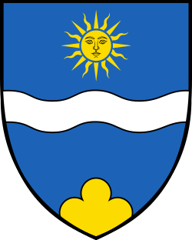
Azure, a fess wavy argent between in chief a sun Or and in base a mount of three hills of the same. On a blue field, a wavy white band crosses the shield horizontally. Above it shines a yellow sun, below it rises a yellow hill with three peaks. Adopted in 1927, the arms take up the blue field of the lords of Colombier, long holders of the lordship of Vufflens to which Clarmont belonged. Their chevron is replaced by a wavy fess standing for the Morges, the river along the commune. The mount recalls the hill above the village.[6][7]
Founding of Clarmont
The territory was crossed by the Roman road from Nyon to Yverdon, and a few Roman coins have been found there. In the Middle Ages the village belonged to the lordship of Vufflens. In the Bernese period it came under the bailiwick of Morges and the castellany of Vullierens.[1]
History of Clarmont
Roman period. The Nyon-Yverdon road crosses the territory. A few Roman coins have been found there.[1]
Middle Ages. Clarmont belongs to the lordship of Vufflens and to the parish of Vullierens.[1]
16th century. The Chantemerle mill, on the Morges, is already in operation.[1]
16th century. Clarmont moves from the parish of Vullierens to that of Vufflens-le-Château.[1]
1536-1798. Bernese period: Clarmont comes under the bailiwick of Morges and the castellany of Vullierens.[1]
1798. Clarmont is assigned to the district of Morges.[1]
1840-1845. Clarmont belongs to the parish of Colombier.[1]
1846-1862. Clarmont belongs to the parish of Apples.[1]
1863. Clarmont again becomes a branch of the parish of Colombier.[1]
Around 1900. The small village, near the right bank of the Morges on the Cossonay-Aubonne road known as the Vy de l'Etraz, has 25 houses and 130 Protestants of Colombier parish. Fields and a little vineyard are worked.[5]
1959-1961. Land consolidation.[1]
1961. Construction of the intermunicipal school of Chaniaz, with Bussy-Chardonney, Réverolle and Vaux-sur-Morges, replacing the old school of Clarmont.[1]
1976. Adoption of a zoning plan.[1]
2008. Clarmont remains in the new district of Morges, in force from 1 January 2008.
Population of Clarmont
Sources and references: [1][4]
| 1764 | 64 |
| 1798 | 112 |
| 1850 | 145 |
| 1900 | 129 |
| 1950 | 93 |
| 2000 | 142 |
| 2025 | 232 |
Families of Clarmont
Citizen families before 1800. Courvoisier, Morel, Moret, Viande, Vidoudez and Wuistaz, without a precise date.[8]
In the 19th century. Berguer and Dubosson, without a precise date.[8]
From 1901 to 1962. Several families come from abroad: from Italy (Carestia in 1941) and from France (Denat in 1960). From Switzerland come the Schopfer family from Lauenen BE (1956) and the Fiechter family from Dürrenroth BE (1958). The last family registered, in 1960, is the Denat family.[8]
Economy of Clarmont, past and present
The Chantemerle mill. On the Morges, the Chantemerle mill is already working in the 16th century. It is later converted into a sawmill.[1]
Fields, vines and solar panels. Clarmont remains a farming and winegrowing village. Thanks to solar panels on its farm buildings, it is one of the few communes that produce more electricity than they consume. A farm market run by the Viande family sells flowers, seedlings, dairy products and Vaud alpine Gruyère. The village has neither café nor restaurant.[1][7]
Historic sites in Clarmont
Chantemerle mill. On the banks of the Morges, this mill was already in operation in the 16th century. It was later converted into a sawmill.[1]
Chaniaz school. Intermunicipal school built in 1961 with Bussy-Chardonney, Réverolle and Vaux-sur-Morges, replacing the old village school.[1]
Remains in Clarmont
Roman coins. A few coins from the Roman period have been found in the municipal territory, which the Nyon-Yverdon road crossed. Roman weapons and tiles were also found there, along with rectangular stone-lined graves.[1][5]
Traditions and festivals in Clarmont
The Vineyard Race. Residents of Clarmont organise the Vineyard Race (Course des Vignes), with courses for children and for athletes. The second edition takes place on 27 August 2023.[7]
Sources
- Dictionnaire historique de la Suisse, « Clarmont » (François Béboux, version du 22.12.2003)
- Canton de Vaud, Loi sur le découpage territorial (LDecTer, RSV 132.15) du 30 mai 2006
- État de Vaud, communiqué du 12.07.2007, « Organisation des préfectures et adaptation au nouveau découpage territorial »
- Statistique Vaud, « Population résidante permanente au 31 décembre 2025 »
- Geographisches Lexikon der Schweiz, Band I (Neuenburg, Attinger, 1902)
- IPI, Swissreg, emblems database: coat of arms of Clarmont (no. 101941)
- Official Gazette of the Canton of Vaud (FAO), "Alphabet des communes vaudoises: Clarmont"
- Register of Swiss Surnames, 3rd edition (1989), search Commune "Clarmont", Canton VD
Published by Sébastien Jörg ·
Other villages near Clarmont
Missing information, or do you have a source? Suggest a correction or addition. Every submission is checked before it's published.
Suggest a change