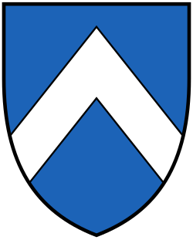
Colombier
At the end of the Middle Ages the lords of Colombier were among the most influential nobles of the Pays de Vaud. One of them had the present château built around 1500.
Entry based on 11 sources · Our method · Reusable text (CC BY-SA)
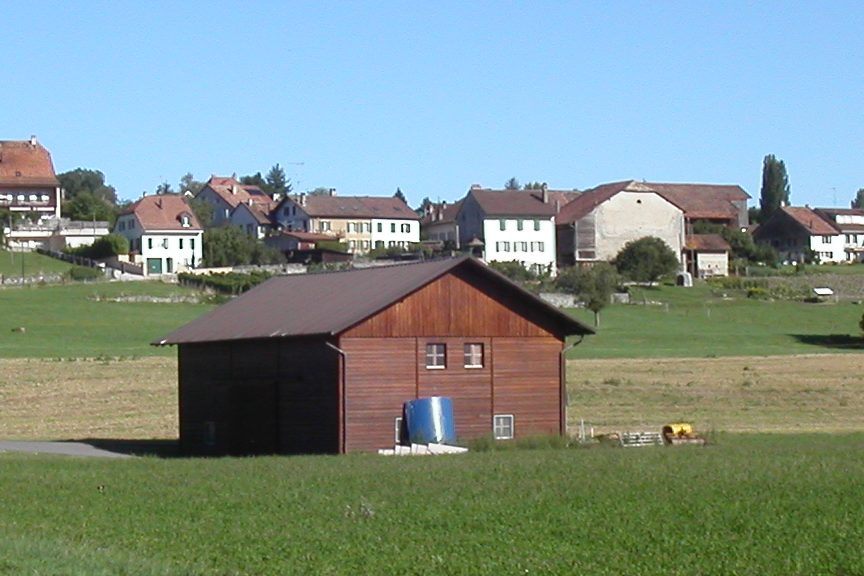
Origin of the name Colombier
The name Colombier comes from the Latin columbarium, which designates a dovecote, a building intended for raising pigeons. The locality first appears in a text in 937 in the form Columbaris. The forms Colonberio (987), Columberium (1005) and Columbie (1228) follow, before the spelling gradually settled into Colombier.[1][4][8]
Founding of Colombier
No founding act is known for Colombier. The place first belonged to the lands of the kingdom of Burgundy. In the Middle Ages it was part of the land of Vullierens, itself attached to the barony of Cossonay. A first seigneurial family settled there, but it was extinct by the early 13th century. A new lineage from Villars-le-Terroir then took the name of the place and held the seigneury from the 13th to the 16th century. At the end of the Middle Ages these Colombiers became one of the most influential noble houses of the Pays de Vaud, notably thanks to Humbert de Colombier, bailiff of Vaud for Savoy, and then his son Henri, lord of Colombier, of Vullierens and of Vufflens-le-Château. Henri was a close advisor to Duke Amadeus VIII of Savoy, elected pope in 1439 under the name Felix V. Another member of the family, Jean-Donat de Colombier, had the château rebuilt. The village developed around this château and the parish church of Saint-Martin, which may date back to the 11th century.[1][2][4][6][7]
History of Colombier
937. First known written mention of the place, in the Latin form Columbaris.
early 12th century. The parish church of Saint-Martin, which may date back to the 11th century, comes under the Archbishop of Besançon.[1]
1281. Girard de Colombier is attested: the de Colombier family, originally from Villars-le-Terroir, establishes itself at the place and holds the seigneury there until the 16th century.[6]
1323. The parish church of Colombier becomes the property of the abbey of Romainmôtier, which retains it until 1536.[1]
around 1420. Henri de Colombier, lord of Colombier, of Vullierens and of Vufflens-le-Château and a close advisor to Duke Amadeus VIII of Savoy, has the château of Vufflens built.[7]
around 1500. Jean-Donat de Colombier has the present château built, with its heptagonal stair tower and Flamboyant Gothic doorway. Nothing remains of the first castle.[1][4][7]
1536. The canton of Berne conquers the Pays de Vaud and imposes the Reformation there: Colombier loses its parish status and is attached to Vullierens.[1]
1536-1798. Under Bernese rule, Colombier is part of the bailiwick of Morges and is administered by a council of ten members.[1]
1544. The Colombier family dies out. The lordship then passes to the d'Allinges, then to Nicolas de Joffrey, then to the Crinsoz.[2]
1727-1845. Colombier forms a joint parish suffragancy with Saint-Saphorin-sur-Morges.[1]
1764. The village has 241 inhabitants.[1]
1765. The seigneury of Colombier, then owned by the Crinsoz, is sold to the city of Lausanne.[1]
1798. The village has 309 inhabitants, at the time of the end of the Ancien Régime and the creation of the Helvetic Republic.[1]
1801. Construction of the town hall.[1]
1803. Colombier becomes the chief town of a circle.[1]
1845-1863. Colombier is once again attached to the parish of Vullierens.[1]
1850. The village has 363 inhabitants.[1]
1863. Colombier officially becomes a parish again.[1]
1870. The village has 409 inhabitants.[1]
1896. The parish of Colombier, re-established in 1863, finally has a pastor in post.[1]
1900. The village has 375 inhabitants.[1]
1950. The village has 285 inhabitants.[1]
1970. The village reaches its 20th-century demographic low, with 251 inhabitants.[1]
2000. The village has 456 inhabitants. Agriculture and winegrowing then provide about a third of local jobs.[1]
2010. On 31 December, the last figure before the merger, Colombier reportedly has 522 inhabitants.
2011. On 1 July, Colombier merges with Échichens, Monnaz and Saint-Saphorin-sur-Morges to form the new municipality of Échichens, ending its existence as an independent municipality.[3][5]
Population of Colombier
Sources and references: [1]
| 1764 | 241 |
| 1798 | 309 |
| 1850 | 363 |
| 1870 | 409 |
| 1900 | 375 |
| 1950 | 285 |
| 1970 | 251 |
| 2000 | 456 |
| 2010 | 522 |
Families of Colombier
Citizen families before 1800. Bolens, Bron, Carrard, Chauvet, Clerc, Durand, Mercier, Panchaud, Penel, Rochat and Vidoz, without a precise date. The Gaulis family (from Genève GE) obtains citizenship in 1620.[11]
In the 19th century. The Thurin family (from Saint-Saphorin-sur-Morges VD), without a precise date.[11]
From 1901 to 1962. 9 registrations. Several families come from abroad: from Italy (Pellegrino in 1939, De Micheli in 1951 and Cardis in 1959), from Austria (Kovar in 1934) and from Germany (Metzger in 1944). From Switzerland come the Gygax family from Thörigen BE, the Löffel family from Oberburg BE and the Staudenmann family from Guggisberg BE (1956) and the Jaggi family from Gsteig BE (1962). The last family registered, in 1962, is the Jaggi family.[11]
Notable people of Colombier
Bertha of Swabia and Hugh of Arles. The wedding of Bertha of Swabia and Hugh of Arles, King of Italy, took place at Colombier in 938. Two episodes from Queen Bertha's life are shown in the church's stained-glass windows.[4]
Historic sites in Colombier
Reformed church of Saint-Martin. A church that may date back to the 11th century and has undergone many alterations. Jean-Donat de Colombier had a Gothic chapel built in it. It is cultural property of regional significance (PCP).[1][9]
Château de Colombier. A residence built around 1500, probably by Jean-Donat de Colombier. Nothing remains of the first castle. Its heptagonal stair tower and door frame are Flamboyant Gothic. Inside are a fresco of a pope, probably Amadeus VIII of Savoy (Felix V), and a period fireplace. The building was renovated in the 17th and 18th centuries. The château, its outbuilding and the tower of the old castle are cultural property of regional significance (PCP).[1][7][9]
Small château. A square tower called the « Petit château », renovated, next to the château. Cultural property of regional significance (PCP).[7][9]
Communal house. Town hall built in 1801. Cultural property of regional significance (PCP).[1][9]
Protected heritage in Colombier
Cultural property of regional significance (B objects)[10]
- Château et dépendance avec la tour de l'ancien château
- Eglise réformée Saint-Martin
- Fontaine
- Maison de Commune
- Petit château
Sources
- Dictionnaire historique de la Suisse, « Colombier (VD) » (François Béboux, version du 04.01.2017)
- Dictionnaire historique de la Suisse, « Colombier, de (VD) » (Jean-Daniel Morerod, version du 29.08.2005)
- Commune d'Échichens, page « La fusion »
- Commune d'Échichens, page « Les 4 villages »
- Canton de Vaud, décision du Conseil d'État ratifiant la fusion de Colombier, Echichens, Monnaz et Saint-Saphorin-sur-Morges (séance du 9 septembre 2009)
- Swisscastles.ch, « Le château de Colombier » (Vaud)
- C. Vuilleumier, « Le château de Colombier sur Morges », Papers etc., 22.11.2011
- Henry Suter, Noms de lieux de Suisse romande, Savoie et environs, entrée « Colombier »
- Office fédéral de la protection de la population, Inventaire suisse des biens culturels d'importance nationale et régionale, liste du canton de Vaud (état au 1.1.2026)
- Federal Office for Civil Protection (FOCP), Swiss Inventory of Cultural Property (PCP), list for the canton of Vaud (as of 1.1.2026)
- Register of Swiss Surnames, 3rd edition (1989), search Commune "Colombier", Canton VD
Published by Sébastien Jörg ·
Other villages near Colombier
Missing information, or do you have a source? Suggest a correction or addition. Every submission is checked before it's published.
Suggest a change