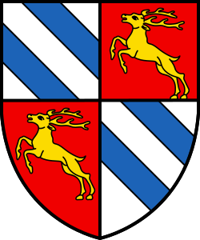
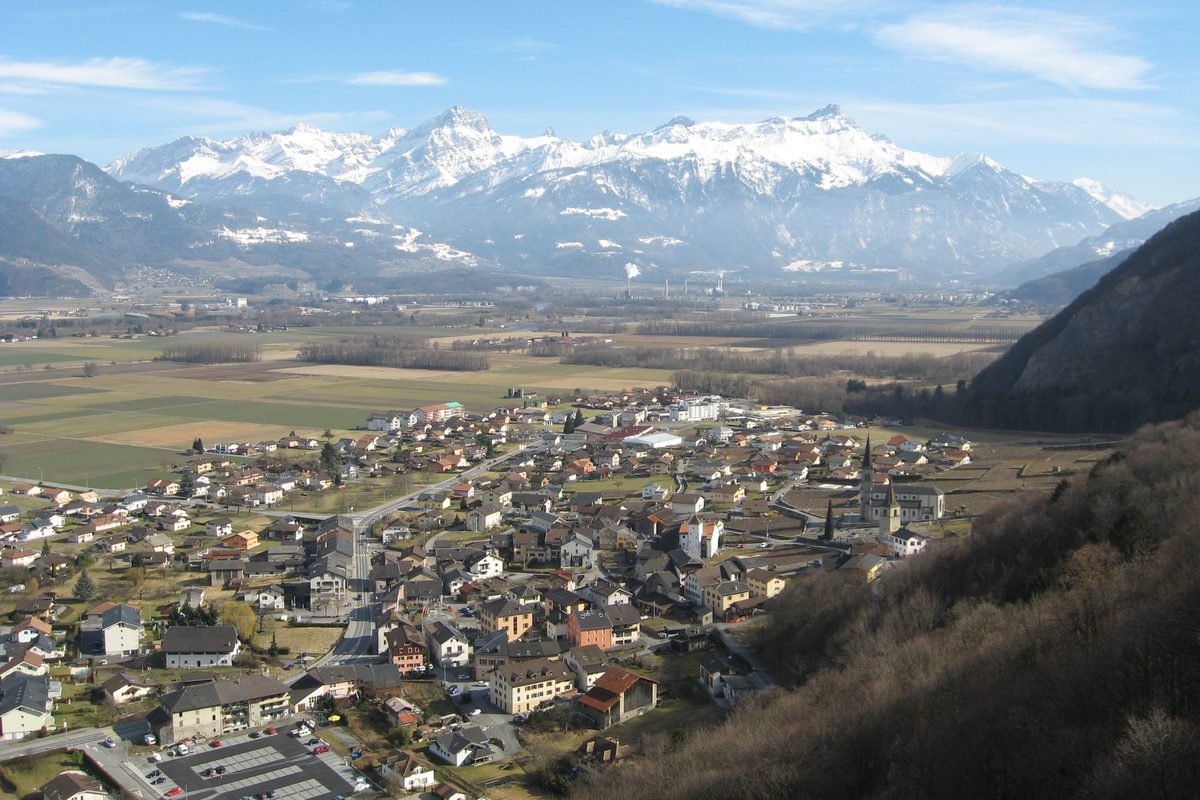
Vionnaz
Origin of the name Vionnaz
The first known form is « Viona », in 1282. In German the village was once called « Vienen ». Where does the name come from? That is still unknown.[1]
Founding of Vionnaz
Nobody knows who founded Vionnaz. The plain village was built on the alluvial cone of the Greffaz, in an area frequented since the Mesolithic, where the remains of a 2nd-century Roman villa have been found. At the beginning of the 11th century Vionnaz, Revereulaz and Torgon formed a lordship of the priory of Lutry, itself a dependency of the abbey of Savigny-en-Lyonnais. Count Amadeus V of Savoy, its sovereign, later granted the village a charter of franchises. After the Upper Valais occupation and the death of the last lord, the lordship was united with the governorship of Monthey. The municipality also includes the mountain villages of Mayen, Revereulaz and Torgon.[1]
History of Vionnaz
9500-7000 BC. A Mesolithic rock shelter yields microliths.[1]
2nd century. A Roman villa is built in the area.[1]
1025. Vionnaz, Revereulaz and Torgon form a lordship of the priory of Lutry, a dependency of the abbey of Savigny-en-Lyonnais.[1]
1140. Vionnaz is listed among the possessions of Savigny; a chapel exists there.[1]
1282. First attestation of the name, as « Viona ». Vionnaz already forms a parish under the priory of Lutry.[1]
1293. Count Amadeus V of Savoy grants Vionnaz a charter of franchises.[1]
1536. The Upper Valais occupy the territory of Monthey.[1]
1552. The Diet unites the lordship with the governorship of Monthey and takes over the right of collation of the parish.[1]
1585. A second church replaces the chapel. Its bell tower dates from 1581.[1]
1613. The Barberini family, which often provides the castellan, has a fortified house built, the castle of Vionnaz.[1]
1659. Work on the Stockalper canal, planned as a waterway, is suspended.[1]
1742. The Diet finances a large protective wall against the Greffaz, about 200 m long.
1798. Vionnaz forms a municipality with Revereulaz and Torgon.[1]
1800. The village burns down.[1]
1903. Consecration of the neo-Gothic church.[1]
1907. The Grand Council gives up the right of collation in favour of the bishop of Sion.[1]
1960. Foundation of Télé-Torgon SA, which develops the resort from 1970 at La Jorette.[1]
1994. Protection of a 14-hectare peat bog.[1]
2012. A suspension bridge links the village of Torgon with the La Jorette district.[1]
Population of Vionnaz
Sources and references: [1][2]
| 1850 | 776 |
| 1900 | 800 |
| 1950 | 768 |
| 2000 | 1'562 |
| 2025 | 3'079 |
Historic sites in Vionnaz
Church of Vionnaz. Neo-Gothic church consecrated in 1903 and restored in the 1960s. It succeeds a church of 1585, whose bell tower dated from 1581, itself the successor of the chapel mentioned in 1140.[1]
Castle of Vionnaz. Fortified house built in 1613 by the Barberini family, which often provided the castellan of the lordship.[1]
Torgon. Mountain village of the municipality, which became a resort from the late 1950s and was developed from 1970 at La Jorette. It is part of the Portes du Soleil ski area.[1]
Stockalper canal. Canal planned as a waterway, work on which was suspended in 1659. It now serves as a drainage canal.[1]
Remains in Vionnaz
Mesolithic rock shelter. Shelter occupied in the Mesolithic (9500-7000 BC), which has yielded microliths.[1]
Roman villa. Remains of a villa from the 2nd century AD.[1]
Greffaz wall. Large protective wall about 200 m long and up to 4 m wide, financed by the Diet in 1742 against the floods of the Greffaz torrent.
Sources
- Dictionnaire historique de la Suisse, « Vionnaz » (David Rey, version de 2012, remanié le 07.08.2013)
- Office fédéral de la statistique (OFS), STATPOP, chiffres provisoires au 31.12.2025, via citypopulation.de
- geo.admin.ch, recherche de lieux (coordonnées)
Localities of the municipality with a page
Other villages near Vionnaz
Missing information, or do you have a source? Suggest a correction or addition. Every submission is checked before it's published.
Suggest a change