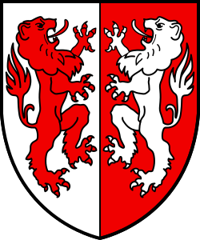
Visp
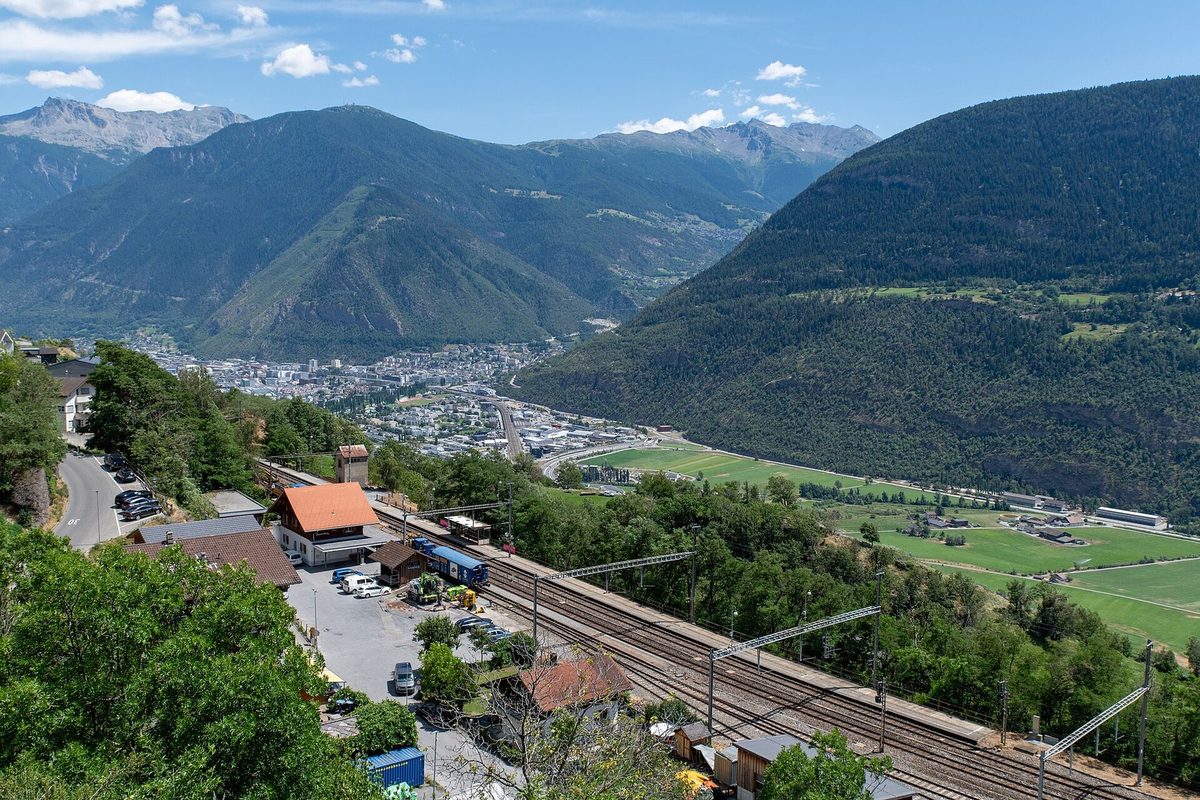
Origin of the name Visp
Early forms are « Vesbia » (1034), « Vispach » (12th century) and « Visp » (1272). The French name is Viège, the former Italian name « Vespia ». The form « Vispach » is said to be a folk etymology, and the origin of the name remains uncertain. In Upper Valais dialect the town is reportedly called « Fischp ».[1]
Founding of Visp
Visp grew up on the left of the Rhône, at the entrance to the Visp valley. The site was frequented long before the Middle Ages: finds include an Iron Age vase, a La Tène brooch, a Celtic statue of the god Sucellus, Roman silver coins and a grave. After 999 the Bishop of Sion installed hereditary vidames and mayors there, who also held high justice and sat in the mayors' tower (12th-13th century). The counts of Visp, probably based at the Hübschburg, held the mayoralty before it passed to Italian nobles. Visp was a great parish from the 11th century, for the surroundings and both Visp valleys. A market place and a stage on the route over the Antrona Pass and the Monte Moro, the town then became, from the 16th century to 1798, the centre of the Visp dizain. Its burgher community still exists at the start of the 21st century.[1][2]
History of Visp
after 999. The Bishop of Sion appoints hereditary vidames and mayors, who also hold high justice.[1]
1034. Recorded as « Vesbia ».[1]
1220. First mention of the church of Our Lady on the Gräfibiel, today the Three Kings or burgher church.[1]
1248. First mention of Visp as a municipality. The mayoralty passes by marriage to the counts of Blandrate.[1]
1260. Peter vom Turn, a supporter of Savoy, destroys the village, the church of Our Lady and the Hübschburg.[1]
1267. A contract, followed by others in 1291, 1298 and 1300, shows Visp as a market place and a stage towards the Antrona Pass and the Monte Moro.[1]
1365. After the murder of Isabella Blandrate, the mayoralty passes to the family of her husband François de Compey, then in 1378 to the de Platea.[1]
1388. With the people of Upper Valais, the inhabitants of Visp defeat Count Rudolf IV of Gruyère, sent to conquer the Valais for Amadeus VII of Savoy. The victory is celebrated every December with the « Mannenmittwoch ».[1]
around 1400. The mayoralty is turned into a castellany. Saas separates from the parish of Visp.[1]
1489. Oldest surviving burgher statutes, followed by many others up to the 20th century.[1]
1543. Two consuls head the administration.[1]
1650-1655. The church of St Martin is rebuilt in Baroque style.[1][3]
1799. The Upper Valais people try in vain to stop the French troops at Visp.[1]
1855. An earthquake damages many buildings and destroys the lantern of the St Martin's tower. The population lives for a time in tents outside the village.[1]
1863-1894. First correction of the Rhône.[1]
1876. The railway arrives from Leuk and is extended to Brig in 1878. The Visp-Zermatt line (1891) ends the town's boom in inns and hotels.[1]
1907. Lonza begins producing calcium carbide and builds the Ackersand I power station: the start of industrialisation.[1]
1972. The former municipality of Eyholz is incorporated.[1]
2007. Opening of the Lötschberg Base Tunnel and of a new station. Visp partly replaces Brig as a transport hub.[1]
2025. On 13 February the Grand Council adopts the law merging Baltschieder, Eggerberg and Visp, taking effect on 1 January 2027.[2]
Population of Visp
Sources and references: [1][4]
| 1798 | 412 inhabitants |
| 1802 | 359 inhabitants |
| 1850 | 529 inhabitants |
| 1900 | 934 inhabitants |
| 1950 | 2'727 inhabitants |
| 2000 | 6'550 inhabitants |
| 2025 | 9'069 inhabitants |
Historic sites in Visp
Church of St Martin. Mother church of the great parish, mentioned in the 13th century but older. Rebuilt in Baroque style in 1650-1655, damaged by the 1855 earthquake and remodelled in 1953.[1]
Three Kings church (burgher church). Former church of Our Lady on the Gräfibiel, mentioned from 1220, with an 11th-century crypt. Rebuilt after 1260, its choir was baroquised and its tower raised in 1710-1730.[1][3]
Mayors' tower (Meierturm). Tower of the 12th-13th century, seat of the vidames and mayors. It is also called the Lochmatter tower.[1][3]
La Poste cultural and congress centre. Cultural and congress centre opened in 1991.[1]
Visp station. Served since 1876, starting point of the line to Zermatt since 1891, with a new station when the Lötschberg Base Tunnel opened in 2007.[1]
Remains in Visp
Archaeological finds. Iron Age vase, La Tène brooch, Celtic statue of the god Sucellus, Roman silver coins and a grave. A copy of the statue reportedly adorns a fountain on the station square.[1]
Hübschburg. Castle probably occupied by the counts of Visp, destroyed in 1260 by Peter vom Turn.[1]
Sources
- Historisches Lexikon der Schweiz, « Visp (Gemeinde) » (Alois Grichting, version du 06.08.2013)
- Grand Conseil du Valais, « Gesetz über die Fusion der Einwohnergemeinden Baltschieder, Eggerberg und Visp » (13.02.2025)
- Office fédéral de la culture, ISOS, « Visp » (Gemeinde Visp, 2e version, septembre 1996)
- Office fédéral de la statistique (OFS), STATPOP, chiffres provisoires au 31.12.2025, via citypopulation.de
- geo.admin.ch, recherche de lieux (coordonnées)
Other villages near Visp
Missing information, or do you have a source? Suggest a correction or addition. Every submission is checked before it's published.
Suggest a change