Vucherens
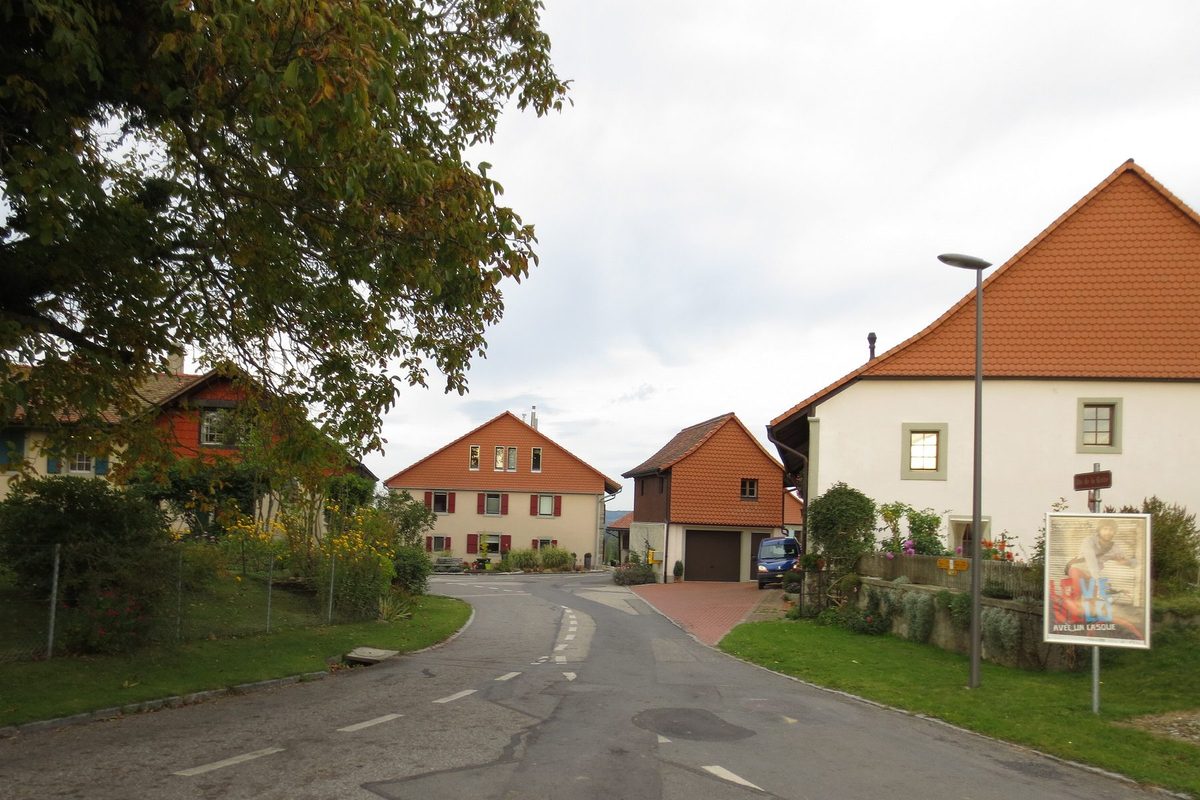
Farming village of the Jorat, between the valleys of the Flon de Carouge and the Bressonnaz, mentioned since 1224, with its church of 1737 dedicated to Saint Peter and Saint Pancras.
Entry based on 8 sources · Our method · Reusable text (CC BY-SA)
Origin of the name Vucherens
First mentioned in 1224 as «Wicherens». The name is said to derive from a Burgundian personal name, Wisihar, with the Germanic suffix -ingōs, meaning «among Wisihar's people». In Vaud patois the village is reportedly called «Vutsèrin», a form not yet confirmed.[3]
Coat of arms of Vucherens
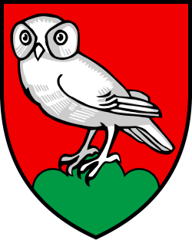
Gules, an owl argent on a mount of three hillocks vert. On a red field, a white owl stands on a green hill with three peaks. The owl recalls the many owls of the Biolley wood. The three peaks stand for the municipality's three hamlets: La Râpe, le Village and le Closy.[6][7]
Founding of Vucherens
Who founded Vucherens remains unknown. Its name, formed from a Germanic personal name followed by the suffix -ingōs, may point to an early medieval settlement around the estate of a certain Wisihar, though this is not confirmed. The municipality groups several hamlets and isolated farms (La Râpe, Le Closy, Sarandin) between the valleys of the Flon de Carouge and the Bressonnaz. In the Middle Ages local families held property there, such as Giroldus de Syens at Sarandin in 1280.
History of Vucherens
1224. First written mention, as «Wicherens».
1280. Giroldus de Syens holds property at Sarandin.
1300. Jean de Vucherens is mentioned as owner of the tower of Saint-Martin-du-Chêne.
1358. Vucherens belongs to a Savoyard castellany, possibly that of Moudon, though this is not confirmed.
1523. A chapel is mentioned; Vucherens then belongs to the parish of Syens, with Hermenches and Rossenges.
1536-1798. Bernese period: Vucherens belongs to the bailiwick of Moudon.
1737. Construction of the present church, dedicated to Saint Peter and Saint Pancras, on the ridge above the village.[2]
18th century. From the early 18th century until around 1900, tufa quarries are worked.
1798. Vucherens is attached to the district of Moudon, until the end of 2007.
1902-1962. The village is served by the Lausanne-Moudon tramway.
2000. The municipality joins the Reformed parish of the Jorat, centred on Mézières.[2]
2005. The primary sector still provides almost 25% of jobs. The municipality gradually becomes residential.
2008. On 1 January, with the new Vaud districts, Vucherens joins the district of Broye-Vully.[5]
Population of Vucherens
Sources and references: [4]
| 1550 | 18 hearths (households) |
| 1764 | 245 inhabitants |
| 1850 | 458 inhabitants |
| 1900 | 379 inhabitants |
| 1950 | 289 inhabitants |
| 2000 | 444 inhabitants |
| 2025 | 634 inhabitants |
Families of Vucherens
Citizen families before 1800. Cavin, Cherpillod, Deytard, Gavillet, Jaquier, Porchet and Vuagniaux, all with no precise date.[8]
From 1901 to 1962. Twelve entries, seven of them families from Germany: the Faust in 1918, the Dressel and the Léwy in 1922, the Spee in 1924, the Fünfgeld in 1925, the Schwebel in 1952 and the Langhans in 1961, the last to be entered. To these were added the Welsch from Belgium (1945), the Lorini from Italy (1948), the Wypart from Poland (1954), then in 1958 the Burgi of Bäretswil ZH and the Grosjean of Saules BE.[8]
Economy of Vucherens, past and present
Tufa. According to the FAO, Vucherens has 450 inhabitants in 1850, at the time when tufa is quarried. In 1962, the year the Lausanne-Moudon tramway closes, the population falls to 226, its lowest level in 150 years.[7]
The Trois Suisses inn. The Trois Suisses restaurant has a sign listed as a historic monument by the canton.[7]
Historic sites in Vucherens
Church of Saint-Pierre-et-Saint-Pancrace. Built in 1737 on the ridge above the village, replacing a chapel mentioned in 1523. Long a dependency of the parish of Syens, it was reportedly restored in 1897, 1923-1924 and 1957 (dates uncertain).
Hamlets of La Râpe, Le Closy and Sarandin. Scattered hamlets and farms that make up the municipality. Sarandin is recorded in the 13th century, when Giroldus de Syens held property there (1280).
Old farmhouses. Some characteristic farmhouses from the 17th to the 19th century reportedly survive.
Remains in Vucherens
Former tufa quarries. Tufa, a light limestone, was extracted on the municipal territory from the early 18th century until around 1900.
Traditions and festivals in Vucherens
The Sentinelle du Biolley abbaye. Since 1945 the Sentinelle du Biolley abbaye has livened up the village. Every three years it brings the population together for its village festival. Its 75th anniversary festival, planned for 2020, was postponed to 2021 because of COVID.[7]
Sources
- Dictionnaire historique de la Suisse, « Vucherens »
- Commune de Vucherens, « À voir, à faire » (la chapelle)
- Henry Suter, « Noms de lieux de Suisse romande, Savoie et environs », lettre V
- Statistique Vaud, « Population résidante permanente au 31 décembre 2025 »
- État de Vaud, communiqué du 12.07.2007, « Organisation des préfectures et adaptation au nouveau découpage territorial »
- IPI, Swissreg, emblems database: coat of arms of Vucherens (no. 101748)
- Official Gazette of the Canton of Vaud (FAO), "Alphabet des communes vaudoises: Vucherens"
- Register of Swiss Surnames, 3rd edition (1989), search Commune "Vucherens", Canton VD
Published by Sébastien Jörg ·
Other villages near Vucherens
Missing information, or do you have a source? Suggest a correction or addition. Every submission is checked before it's published.
Suggest a change