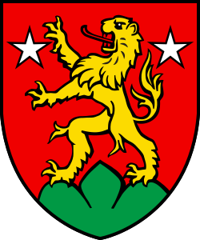
Zermatt
Origin of the name Zermatt
Early forms are « Pratobornum » (1280) and « Zer Matt » (1495). The former French name is Praborgne. The form « ze Made » is also cited for 1435, and « zer Matt » reportedly means « at the meadow », but neither point is confirmed.
Founding of Zermatt
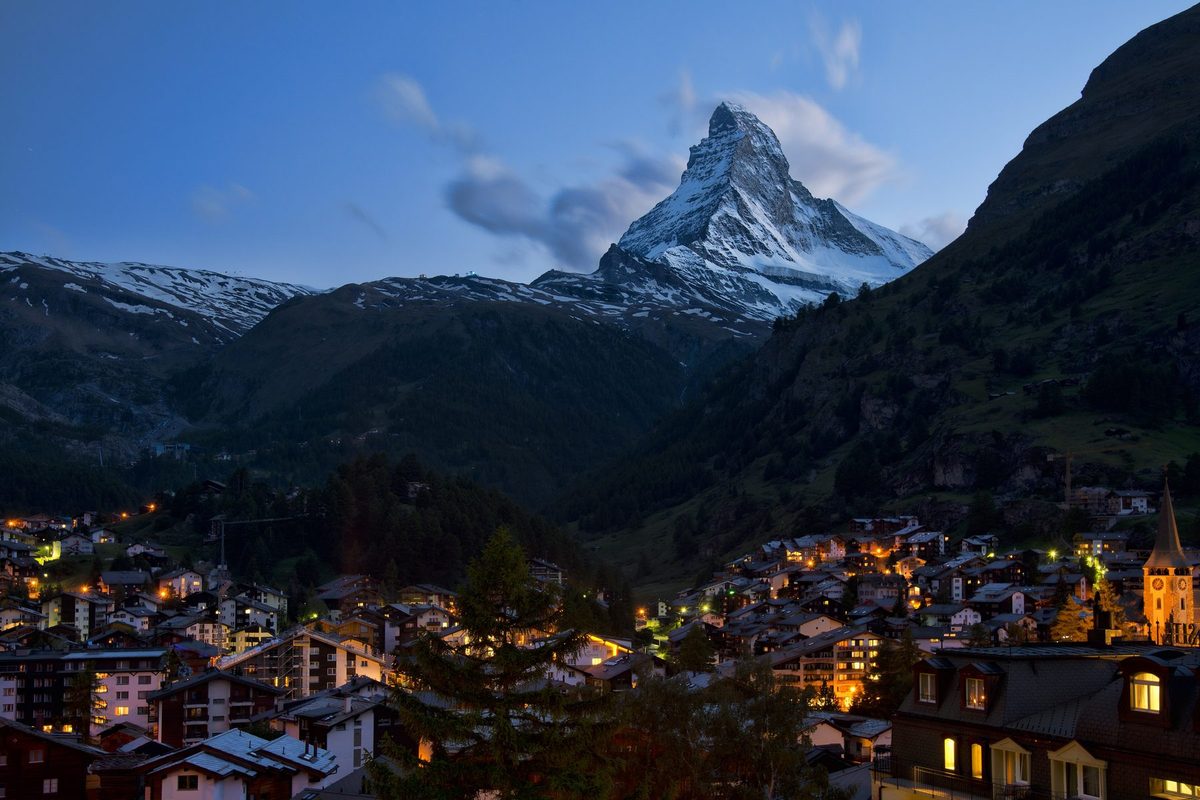
Zermatt is the southernmost municipality of the Mattertal, at the northern foot of the Matterhorn (Cervin). The place has been frequented for a very long time: a rock shelter on the Hermetje alp has yielded Mesolithic and Neolithic traces, and Roman coins found on the Theodul Pass show that the crossing was used in Antiquity. Before the year 1000, immigrant Alemanni met the Romanised Celtic population, so that place names are, with few exceptions, of German origin. The Bishop of Sion became lord of the land. After him the Counts of Savoy and several noble families held rights there, later acquired by patrician families from Visp. The inhabitants in turn bought themselves free and formed three municipalities with free jurisdiction. Under the Ancien Régime, Zermatt formed one of the quarters of the dizain of Visp together with the majorie of St. Niklaus; its church was a daughter church of the parish of St. Niklaus.
History of Zermatt
from 9000 BC. Mesolithic, then Neolithic (5500-2200 BC) traces in a rock shelter on the Hermetje alp.
380-120 BC. Iron Age workshop where vessels were hollowed out of soapstone, uncovered at Furi in the 1990s.
Antiquity. Roman coins found on the Theodul Pass attest the use of the crossing.
999. The Bishop of Sion becomes lord of the land and has the valley administered by a vidomne.
before 1249. The Counts of Savoy exercise seigneurial rights, followed by the de la Tour, Raron, Asperlin and Blandrate families.
1280. Mention as « Pratobornum ». Zermatt, a daughter of the parish of St. Niklaus, already has its own priest.
1476. The heads of the 182 families divide the community into four quarters: Hoffero, Wychilmattero, Aroleitero and Muttero.
1495. Mention as « Zer Matt ».
1538. First buy-out of seigneurial rights from the sons of the governor Johannes von Werra. The freed families adopt statutes in 1540.
1546. The daughter church buys itself free from the tithe on large and young livestock owed to the mother church.
1562. Buy-out from Johann Perrini, son of the vidomne of Leuk.
1579. The statutes, revised in 1576, are raised to a Bauernzunft (rules of the farming community).
1618. Buy-out from Franz de Platea, banneret of Sierre. From 1621 three municipalities with free jurisdiction share a common major.
1666. The people of Zermatt buy themselves free from the annual pilgrimage to Sion over the Col d'Hérens.
1791. The four quarters merge into a single municipality.
1838. The first small inn opens, followed by the Hotel Mont Cervin in 1852.
1853. Alexander Seiler, who arrived in 1850, begins building his hotel empire. The mountain guides' association is founded in 1858.
1865. On 14 July, first ascent of the Matterhorn by the north-east ridge, after a race with a party coming from Italy: Edward Whymper, Francis Douglas, Robert Hadow and Charles Hudson, led by Michel Croz of Chamonix and by Peter Taugwalder of Zermatt and his son, reach the summit. The descent claims four victims and leads to a judicial inquiry.
1891. The Visp-Zermatt railway (today the Matterhorn-Gotthard-Bahn) reaches the village.
1898. The Zermatt-Gornergrat rack railway opens.
1916. The new church of Saint Maurice is consecrated, replacing the 16th-century church demolished in 1913.
1928. The line from Visp is electrified and winter operation begins, making Zermatt attractive in winter too.
1931. The brothers Franz and Toni Schmid, from Munich, conquer the north face of the Matterhorn.
1979. The cable car to the Klein Matterhorn opens.
2011. Zermatt records 1'875'737 overnight stays, with more than 29'000 guest beds counted in 2010.
Population of Zermatt
Sources and references: [5]
| 1802 | 436 inhabitants |
| 1850 | 369 inhabitants |
| 1900 | 741 inhabitants |
| 1950 | 1'395 inhabitants |
| 2000 | 5'988 inhabitants |
| 2025 | 6'112 inhabitants |
Historic sites in Zermatt
Matterhorn (Cervin). 4'478 m peak at whose foot Zermatt lies, called Monte Cervino in Italian. Its first ascent, on 14 July 1865, ended with the death of four members of the party. Having become a national symbol in the 20th century, it made Zermatt one of the most famous tourist places in Switzerland.
Church of Saint Maurice. Parish church consecrated in 1916 and renovated in 1980, which replaced the 16th-century church demolished in 1913.
Hamlets and chapels. Zmutt, Zum See and Furi to the south, Findeln to the south-east and Ried to the north have remained separate from the resort. The hamlet chapels partly preserve old altars.
Theodul Pass. Crossing to Italy used since Antiquity, as shown by Roman coins found on the pass and by late medieval coins and weapons discovered at the glacier edge near the Trockener Steg.
Gornergrat railway. Rack railway opened in 1898 between Zermatt and the Gornergrat.
Matterhorn Museum. Underground museum « Zermatlantis », opened in 2006 on the church square under the glass roof of the former casino, with original houses and interiors and recreations of old Zermatt.[3][4]
Remains in Zermatt
Hermetje rock shelter. Excavations that yielded traces from the Mesolithic (from 9000 BC) and the Neolithic (5500-2200 BC).
Cup-marked stones of the Hubelwäng. Five cup-marked stones at the foot of the Unter Gabelhorn, along the old trade route, evidence of early settlement.
Soapstone workshops. La Tène workshop where vessels were hollowed out of chlorite schist, discovered in the 1880s during construction of the Hotel Monte Rosa, and a similar Late Iron Age workshop (380-120 BC) uncovered at Furi in the 1990s.
Sources
- Historisches Lexikon der Schweiz, « Zermatt » (Bernard Truffer, version du 13.02.2014)
- Dictionnaire historique de la Suisse, « Cervin » (Alma Treyer, version du 29.01.2007)
- Association des musées suisses (museums.ch), « Matterhorn Museum - Zermatlantis »
- Zermatt Tourismus (zermatt.swiss), « Matterhorn Museum - Zermatlantis »
- Office fédéral de la statistique (OFS), STATPOP, chiffres provisoires au 31.12.2025, via citypopulation.de
- geo.admin.ch, recherche de lieux (coordonnées de Zermatt)
Localities of the municipality with a page
Other villages near Zermatt
Missing information, or do you have a source? Suggest a correction or addition. Every submission is checked before it's published.
Suggest a change