Bevaix
A Cluniac priory founded in 998 on Lake Neuchâtel, on shores where twelve Neolithic and Bronze Age sites have been counted.
Entry based on 10 sources · Our method · Reusable text (CC BY-SA)
Origin of the name Bevaix
The place is mentioned in 998 in the Latin form « in villa Bevacensi », when the priory was founded. A form « Betuaci » is reported in 1139. What « Bevaix » means is still not known.[1]
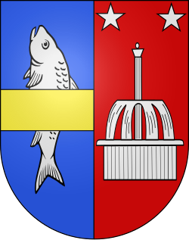
Coat of arms of Bevaix
Per pale, azure a fish palewise argent overall a fess Or, and gules a fountain with five spouts argent, in chief two mullets of the same. On the left a white fish stands upright on blue, crossed by a yellow horizontal band. On the right, a white fountain with five spouts and two white stars sits on red. These are the arms of the former municipality of Bevaix.[9]
Founding of Bevaix
Bevaix did not arise from a single act of foundation. The site was inhabited long before: twelve Neolithic and Bronze Age sites have been counted along the lake shore. The village enters written history in 998 with the founding of the Cluniac priory. The donation is attributed to a lord named Rodolphe, who is said to have given land and vineyards. Monks from Payerne reportedly settled there under Abbot Odilo of Cluny. On the priory's small territory a lordship developed whose extent matched that of the former municipality. The village, grouped in front of a small marshy plateau, is mentioned from the time of this foundation.[1]
History of Bevaix
Neolithic and Bronze Age. Settlement of the lake shore: twelve Neolithic and Bronze Age sites are counted along the shore in the territory of Bevaix. The site of Bevaix-L'Abbaye 2 is one of the 56 Swiss lakeside settlements on the UNESCO World Heritage list (« Prehistoric Pile Dwellings around the Alps »).[1]
1053-878 BC. Occupation, dated by the dendrochronology of eleven oak piles, of the Late Bronze Age lakeside village of Bevaix-L'Abbaye 2, now submerged 180 metres from the shore. Nearly 400 objects were collected there at the end of the 19th century.[7]
Bronze Age / early Iron Age. A Bronze Age menhir stands at the foot of the mountain. Other standing stones are reported: north of La Loge, a group of menhirs whose central stone bears at its top tool marks depicting a human face, and the Neolithic Vauroux menhir, a cultural property of regional importance.[1][8]
Late Bronze Age. A necropolis of the Urnfield culture is established west of the village.[1]
Roman period. The bay of Bevaix has yielded dugout canoes and boats that have shed light on shipbuilding techniques in Gallo-Roman times. A paved path along the lake, the « vy d'Étra », reportedly dates from this period.[1]
Burgundian period. Walled graves on three levels are built at Le Châtelard. They were destroyed when this mound was lowered.[1]
998. Founding of the Cluniac priory of Bevaix. The place is mentioned in the form « in villa Bevacensi ». The donation is attributed to a lord named Rodolphe, and monks from Payerne reportedly settled there under Abbot Odilo of Cluny.[1]
1139. The place is mentioned in the form « Betuaci ».[1]
around 1263. The lordship of Bevaix belongs jointly to the lords of Gorgier, the lords of Colombier and the prior. In 1263 an agreement between these advocates sets the rights of the inhabitants. The count of Neuchâtel holds the wardship, the right of banner and the execution of capital sentences, and Bevaix follows the customary law of Neuchâtel.[1]
1362. First mention of the mairie of Bevaix: civil justice is administered there by a mayor (maire), with appeal to the three advocates and then to the count of Neuchâtel.[1]
late 15th century. The inhabitants organise themselves and manage to acquire some properties from the prior (woods, meadows, waste land). In the early 16th century they try without success to issue their own regulations and to free themselves from the heaviest fines.[1]
1531. The village adopts the Protestant Reformation, which reportedly led to the abandonment of the priory.
1541-1545. After the Reformation, the lordship of Bevaix passes to Jean-Jacques de Watteville, lord of Colombier (partly in 1541, partly in 1545).[1]
1564. The lordship of Bevaix passes to the counts of Neuchâtel.[1]
1605. As the sanctuary near the monastery was falling into ruin, a new church, completed in 1605, replaces it in the centre of the village.[1]
1722. Frédéric Chambrier has the château of Bevaix built as a country residence, thanks to the property of his wife Esther Jeanjaquet. The construction date is reportedly engraved beneath the building's pediment.
1746-1747. Construction of the Maison Chambrier; date uncertain.
18th century. A violent conflict over the use of the woods sets the commune's burghers against the non-burgher inhabitants.[1]
early 19th century. Bevaix sides resolutely with the republican cause. The calico (indienne) factories of the lower Areuse attract many people from Bevaix, but the village remains agricultural.[1]
1832. The mairie (local court) of Bevaix is abolished in favour of Boudry, which already exercised criminal justice.[1]
1859-1860. Bevaix station is opened on the Jura foothills line. Together with the growth of road transport, it makes Bevaix an increasingly residential place. Local industry is mainly in microtechnology.[1]
around 1900. Drainage works change the landscape. They are followed by land consolidations in 1941-1945 and 1960.[1]
1960s. A three-lane bypass road is built around the village; date uncertain.
2002. The commune's drinking water resources reportedly attract the interest of the Nestlé group.
2006. The extension of the A5 motorway towards Neuchâtel connects Bevaix to the Swiss motorway network, with two exits (Bevaix-Est and Bevaix-Ouest/Boudry); date uncertain.
1 January 2018. Bevaix merges with Saint-Aubin-Sauges, Gorgier, Vaumarcus, Montalchez and Fresens to form the new municipality of La Grande Béroche, of which it becomes a locality.[1]
Population of Bevaix
Sources and references: [1]
| 1559 | 36 hearths (households) |
| 1750 | 431 |
| 1850 | 740 |
| 1900 | 1'074 |
| 1950 | 1'217 |
| 1960 | 1'407 (unconfirmed) |
| 1970 | 1'945 |
| 1980 | 2'601 (unconfirmed) |
| 1990 | 3'375 (unconfirmed) |
| 2000 | 3'603 |
| 2010 | 3'837 |
| 2017 | 3'784 |
Families of Bevaix
Citizen families before 1800. Barret, Bon, de Chambrier, Gottreux, Mauley, Mellier, Monin, Ribaux and Tinembart, with no precise date.[10]
In the 19th century. The Olivier family and the Gautschi family from Reinach AG, with no precise date. Five Bernese families are registered in 1889: the Gaschen family from Ins, the Gygi family from Kappelen, the Niederhauser family from Rüderswil, the Straubhaar family from Niederstocken and the Weber family from Jens. The Bucher family from Kallnach BE follows in 1890 and the Jolybournot family from France in 1900.[10]
From 1901 to 1962. Twenty-nine registrations. The Lauber family from Adelboden BE appears with no precise date. Families from Vaud are numerous: Senaud from Avenches (1902), Cavin from Vulliens and Paris from Concise (1906), Fardel from Mutrux, Fauguel from Concise and Grandjean from Bellerive (1907), Jeanmonod from Provence (1910), Bridel from Donneloye (1911), Perdrizat from Onnens (1926) and Gilliéron from Servion (1945). The canton of Bern provides six: Jampen from Müntschemier (1901), Walther from Wohlen bei Bern (1903), Zwahlen from Rüschegg (1905), Brunner from Uetendorf (1906), Steiner from Signau (1924) and Dällenbach from Otterbach (1932). Others come from France (Rousselot in 1901, Bromberger in 1931, Comtesse in 1939), Germany (Ritty in 1904, Ehresmann in 1917), Ticino (Borioli from Lugano in 1906, Bernasconi from Vezia in 1929) or Italy (Moerlini in 1953). They are joined by the Maeder family from Agriswil FR (1909) and the Peynirian family (1948). The last registration, in 1961, covers the Seletto family from Italy and the Sjögren family from Sweden.[10]
Economy of Bevaix, past and present
A farming village. For a long time Bevaix lived off the land. In the early 19th century many inhabitants worked in the printed calico (indiennes) factories of the lower Areuse, but the village remained agricultural. Around 1900, drainage works reshaped the countryside. Land consolidations followed in 1941-1945 and in 1960.[1]
Homes and microtechnology. The railway station, opened in 1859-1860, and then the growth of road transport made Bevaix an increasingly residential place. Local industry works mainly in microtechnology.[1]
Historic sites in Bevaix
Château of Bevaix. Baroque country residence built in 1722 by Frédéric Chambrier thanks to the property of his wife Esther Jeanjaquet. The construction date is reportedly engraved beneath the building's pediment.
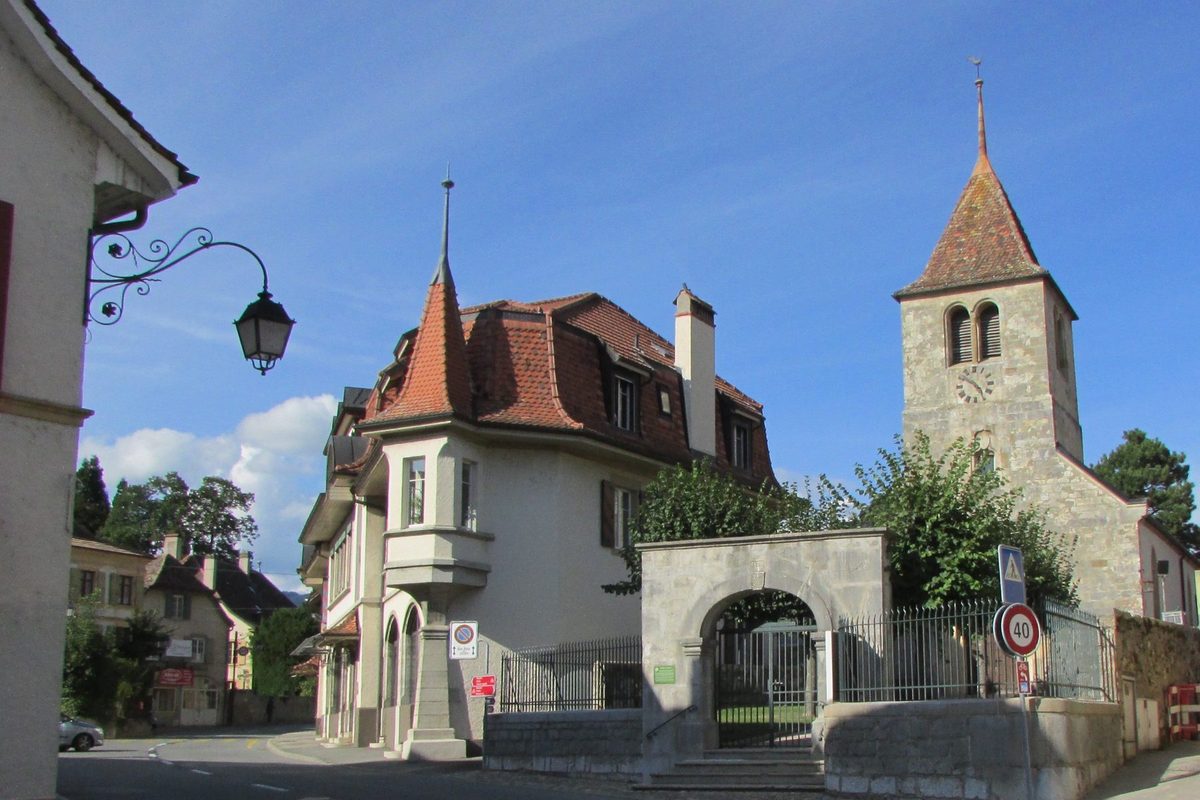
Temple of Bevaix (Reformed church). Church completed in 1605 in the centre of the village to replace the old sanctuary near the monastery, which was falling into ruin.[1]
Maison Chambrier. Building constructed in 1746-1747 in the historic village at the foot of the Jura. It is reportedly linked to the same family as the château.
Lake shore and vineyards. The part of the territory close to Lake Neuchâtel is occupied by sloping vineyards and the village's marina, separated from the historic centre by a former marshy area now used for farming.
La Vy d'Étra. Old paved path along the lake, attributed to the Roman period by local documentation.
Remains in Bevaix
Prehistoric lakeside settlements. Twelve Neolithic and Bronze Age sites have been counted along the shore in the territory of Bevaix, including L'Abbaye 2 and Treytel. Bevaix-L'Abbaye 2 is one of the 56 Swiss lakeside settlements on the UNESCO World Heritage list as « Prehistoric Pile Dwellings around the Alps ».[1]
Late Bronze Age lakeside village (L'Abbaye 2). Occupied between 1053 and 878 BC according to the dendrochronology of eleven oak piles, this pile-dwelling village, now submerged 180 metres from the shore, yielded nearly 400 objects collected at the end of the 19th century. It has been a UNESCO World Heritage site since 2011.[7]
Menhirs. A Bronze Age menhir was found at the foot of the mountain. Also reported are, north of La Loge, a group of menhirs whose central stone bears at its top tool marks depicting a human face, and the Neolithic Vauroux menhir, a cultural property of regional importance.[1][8]
Urnfield necropolis. A necropolis of the Urnfield culture (Late Bronze Age) has been uncovered west of the village.[1]
Gallo-Roman remains. The bay of Bevaix has yielded dugout canoes and boats that have shed light on shipbuilding techniques in Gallo-Roman times. A Roman remain is reported at the place called Plan Jacot. The paved path of the vy d'Étra along the lake reportedly dates from the Roman period as well.[1]
Burgundian graves. Walled graves on three levels from the Burgundian period were destroyed when Le Châtelard was lowered.[1]
Protected heritage in Bevaix
Cultural property of national significance (A objects in the PCP inventory)[8]
- L'Abbaye 2 (CH-NE-04), site du patrimoine mondial de l’UNESCO «Sites palafittiques préhistoriques autour des Alpes»
- Treytel-A Sugiez, zone funéraire et cultuelle néolithique
Cultural property of regional significance (B objects)[8]
- Château
- Prieuré
- Temple
- Vauroux, menhir néolithique
Sources
- Dictionnaire historique de la Suisse, « Bevaix (commune) » (Germain Hausmann)
- Documentation historique du site de Treytel (PDF)
- Site officiel de la commune de La Grande Béroche
- Fritz Chabloz, La Béroche : recherches historiques sur la paroisse de Saint-Aubin (1867), via Google Books
- UNESCO, Sites palafittiques préhistoriques autour des Alpes
- Office fédéral de la statistique, portraits régionaux des communes
- Dictionnaire historique de la Suisse, « Bevaix - L'Abbaye 2 » (Sonia Wüthrich)
- Office fédéral de la protection de la population, Inventaire PBC, liste cantonale de Neuchâtel (état au 1.1.2026)
- IPI, Swissreg, emblems database: coat of arms of Bevaix (no. 102906)
- Register of Swiss Surnames, 3rd edition (1989), search Commune "Bevaix", Canton NE
Published by Sébastien Jörg ·
Other villages near Bevaix
Missing information, or do you have a source? Suggest a correction or addition. Every submission is checked before it's published.
Suggest a change