Bioley-Magnoux
On 4 and 5 June 1476, marching on Morat, Charles the Bold stayed at Bioley castle, which the Confederates had occupied the year before.
Entry based on 15 sources · Our method · Reusable text (CC BY-SA)
Origin of the name Bioley-Magnoux
The village is mentioned in 1228 as «Biolai». Where the name «Bioley» and the addition «Magnoux» come from is not known.[1]
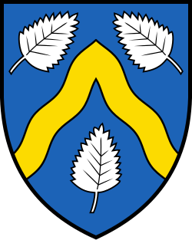
Coat of arms of Bioley-Magnoux
Azure, a chevron wavy or between three birch leaves argent. On a blue field rises a yellow chevron with wavy edges, shaped like a roof. Three white birch leaves surround it, two above and one below.[9]
Founding of Bioley-Magnoux
An Early Medieval cemetery was found at the place called Montelier. Around 1225, when the lordship of Saint-Martin-du-Chêne was divided, Bioley broke away with Gossens, Oppens, Orzens, Correvon and Ogens to form a lordship of its own, given to Guillaume de Bioley. The castle protected a small fortified town, mentioned until 1403. The lordship then passed to the Corbières, then to the Goumoëns and to various families from Fribourg and Neuchâtel, before being wound up between 1791 and 1804. Who founded Bioley-Magnoux remains unknown.[1][2]
History of Bioley-Magnoux
Early Middle Ages. A necropolis is laid out at Montelier.[1]
around 1225. Bioley becomes the centre of a lordship separated from Saint-Martin-du-Chêne, with Gossens, Oppens, Orzens, Correvon and Ogens, for Guillaume de Bioley.[1][2]
1228. First mention of the village, «Biolai».[1]
1244. First mention of the castle: on 2 February Guillaume de Bioley pledges his domain to Peter of Savoy, probably to finance the castle.[1][2][3]
1311. The lordship passes to the Corbières, brought as a dowry by Perrette de Bioley to Guillaume de Corbière.[1][2][3]
1359. The Goumoëns become lords of Bioley.[1][2][3]
1403. Last mention of the town protected by the castle.[1]
1416. Bioley has 20 hearths.[1]
around 1438. Major building campaign at the castle, financed by a wealthy marriage of the Goumoëns.[2][3]
1453. The parish has about 16 hearths.[1]
1476. During the Burgundian Wars the Confederates occupy the castle in 1475. On 4 and 5 June 1476 Charles the Bold stays there while marching on Murten.[2][3]
1536. With the Reformation the parish church of Saint-Etienne is attached to the parish of Donneloye.
1608. The lordship passes to the Erlach family of Fribourg.[1][2][3]
1646 or 1643. Jacques Guy d'Haudanger becomes lord of Bioley.[1][2][3]
18th century. Jean d'Osterwald and his successors hold the lordship until 1770 and have the great interior staircase of the castle built.[1][2][3]
1770. The Comte family of Moudon acquires the lordship, which is liquidated between 1791 and 1804.[1][2][3]
1798. The municipality joins the district of Yverdon.[1]
1825. The church is almost entirely rebuilt.[1]
1890. Collapse of the castle keep.[2][3]
1972. Roger Bär acquires the castle and begins its restoration.[1][2][3]
early 1980s. Restoration of the church.[1]
1998. The castle is bought by Ulrich and Christine Sigwart. It remains a private residence.[2][3]
2008. With the new districts coming into force on 1 January, the municipality joins the district of Jura-Nord vaudois.[6][7]
Population of Bioley-Magnoux
Sources and references: [1][4]
| 1416 | 20 hearths (households) |
| 1453 | 16 hearths (households) approximately, for the parish |
| 1764 | 153 |
| 1850 | 268 |
| 1900 | 293 |
| 1950 | 186 |
| 2000 | 169 |
| 2025 | 252 |
Families of Bioley-Magnoux
De Goumoëns. A noble Vaud family that takes its name from the castle of Goumoens-le-Châtel and appears in documents in 1097. A vassal of, among others, the bishop of Lausanne and the Montfaucon, it rose after Jacques married Agnès de Corbières, heiress to the lordship of Bioley-Magnoux, in the second half of the 14th century. It was admitted to the burghership of Bern in 1632 with Jérémie and still exists.[10]
Burgher families before 1800. Bettens, Burnand, Groux, Pahud and Rapit, with no precise date.[15]
From 1901 to 1962. Two entries: the Guidetti, from Italy, in 1910, and the Walther, from Germany, in 1952.[15]
Notable people of Bioley-Magnoux
Henri Monod (Morges 1753 - Morges 1833). Lord of Bioley-Magnoux. In January 1798 he chaired, with Philippe Secretan, the Central Committee that became the Provisional Assembly of the Pays de Vaud. Prefect of Léman in 1802, he then chaired the commission that set up the authorities of the new canton of Vaud.[11]
Antoine Blanchenay (Morges 1766 - Vevey 1841). He bought the castle of Bioley-Magnoux in 1802. The same year he commanded the patriot troops at Orbe. He then commanded the 6th military district, at Yverdon, from 1803 to 1814, and sat as a deputy from 1803 to 1836.[12]
Henri Pahud (Prilly 1885 - Lausanne 1970). A citizen of Bioley-Magnoux. Director of Henniez Lithinée SA from 1916, he brought the company out of its difficulties and sold its mineral water throughout Switzerland from 1922. He was mayor of Henniez from 1937 to 1961.[13]
Economy of Bioley-Magnoux, past and present
Crops and cattle. Bioley-Magnoux has remained a farming municipality. Its farmers raise cattle and grow rapeseed, cereals, beet and potatoes.[1]
Historic sites in Bioley-Magnoux
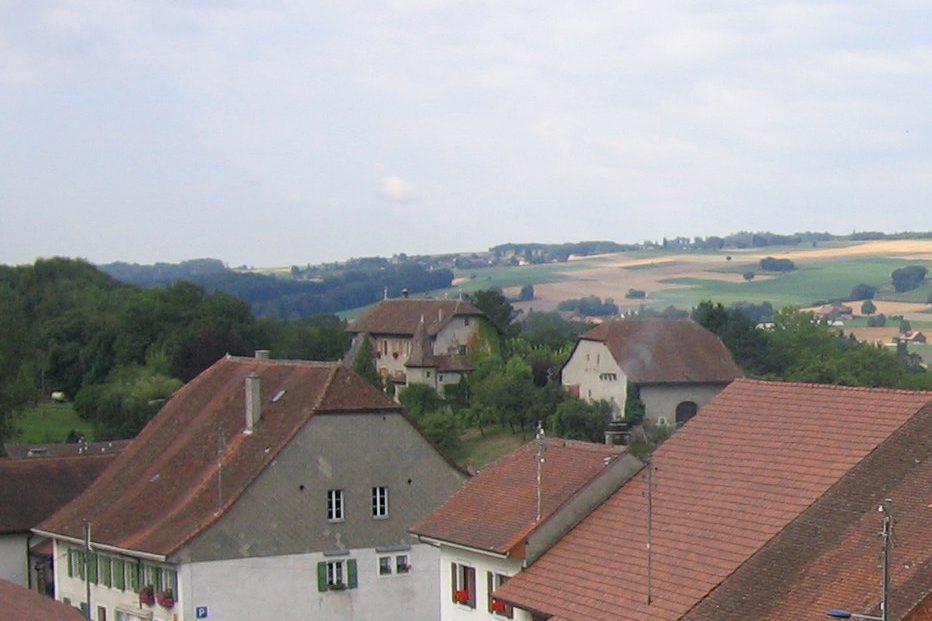
Bioley-Magnoux Castle. Attested in 1244, it protected a small fortified town. The Goumoëns thoroughly transformed it, especially around 1438. Charles the Bold stayed there on 4 and 5 June 1476. The Osterwald family added a great interior staircase in the early 18th century. After the collapse of its keep in 1890, it was restored from 1972 and remains a private residence. The castle and its barn are a cultural property of regional significance.[1][2][3][5]
Church of Saint-Etienne. Former parish church, attached to the parish of Donneloye since the Reformation. It was almost entirely rebuilt in 1825 and then restored in the early 1980s.[1]
Remains in Bioley-Magnoux
Montelier necropolis. Early Medieval necropolis discovered at the place called Montelier, on the municipality's territory.[1]
Protected heritage in Bioley-Magnoux
Cultural property of regional significance (B objects)[8]
- Château et grange
Traditions and festivals in Bioley-Magnoux
The Menthue societies. Bioley-Magnoux shares with neighbouring villages several societies named after the Menthue: an abbaye, the riflemen and the scouts. The youth society is shared by Bioley and Ogens.[14]
Sources
- Dictionnaire historique de la Suisse, « Bioley-Magnoux »
- Commune de Bioley-Magnoux, « Notre histoire »
- Swisscastles, « Le château de Bioley-Magnoux »
- Statistique Vaud, « Population résidante permanente au 31 décembre 2025 »
- Office fédéral de la protection de la population, Inventaire PBC, liste cantonale VD (état au 1.1.2026)
- Canton de Vaud, Loi sur le découpage territorial (LDecTer, RSV 132.15) du 30 mai 2006
- État de Vaud, communiqué du 12.07.2007, « Les préfètes et les préfets sont attribués aux nouveaux districts »
- Federal Office for Civil Protection (FOCP), Swiss Inventory of Cultural Property (PCP), list for the canton of Vaud (as of 1.1.2026)
- IPI, Swissreg, emblems database: coat of arms of Bioley-Magnoux (no. 101319)
- Historical Dictionary of Switzerland (HDS), article "Goumoëns, de"
- Historical Dictionary of Switzerland (HDS), article "Monod, Henri"
- Historical Dictionary of Switzerland (HDS), article "Blanchenay, Antoine"
- Historical Dictionary of Switzerland (HDS), article "Pahud, Henri"
- Commune of Bioley-Magnoux, "Sociétés locales"
- Register of Swiss Surnames, 3rd edition (1989), search Commune "Bioley-Magnoux", Canton VD
Published by Sébastien Jörg ·
Other villages near Bioley-Magnoux
Missing information, or do you have a source? Suggest a correction or addition. Every submission is checked before it's published.
Suggest a change