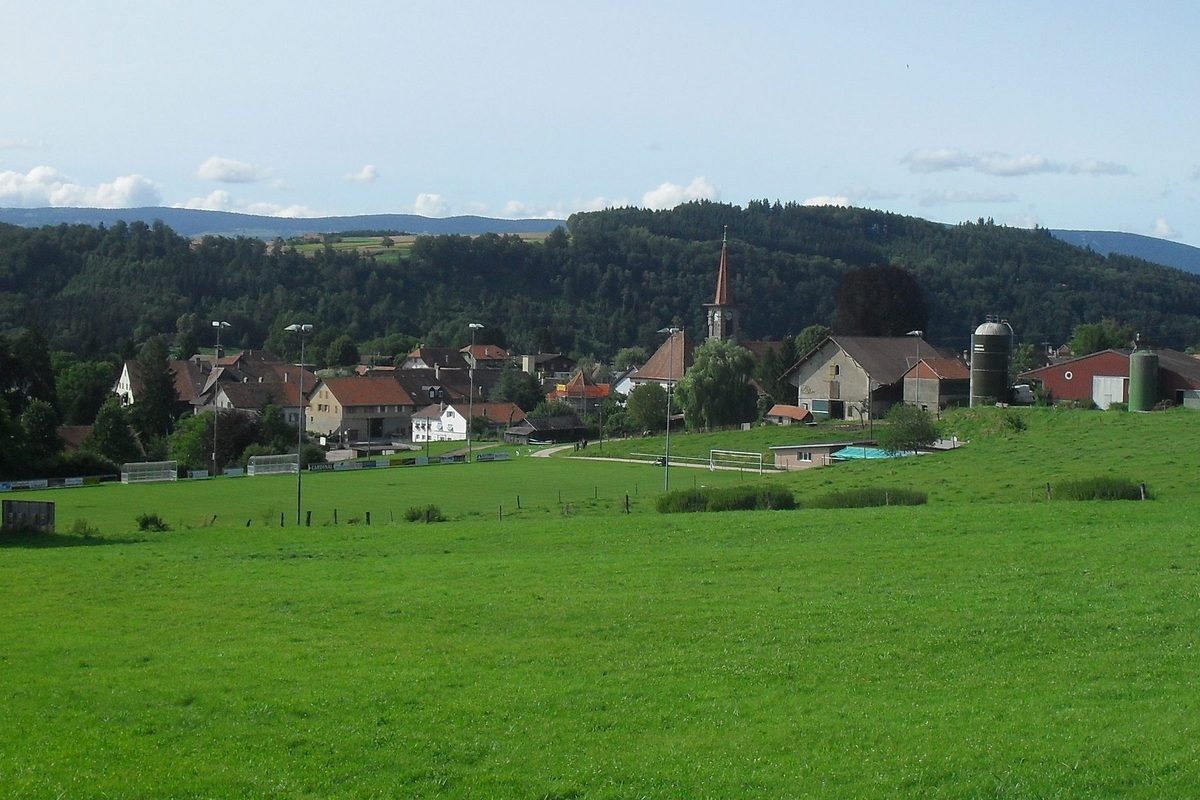
Donneloye
At Donneloye a tunnel more than 500 metres long linked the caves of the Moulin du Pont to the parsonage. It was still in use in 1925.
Entry based on 8 sources · Our method · Reusable text (CC BY-SA)
Origin of the name Donneloye
The village is mentioned around 1150 as «Donnolui». Then come «Donneloya» (1174), «Donneloix» (1177), «Donnelve» (1228), «Donnnelui» and «Dogne Eloye» (1240), then «Domgneloye» (1453). In the 12th century a family of knights descended from a branch of the Goumoëns bore this name. The name «Donneloye» still awaits an explanation.[1][2]
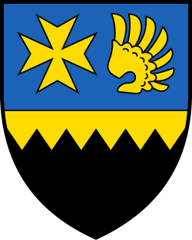
Coat of arms of Donneloye
Per fess, azure a Maltese cross with a demi-vol to sinister, all Or, and sable a chief indented Or. The shield is divided horizontally. At the top, on a blue field, a yellow Maltese cross is accompanied on the right by a yellow wing. At the bottom, on a black field, the upper edge is taken up by a yellow band cut into points.[7]
Founding of Donneloye
Nobody knows who founded Donneloye. From the 12th century Donneloye formed a lordship, held by a family of knights of the same name descended from a branch of the Goumoëns. The church of Notre-Dame was founded there in the same century. When the Donneloye family died out, the lordship was divided into several parts. Édouard Provana inherited one through his marriage to Marguerite de Donneloye. The de Glâne family later probably built the present castle. The Loys-Villardin brought almost the whole lordship together before ceding it to the Bernese. Donneloye became a large farming village at the crossroads of the Yverdon-Moudon and Yvonand-Bercher roads.[1][2]
History of Donneloye
around 1150. First mention, as «Donnolui».[1]
12th century. Donneloye is a lordship held by a family of knights of the same name. Foundation of the church of Notre-Dame, whose presentation belonged to the chapter of Lausanne and whose collation to the bishop.[1]
1380. The Donneloye family dies out (Othenin de Donneloye dies around 1387). The lordship is divided into several parts.[1]
1416. Donneloye has 80 hearths.[1]
1440-1528. The de Glâne family holds the castle, which it probably had built towards the end of the 15th century.[2]
1453. The village now has only 36 hearths.[1]
1496. Casting of a bell still preserved in the church.[1]
Reformation. The parish includes the annex of Bioley-Magnoux and the villages of Mézery-près-Donneloye, Chanéaz and Prahins.[1]
1652. The Loys-Villardin come to own almost the entire lordship.[1]
1664. Alteration of the church of Notre-Dame.[1]
1711. The Loys-Villardin cede the lordship to the Bernese, who already owned a manor house in the village. Donneloye belongs to the Bernese bailiwick of Yverdon.[1]
1712. Construction of the parsonage.[1]
1754. Construction of the first stone bridge over the Mentue.[2]
1798. Donneloye becomes part of the district of Yverdon.[1]
1892. Widening of the bridge over the Mentue, which forms the present bridge of the Yverdon-Moudon road.[2]
1894. Construction of the school building.[1]
1903. Rebuilding of the church of Notre-Dame, which keeps its portal, its pulpit and a bell from 1496.[1]
2008. Merger with Gossens and Mézery-près-Donneloye. The municipality becomes part of the new district of Jura-Nord vaudois.[1]
2012. Prahins joins the municipality of Donneloye.[1]
Population of Donneloye
Sources and references: [1][3]
| 1416 | 80 hearths (households) |
| 1453 | 36 hearths (households) |
| 1764 | 165 |
| 1850 | 282 |
| 1900 | 382 |
| 1950 | 274 |
| 1970 | 245 |
| 2000 | 320 |
| 2025 | 905 (merged municipality) |
Families of Donneloye
Provana. A family from northern Italy settled in the Pays de Vaud. After Édouard Provana married Marguerite de Donneloye, it held part of the land until the first third of the 15th century.[2]
Glâne. An old Vaud family, lords of Villardin and La Molière. It held the castle of Donneloye from 1440 to 1528, before it passed by marriage to the Roguenet of Romont and then to the von Roll of Solothurn.[2]
Loys. In 1652 the Loys-Villardin brought almost the whole lordship together. The family also acquired the neighbouring lordships of Chanéaz and Prahins and controlled the road from Moudon to Donneloye until the end of the 18th century.[1][2]
Show more families (2)
Citizen families before 1800. Bezençon, Billaud, Bridel, Courvoisier, Durussel, Ferrot, Peytregnet, Peytrignet, Potterat and Viquerat, without a precise date.[8]
From 1901 to 1962. 8 registrations. Several families come from abroad: from Italy (Ciocca in 1939 and 1943, Cambrosi in 1953 and Ginesi in 1958) and from France (Bondaz in 1933 and Trembalsky in 1960). From Switzerland comes the Ceppi family from Novazzano TI (1956). They are joined by the Clerc family (1923) and the Briner family (1950). The last family registered, in 1960, is the Trembalsky family.[8]
Economy of Donneloye, past and present
A large farming village. In the 19th century Donneloye strengthened its role as a large farming village, at the crossroads of the Yverdon-Moudon and Yvonand-Bercher roads.[1]
Historic sites in Donneloye
Donneloye Castle. Former manor house, probably built by the de Glâne family towards the end of the 15th century, later held by the Roguenet of Romont, von Roll of Solothurn and de Loys families. It consists of a rectangular main block divided in two by a wide central corridor and a cylindrical tower to the south-east, a dovecote tower said to have also served as a prison. State Councillor Viquerat (1838-1904) bought and restored it. The castle, an example of a medieval Savoyard seigneurial country house, is not open to the public. The manor with its dovecote tower is a cultural property of regional significance.[2][4]
Church of Notre-Dame. Church founded in the 12th century, altered in 1664 and rebuilt in 1903. It keeps the portal, the pulpit and a bell from 1496.[1]
Parsonage. Parsonage building, built in 1712.[1]
Bridge over the Mentue. First stone bridge, built in the Bernese period in 1754 and widened in 1892. It is the present bridge of the Yverdon-Moudon road.[2]
Villages of the municipality. Since 2008 the municipality has also included Gossens and Mézery-près-Donneloye, and since 2012 Prahins, each with its own history.[1]
Remains in Donneloye
Underground passage. An underground passage over 500 metres long linked the caves of the Moulin du Pont to the parsonage. Still used in 1925, it became inaccessible after collapses.[2]
Protected heritage in Donneloye
Cultural property of regional significance (B objects)[6]
- Manoir avec tour-colombier
Sources
- Philippe Heubi, « Donneloye », Dictionnaire historique de la Suisse (DHS), version du 04.01.2017
- Commune de Donneloye, « Histoire de Donneloye »
- Statistique Vaud, « Population résidante permanente au 31 décembre 2025 »
- Office fédéral de la protection de la population, Inventaire PBC, liste cantonale VD (état au 1.1.2026)
- État de Vaud, communiqué du 12.07.2007, « Organisation des préfectures et adaptation au nouveau découpage territorial »
- Federal Office for Civil Protection (FOCP), Swiss Inventory of Cultural Property (PCP), list for the canton of Vaud (as of 1.1.2026)
- IPI, Swissreg, emblems database: coat of arms of Donneloye (no. 101483)
- Register of Swiss Surnames, 3rd edition (1989), search Commune "Donneloye", Canton VD
Published by Sébastien Jörg ·
Localities of the municipality with a page
Other villages near Donneloye
Missing information, or do you have a source? Suggest a correction or addition. Every submission is checked before it's published.
Suggest a change