Gossens
Until the 17th century Gossens consisted of a single house sheltering some fifteen families, plus two farmhouses. A great fire then destroyed almost the whole village and its archives.
Entry based on 6 sources · Our method · Reusable text (CC BY-SA)
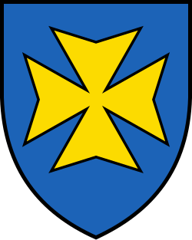
Coat of arms: Public domain, Wikimedia Commons
Origin of the name Gossens
The name Gossens derives from Gozzo, a Germanic personal name. The village owes its origin to an estate equipped with a barn that the commandery of La Chaux owned at this location.[2]
Founding of Gossens
Gossens developed out of a farming estate with a barn belonging to the commandery of La Chaux, a dependency of the Order of Saint John of Jerusalem (the Hospitallers) established on Vaud soil. The territory first belonged to the seigneury of St-Martin du Chêne, before coming under other seigneurial authorities. The neighbouring hamlet of Granges-de-Gossens, formerly called Granges de Joux, belonged instead to the seigneury of Bioley-Magnoux. This difference in jurisdiction caused numerous conflicts between the two authorities in the Middle Ages.[2]
History of Gossens
until 1228. Gossens is attached to the seigneury of St-Martin du Chêne.[2]
1376. Brother Pierre de Billens, knight and commander of the Order of Saint John of Jerusalem in the land of Vaud, leases out lands of Gossens, confirming the village's link with the commandery of La Chaux.[2]
17th century. Until this period, the village consisted of only one house sheltering about fifteen families, together with two rural buildings. A major fire then destroys almost the entire village as well as its archives, which explains the scarcity of documents predating this date.
Bernese period. Under Bernese rule, Gossens belongs to the seigneury of Bioley-Magnoux.[2]
1798. Gossens joins the newly created district of Yverdon, where it will remain until the end of 2007.
until 1846. Gossens depends on the parish of Cronay.[2]
1846. The parish it belongs to changes: Gossens now depends on Orzens.[2]
1862. Gossens joins the parish of Sauteruz, to which it remains attached thereafter.
1949. Construction of the village school.[2]
1957. A land consolidation is carried out across the municipal territory.
1972. Gossens is connected to the intermunicipal association for the water supply of the Menthue.[2]
1979. The village's internal water pipes are replaced.[2]
1982. A postal delivery service is set up for the village.[2]
2007. The citizens of Gossens, Donneloye and Mézery-près-Donneloye vote to merge their three municipalities under the name Donneloye. The vote reportedly took place on 11 March; the date is uncertain.
1 January 2008. The merger takes effect: Gossens becomes a village of the new municipality of Donneloye, attached the same day to the new district of Jura-Nord vaudois, which replaces that of Yverdon.[3][4]
August 2008. Final closure of the class at the Gossens school.[2]
Population of Gossens
| 1803 | 62 |
| 1850 | 152 |
| 1900 | 115 |
| 1950 | 92 |
| 2000 | 113 |
Families of Gossens
Burgher families before 1800. Bezençon, Duc, Lequatre and Rey, with no precise date.[6]
In the 19th century. Bessaud, Dambach, Danthe, Schwarzwald, Wirtz and Wolfgang are registered with no precise date. The Petitpierre, from Neuchâtel NE, followed in 1849 and the Walter, from Germany, in 1860.[6]
From 1901 to 1962. Forty-seven entries, a high number for a village of about a hundred inhabitants. Almost all date from 1910 to 1918, and 1915 alone accounts for more than twenty-five. The families came mainly from Germany (21), Italy (12), France (6) and Austria (3). The Hoon, from Thailand, were registered in 1960. The last families admitted, in 1962, were the Erismann from Bern BE, the Gasser from Rüschegg BE and the Monge from Geneva GE.[6]
Economy of Gossens, past and present
Land and milk. Gossens long lived mainly from farming, which is no longer the case. The Granges-de-Gossens were reorganised in 1957. The village dairy society merged with that of Orzens, and no organisation now has its seat in Gossens.[2]
Disasters and major events in Gossens
The fire of the 17th century. A fire then destroyed almost the whole village. The archives burned with the houses, which is why the earlier history of Gossens is poorly documented.[2]
Historic sites in Gossens
The Gossens school. Built in 1949, this school building took in the children of the village until its class was finally closed in August 2008, shortly after the municipal merger.[2]
The hamlet of Granges-de-Gossens. Separated from the village by the Barbeire stream, this hamlet, formerly called Granges de Joux, belonged to the seigneury of Bioley-Magnoux, which caused many conflicts with the village in the Middle Ages. Under Bernese rule the two lands were united in that seigneury.[2]
Sources
- Dictionnaire historique de la Suisse, Philippe Heubi, « Gossens », version du 06.01.2017
- Commune de Donneloye, « Histoire de Gossens »
- Canton de Vaud, Loi sur le découpage territorial (LDecTer, RSV 132.15) du 30 mai 2006
- État de Vaud, communiqué du 12.07.2007, « Organisation des préfectures et adaptation au nouveau découpage territorial »
- Statistique Vaud, « Population résidante permanente au 31 décembre 2025 »
- Register of Swiss Surnames, 3rd edition (1989), search Commune "Gossens", Canton VD
Published by Sébastien Jörg ·
Other villages near Gossens
Missing information, or do you have a source? Suggest a correction or addition. Every submission is checked before it's published.
Suggest a change