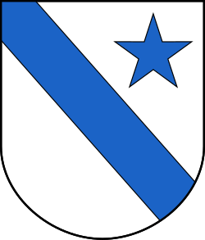
Bonfol
Origin of the name Bonfol
The village is first mentioned in 1136, as « Bunfol ». In German it was once called « Pumpfel ». The origin of the name is not explained.[1][8]
Founding of Bonfol
Nobody knows who founded Bonfol or when. The oldest known remain on its territory is an Iron Age tumulus spotted at Moncevi, and an early medieval cemetery was found at the place called Cras Chalet, north of the village. According to tradition, the present village took the place of three hamlets, Bonfol-le-Vieux, Trunchéré and Vareroille, destroyed during the Burgundian Wars by Étienne de Hagenbach, in the service of Charles the Bold. In the Middle Ages Bonfol shared the fate of the advocacy of Ajoie, which passed to the Prince-Bishopric of Basel at the end of the 13th century. Under the Ancien Régime the municipality belonged to the mairie of Cœuve. A farming village, Bonfol became known for its pottery.[1][3][4][5][8]
History of Bonfol
1136. First mention: « Bunfol ».[1][8]
end of the 13th century. The advocacy of Ajoie, whose fate Bonfol shares, is incorporated into the Prince-Bishopric of Basel.[1]
Burgundian Wars (1474-1477). According to tradition, Étienne de Hagenbach destroys the hamlets of Bonfol-le-Vieux, Trunchéré and Vareroille, which the present village is said to have replaced.
1497. First mention of the ponds of Bonfol.[1][8]
1619. Bonfol breaks away from the parish of Damphreux and forms a parish with Vendlincourt, which belongs to the diocese of Besançon until 1779.[1]
1751-1754. The Prince-Bishop of Basel has the ponds laid out for fishing.[1]
1770. 24 heads of family out of 123 are potters.[1]
1783-1784. Construction of the church of Saint-Laurent.[1]
1792-1814. Bonfol belongs to the French departments of Mont-Terrible, then Haut-Rhin.[1]
1816-1830. Bonfol belongs to the Bernese bailiwick, then to the Bernese district of Porrentruy (1831-1978).[1]
1836. Bonfol becomes a mixed municipality.[1][8]
1885. Discovery of an early medieval cemetery at the place called Cras Chalet.[1][4][5]
1901. Opening of the railway link to Porrentruy, which encourages industrial diversification.[1][8]
1912. Start of factory pottery production.[1]
1914-1918. The Western Front begins at the Largin, a narrow strip of land jutting into Alsatian territory.
1961-1976. The Basel chemical industry dumps toxic waste in a former clay pit. The ponds become nature reserves in 1961 (or 1930).[1]
1979. Bonfol belongs to the Jura district of Porrentruy.[1]
1999. Bankruptcy of the last ceramics company.[1]
2016. Completion of the excavation of the landfill's 220'000 tonnes of waste and its incineration in Germany. The site is restored to nature in 2018-2019.[1]
2024. On 1 January Bonfol merges with Beurnevésin to form the municipality of Basse-Vendline.[1][8]
Population of Bonfol
Sources and references: [1]
| 1770 | 805 |
| 1850 | 1'263 |
| 1900 | 1'340 |
| 1950 | 1'017 |
| 2000 | 679 |
| 2010 | 585 |
| 2020 | 654 |
| 2023 | 648 |
Historic sites in Bonfol
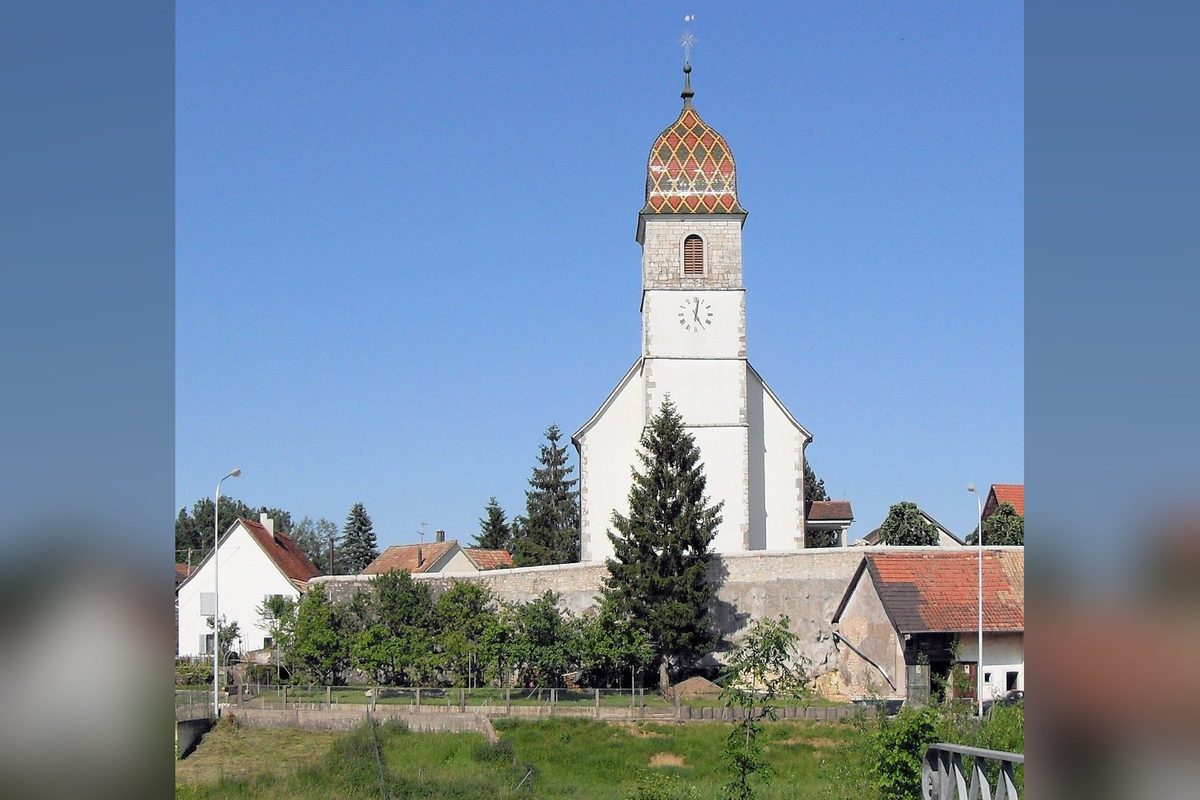
Church of Saint-Laurent. Parish church built in 1783-1784. The parish, formed in 1619 with Vendlincourt, belonged to the diocese of Besançon until 1779.[1]
Ponds of Bonfol. Mentioned from 1497, laid out for fishing by the Prince-Bishop of Basel from 1751 to 1754, they became nature reserves in 1961 (or 1930).[1][8]
Le Largin. Narrow strip of land jutting into Alsatian territory, where the Western Front began during the First World War. From 1942 to 1944 the Largin farm served as a crossing point for refugees.
Bonfol pottery. Bonfol is best known for its pottery, especially caquelons. In 1770, 24 heads of family out of 123 were potters. Factory production began in 1912 and the last ceramics company went bankrupt in 1999. A pottery museum, which grew out of the « Poteries de Bonfol » foundation set up in 1980, presents this craft.[1][7]
Site of the former Bonfol industrial landfill (DIB). From 1961 to 1976 the Basel chemical industry dumped toxic waste in a former clay pit. After two partial campaigns (1986-1989 and 1991-1996), the clean-up was carried out by Basler Chemische Industrie (BCI): the excavation of 220'000 tonnes of waste, incinerated in Germany, was completed in 2016 and the site restored to nature in 2018-2019.[1]
Chapel of Saint-Fromond. Chapel built in 1866 at the initiative of parish priest François-Joseph Jeanguenat, at the place called En-Boréz in the forest north of the village. It is linked to the cult of Saint Fromond.[6][8]
Remains in Bonfol
Cras Chalet cemetery. Early medieval cemetery discovered in 1885 at the place called Cras Chalet, north of the village. It held some forty graves. A belt plate from the early 7th century, known as the « Daniel » plate and usually interpreted as Daniel between two lions, was found there.[1][4][5]
Moncevi tumulus. Iron Age tumulus spotted during an aerial survey in 1989 at Moncevi, described as the only one of its kind known in Ajoie.[3]
Legends of Bonfol
The three destroyed villages. According to tradition, Bonfol replaced Bonfol-le-Vieux, Trunchéré and Vareroille, hamlets destroyed during the Burgundian Wars by Étienne de Hagenbach, in the service of Charles the Bold.[1]
Saint Fromond. According to tradition, a hermit named Fromond lived in the 7th century in a hut deep in the forest. An ancient oak near the chapel is said to have grown from the staff he threw. Venerated since the early 17th century, especially against livestock epidemics, he is honoured with a pilgrimage and procession on the day after Ascension.[6]
Sources
- Dictionnaire historique de la Suisse, « Bonfol » (Dominique Prongué), version du 06.12.2024
- Gouvernement de la République et Canton du Jura, message relatif à la fusion des communes mixtes de Beurnevésin et de Bonfol (Basse-Vendline), 06.12.2022
- Dictionnaire du Jura, « Moncevi (site archéologique, Bonfol) » (Claude Juillerat, François Schifferdecker, Guide archéologique du Jura et du Jura bernois, 1997)
- Dictionnaire du Jura, « Cras Chalet (site archéologique, Bonfol) » (Claude Juillerat, François Schifferdecker, 1997)
- République et Canton du Jura, Office de la culture, archéologie, « Bonfol, Cras Chalet »
- Dictionnaire du Jura, « Saint-Fromont, chapelle (paroisse de Bonfol) » (Philippe Kauffmann et al., Damien Bregnard, 2006)
- Dictionnaire du Jura, « Musée de la poterie, Bonfol » (Emma Chatelain, 2008)
- Commune de Basse-Vendline, « Histoire de Bonfol »
- geo.admin.ch (swisstopo), recherche de lieux « Bonfol »
Other villages near Bonfol
Missing information, or do you have a source? Suggest a correction or addition. Every submission is checked before it's published.
Suggest a change