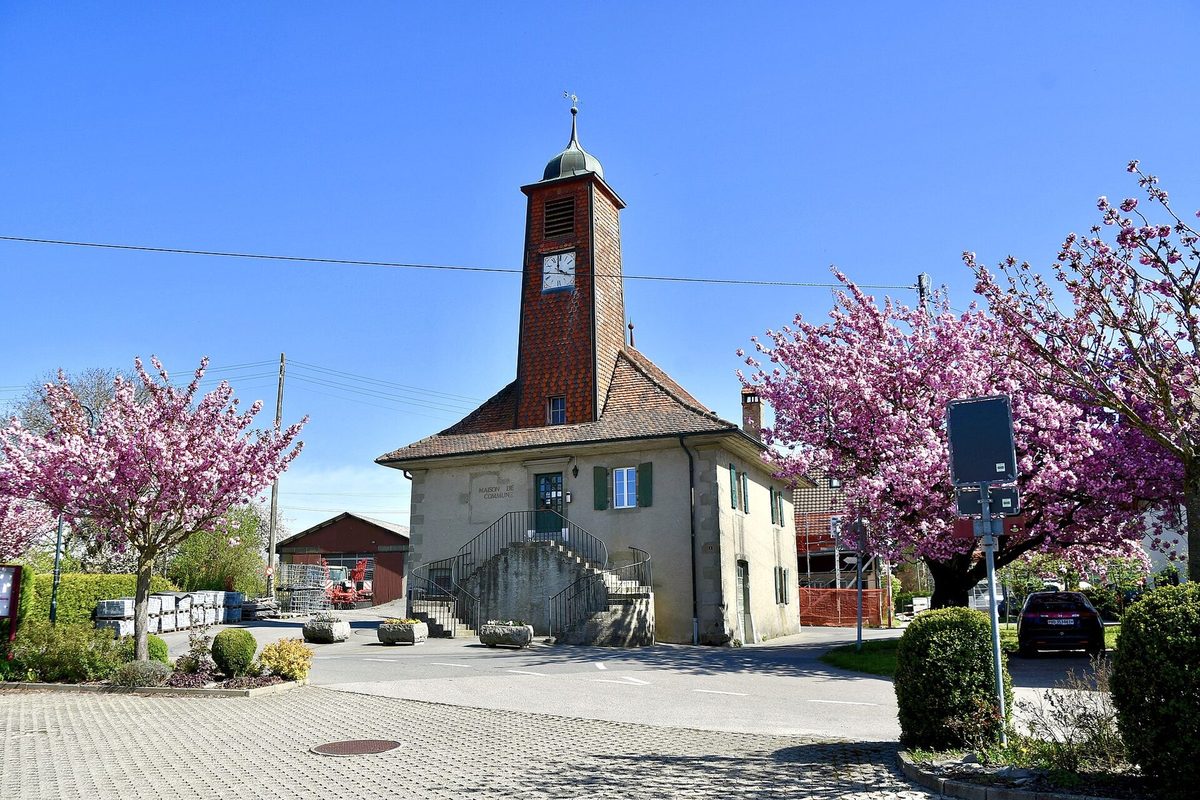
Bottens
Bottens never fully embraced the Reformation: Catholics and Protestants shared the same church until 1904.
Entry based on 11 sources · Our method · Reusable text (CC BY-SA)
Origin of the name Bottens
Bottens appears in 1142 as «Botens». An earlier mention, in 1107 in a deed of the priory of Saint-Sulpice, is also reported. The name «Bottens» has not yet been explained. Locally it is credited with a Burgundian sound, though this is not established.[1][2]
Coat of arms of Bottens
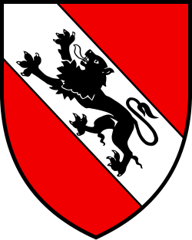
Gules, on a bend argent a lion sable. On a red field, a white band runs diagonally from the upper left corner down to the right. A black lion sits on it.[10][2]
Founding of Bottens
Nobody knows how or by whom the village was created. Roman remains have been found in its upper part. In the 12th century Bottens was a fief of the Bishop of Lausanne, enfeoffed to the lords of Bottens. The first known lord is said to be Wido, around 1107-1113, though this is not certain. These lords owned a castle on the slope between Bottens and Malapalud.[1][2][3]
History of Bottens
Roman period. Roman remains, discovered in 1854 in the upper part of the village.[2]
around 1107. A deed of the priory of Saint-Sulpice mentions the village for the first time. Wido is said to be its first known lord, though this is uncertain.[2][3]
1142. Mentioned as «Botens».[1]
12th century. Bottens is a fief of the Bishop of Lausanne enfeoffed to the lords of Bottens, and a parish depending on the abbey of Montheron.[1]
1342-1354. Girard de Montfaucon acquires most of Bottens and incorporates the castellany into his lordship of Échallens.[1]
1416. Bottens has 33 hearths (households).[1]
1475. The castle is destroyed by fire, possibly by the Confederates, though this is not certain. Until 1798 Bottens belongs to the common bailiwick of Orbe and Échallens. The assembly of burghers runs the village.[1][2][3]
16th century. Bottens does not fully adopt the Reformation and becomes a mixed parish: a Catholic parish and an annex of the Protestant parish of Poliez-le-Grand, the church serving both denominations.[1]
1555. The lords of Russin, successors of the Bottens, sell their property to François Panchaud.[1]
1599. The sanctuary is dedicated to Saint Claude, then to Saint Stephen in 1665.[1]
17th century. The lordship is bought by the Polier family of Lausanne.[1]
1711. Extensive restoration of the old sanctuary, rebuilt from 1711 to 1713 on a medieval plan.[1][2]
1798. Bottens belongs to the district of Échallens until 2007.
1843. Construction of the Catholic church by the architect Henri Perregaux.[1]
1847-1965. A Free Church congregation exists.[1]
1904. The old sanctuary is reserved for Protestants.[1]
1930-1935. Partial land consolidation; agriculture dominates until after the Second World War.[1]
1975-1985. Thanks to its proximity to Lausanne, the municipality attracts several companies.[1]
2002. Opening of a TL bus line to Lausanne, followed by strong population growth.[2]
2008. Under the new Vaud territorial division, Bottens becomes part of the Gros-de-Vaud district.[7][8]
Population of Bottens
Sources and references: [1][4]
| 1416 | 33 hearths (households) |
| 1453 | 19 hearths (households) |
| 1764 | 41 hearths (households), of which 33 Catholic |
| 1850 | 464 |
| 1870 | 529 |
| 1900 | 422 |
| 1950 | 400 |
| 1970 | 424 |
| 2000 | 917 |
| 2025 | 1'389 |
Families of Bottens
De Bottens. In the early 12th century the whole territory forms a seigneurial fief held by this noble family. Its castle stands between Bottens and Malapalud. The male line dies out towards the end of the 15th century.[2]
Citizen families before 1800. Eleven families with no precise date: Baudet, Bavaud, Brouty, Carrard, Déverin, Ecoffey, Gindroz, Longchamp, Pahud, Tzaud and Tzaut. The Jorand, from Penthéréaz VD, are admitted in 1713.[11]
In the 19th century. Dupraz, Panchaud and Perrin, as well as the Guignard of L'Abbaye VD and the Vaney of Cugy VD, with no precise date. The Meylan, from Le Lieu VD, are admitted in 1811 and the Maurer, from Germany, in 1826.[11]
Show more families (1)
From 1901 to 1962. Thirteen registrations. The Pillet, from France, arrive in 1906, the Bernasconi, from Italy, in 1908, then the Gret (1917) and the Ossipow (1942). The 1950s bring three Italian families, the Méda in 1953, the Fiorellino in 1953 and 1957, the Bariatti in 1954, as well as the Favre of Isérables VS in 1956. The year 1957 has four registrations: the Allaman of Charmey FR, the Bertone of Geneva, the Henneberger of Guggisberg BE and the Pfeuti of Rüschegg BE. The Juan are the last admitted, in 1959.[11]
Notable people of Bottens
Louis Rivier. The Vaud painter creates a fresco in the Protestant temple of Bottens in 1943. He also leaves the Catholic church an unfinished triptych, "Le mystère de l'incarnation".[2]
Henri Perregaux. The architect of the Catholic church of Bottens also designed the chamber of the Vaud Grand Council.[2]
Economy of Bottens, past and present
Fields and the tile works. A tile works operated in Bottens in the 18th century. Yet the village lived mainly from the land, and farming dominated until after the Second World War. A first, partial land consolidation took place in the 1930s.[1]
Craftsmen and commuters. Close to Lausanne, Bottens attracted several companies between 1975 and 1985. Many inhabitants work elsewhere and commute. The municipality has no industry, but many craftsmen and a few workshops in construction and mechanics. Two restaurants and a grocery serve the village.[1][2]
Disasters and major events in Bottens
The castle fire of 1475. The castle of the lords of Bottens, built on the slope towards Malapalud, burned in 1475. In the early 20th century the last stones of its walls were used to build the municipal inn of Poliez-le-Grand.[2][3][1]
Historic sites in Bottens
Catholic church of Saint-Étienne. Built from 1843 by the architect Henri Perregaux and consecrated in 1847, it houses an unfinished triptych by the painter Louis Rivier, «Le mystère de l'incarnation». With its cemetery it is a cultural property of regional significance (PBC inventory).[1][2][6]
Protestant church. Old sanctuary attested in the 12th century, dedicated to Saint Claude in 1599 and then to Saint Stephen in 1665, heavily restored in 1711. Long shared by Catholics and Protestants, it has been reserved for Protestants since 1904.[1]
School. School building of 1845-1846, attributed to Henri Perregaux and Achille de La Harpe (attribution uncertain).
Remains in Bottens
Bottens Castle. The castle of the lords of Bottens stood on the slope between Bottens and Malapalud. Its walls are said to have been about four metres thick. It burned down in 1475. In the early 20th century its last stones were reportedly used to build the inn at Poliez-le-Grand.[2][3]
Roman remains. Roman remains were discovered in 1854 in the upper part of the village.[2]
Protected heritage in Bottens
Cultural property of regional significance (B objects)[9]
- Eglise catholique Saint-Etienne avec cimetière
Legends of Bottens
The Ruffan and the Truffian. The inhabitants are nicknamed «lè Ruffan» and «lè Truffian» in patois. The second is said to refer to the potato, the village's staple food.[2]
Traditions and festivals in Bottens
The Potato Festival. Every year in September Bottens celebrates the potato, which gave the inhabitants their nickname. The festival welcomes newcomers and presents the local societies.[2]
Sources
- Dictionnaire historique de la Suisse, « Bottens »
- Feuille des avis officiels du canton de Vaud, « Alphabet des communes vaudoises : Bottens »
- Swisscastles, « Le château de Bottens »
- Statistique Vaud, « Population résidante permanente au 31 décembre 2025 »
- Dictionnaire historique de la Suisse, « Echallens (bailliage, district) » (Jean-Jacques Bouquet, version du 28.02.2006)
- Office fédéral de la protection de la population, Inventaire PBC, liste cantonale VD (état au 1.1.2026)
- Canton de Vaud, Loi sur le découpage territorial (LDecTer, RSV 132.15) du 30 mai 2006
- État de Vaud, communiqué du 12.07.2007, « Les préfètes et les préfets sont attribués aux nouveaux districts »
- Federal Office for Civil Protection (FOCP), Swiss Inventory of Cultural Property (PCP), list for the canton of Vaud (as of 1.1.2026)
- IPI, Swissreg, emblems database: coat of arms of Bottens (no. 102101)
- Register of Swiss Surnames, 3rd edition (1989), search Commune "Bottens", Canton VD
Published by Sébastien Jörg ·
Other villages near Bottens
Missing information, or do you have a source? Suggest a correction or addition. Every submission is checked before it's published.
Suggest a change