Froideville
On 26 September 1284 the imperial bailiff Richard de Corbières granted the people of the convent of Montheron the rights of the monks: Froideville counts that day as its birth.
Entry based on 18 sources · Our method · Reusable text (CC BY-SA)
Origin of the name Froideville
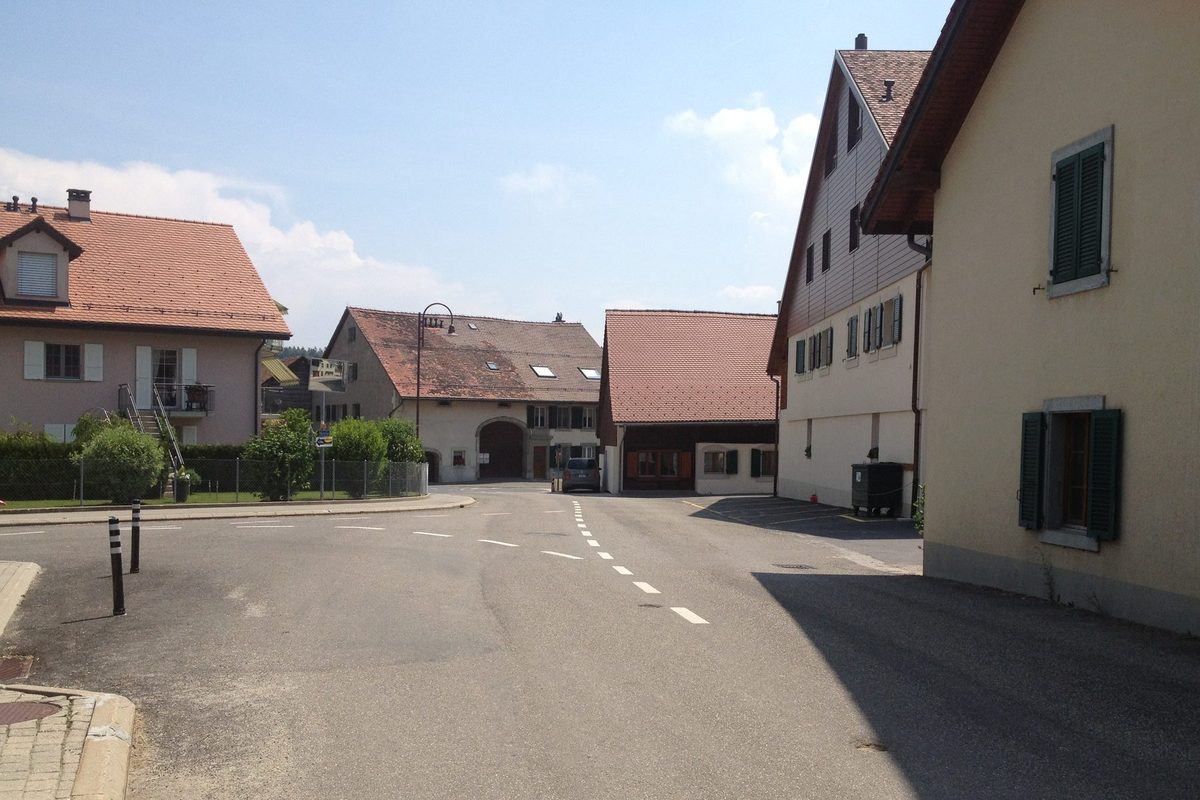
Froideville appears in 1284 in the Latin form « Frigida Villa », which can be translated as « the cold estate » or « the cold village ». The name very probably refers to the site's position on the wooded, damp plateau of the Jorat, with harsher winters than on the nearby Lausanne plain, though this is not certain. This first mention coincides with the deed regarded as the village's founding act. No distinct patois form of the name and no official demonym are known. The people of Froideville are nicknamed « lè Caca-Tchou », the « cabbage-poopers », a nickname that refers to cabbage growing, long widespread in the region, and to a local cabbage sausage.[1][2][3]
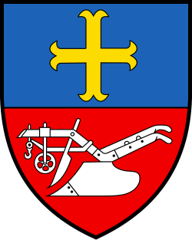
Coat of arms of Froideville
Per fess azure a cross moline Or, and gules a plough argent. The upper half is blue, with a yellow cross whose arms end in anchor shapes. The lower half is red and bears a white plough. Adopted in 1919, the arms recall the village's old ties with the monastery of Montheron and work in the fields.[17][3]
Founding of Froideville
No lay lord founded Froideville all at once: like several villages of the Jorat, it was born from the activity of a Cistercian abbey. The abbey was first established under the name Grâce-Dieu a few kilometres from its final site, then moved to the small valley of the Talent, at the place that would become Montheron. Attached to the abbey of Bellevaux, in Haute-Saône, of the Morimond line, it had received the support of the bishop of Lausanne and the regional nobility. In the 13th century the monks cleared and cultivated the forests and farmland of the Jorat. Gradually, lay people replaced them in working the land and settled on the edge of the abbey's estates: Froideville took shape from this community of the abbey's subjects. Its birth is dated to the day the imperial bailiff Richard de Corbières granted the people of the convent of Montheron the same rights as the monks. Independence did not follow at once: until the Reformation Froideville remained subject to the spiritual and temporal authority of the abbey, its inhabitants liable to arbitrary taxation. Abbot Jean de Cheseaux eventually freed them from all servitude, in return for 43 or 45 gold florins.[1][2][3][4][5]
History of Froideville
before 1126. Founding, under the name Grâce-Dieu, of the Cistercian community that would later become the abbey of Montheron, a few kilometres from its final site.[5]
1142-1147. Transfer of the abbey to the small valley of the Talent, at the site of Montheron. The establishment, attached to the abbey of Bellevaux (Cistercian Morimond line), receives the support of the bishop of Lausanne and the regional nobility.[5]
13th century. The monks of Montheron clear and cultivate the forests and lands of the Jorat. Lay people gradually settle on the fringes of the abbey's estates and form the village community of Froideville. No prehistoric or Roman remains are known so far on Froideville's territory: the documented history of the place begins with this medieval clearance.[1]
26 September 1284. The imperial bailiff Richard de Corbières grants the people of the convent of Montheron the same rights as the monks. This date is regarded as the birth of the village, whose name appears the same year in the Latin form « Frigida Villa ».[2][3][4]
before 1455. Before the Reformation, Froideville remains subject to the spiritual and temporal authority of the abbey of Montheron. Its inhabitants are bound by feudal dues owed to the convent.[1]
16 March 1455. Abbot Jean de Cheseaux frees the inhabitants of Froideville from all servitude to the convent, in return for 43 or 45 gold florins (the sources differ on the amount).[1][2][3][4]
1528. The abbey of Montheron places itself under the protection of the city of Lausanne, amid growing religious tensions.[5]
1536. The Bernese conquest of Vaud leads to the suppression of the convent of Montheron with the introduction of the Reformation. Froideville comes under the administration of the town of Lausanne, in the bailiwick of Lausanne. The Bernese bailiffs erect the Trois Jorats boundary stone, at the meeting point of Froideville, Montpreveyres and Lausanne.[2][3][4][5]
1590-1592. Construction of a Protestant temple on the site of the former abbey of Montheron, on which the reformed parish covering, among others, Froideville then depends.[5]
1764. First available population figure for Froideville: 295 inhabitants.[1]
1778. Addition of a baroque facade to the temple of Montheron.[5]
1798. The Pays de Vaud becomes an independent canton during the period of the Helvetic Republic. Froideville joins the new district of Echallens, to which it will belong for more than two centuries.[1]
1803. The hamlet of Montheron, where the former abbey had been established, is temporarily attached administratively to Froideville.[1][2][3][4]
1813. Montheron is permanently detached from Froideville and attached to the municipality of Lausanne, causing a loss of territory for Froideville but also the end of certain upkeep charges.[1][2][3][4]
1850. The population of Froideville reaches 454 inhabitants, one of the high points of the 19th century before the rural exodus that will affect the region in the following decades.[1]
1900. The population falls back to 360 inhabitants, reflecting the rural depopulation movement then affecting a large part of the Vaud countryside.[1]
1919. Adoption of the municipal coat of arms: per fess azure an anchored cross or (recalling the Cistercian monastic past) and gules a plough argent (evoking the village's farming vocation).[3]
1950. The population continues to decline, to 289 inhabitants.[1]
1960. Demographic low point of the village with 266 inhabitants, before the start of a complete reversal of the trend in the following decades.[1][3][4]
1960s. Beginning of the development of residential neighbourhoods around the historic village centre, driven by the growing proximity to the Lausanne agglomeration.
1980. The population reaches 994 inhabitants, a sign of growth already very marked compared to the low point of the 1960s.[11]
1985. Construction of the ecumenical centre of Froideville, including a chapel fitted with an organ, used in particular by the reformed parish covering Morrens and Montheron.[1]
1990. The population stands at 1'293 inhabitants.[11]
2000. The village has 1'453 inhabitants.[1][11]
1 January 2008. As part of the territorial reform of the canton of Vaud, the district of Echallens, on which Froideville had depended since 1798, is dissolved. Froideville joins the new district of Gros-de-Vaud, whose seat remains Echallens.
2010. The population reaches 1'758 inhabitants (statistical estimate at 31 December).[11]
30 November 2014. Voters in Froideville, like those in Bretigny-sur-Morrens, Cugy and Morrens, reject the plan to merge the four municipalities into a new entity called « Haut-Talent ». In Froideville, only the syndic supported the plan. Froideville remains an independent municipality.[15]
2020. The population crosses a new threshold with 2'695 inhabitants.[11]
2023. On 31 December, Froideville has 2'728 inhabitants, confirming its transformation into a residential municipality largely integrated into the Lausanne agglomeration, without ever having merged with a neighbouring municipality.[3]
2025. On 31 December, Froideville has 2'713 inhabitants. The municipality remains politically independent, in the district of Gros-de-Vaud.[16]
Population of Froideville
Sources and references: [1][3][4][11][16]
| 1764 | 295 |
| 1803 | 470 |
| 1850 | 454 |
| 1900 | 360 |
| 1950 | 289 |
| 1960 | 266 |
| 1980 | 994 |
| 1990 | 1'293 |
| 2000 | 1'453 |
| 2010 | 1'758 |
| 2020 | 2'695 |
| 2023 | 2'728 |
| 2025 | 2'713 |
Families of Froideville
Citizen families before 1800. Burnat, Clerc, Delisle, Grépin, Martin, Michon, Thuillard and Vittoz, with no precise date.[18]
From 1901 to 1962. No family is admitted in the 19th century. The Chamot open the series in 1914. They are followed by the Avezou, from France (1954 and 1957), the Arcidiaconu (1955), then the Luginbühl of Oberthal BE and the Marcuet of Cugy FR (1959). The Bertalot arrive from Italy in 1960. A second Martin family, from Orvin BE, is registered in 1961, and the Wulschleger, from France, close the list in 1962.[18]
Economy of Froideville, past and present
Forests and fields. Forest covers 51% of the territory, farmland 39% and built-up areas 10%. The municipality owns 157 hectares, including 115 hectares of forest managed by the Mèbre-Talent forestry district, and leases the rest to farmers. Seven farmers still work in a village that has become mainly residential.[3]
Wood and water. Froideville's district heating burns wood chips from the municipal forests. In the early 20th century several of the village's springs were sold to a private buyer, then passed to the City of Lausanne, which runs a pumping station at the Bois d'Archens.[3][2]
Historic sites in Froideville
Borne des Trois Jorats. This stone monolith, at 893.6 metres in the Jorat woods, marks the meeting point of the territories of Froideville, Montpreveyres and the town of Lausanne, today the districts of Gros-de-Vaud, Lavaux-Oron and Lausanne. It was erected in 1536 by the Bernese bailiffs. The present stone, the work of the sculptor Milo Martin, replaced the original in 1928 and was inaugurated in 1928 or 1929 (date uncertain). The stone remains a popular walking destination and still marks an administrative boundary.[2][3][4][7][8]
Ecumenical centre of Froideville. Built in 1985 on the rue du Bas de la Fin, this building houses a chapel fitted with an organ and serves as a shared place of worship, in particular for the reformed parish covering Froideville together with the neighbouring villages of Morrens and Montheron. Its ecumenical purpose makes it a relatively recent place of religious gathering, but one well established in current municipal life.[1][6]
Former abbey of Montheron, cradle of the village. Although the site of the Cistercian abbey is today located within the territory of the municipality of Lausanne, following the attachment of Montheron to it in 1813, it remains inseparable from the history of Froideville since the village formed directly from the community of subjects of this abbey. The Protestant temple that stands there today, built in 1590-1592 and given a baroque facade added in 1778, occupies the site of the former monastery suppressed in 1536.[1][2][3][4][5]
Remains in Froideville
Borne des Trois Jorats, remnant of Bernese administration. Beyond its function as a heritage landmark still used today, this boundary stone constitutes a direct material remnant of the administrative reorganisation imposed by Bern on the Pays de Vaud after the 1536 conquest, when the new Bernese jurisdictions redrew the boundaries inherited from the seigneurial and abbatial era. It bears concrete, on-the-ground witness to the moment when Froideville shifted from the tutelage of the abbey of Montheron to Bernese administration, a decisive turning point in its political history.[2][3][4]
Traditions and festivals in Froideville
Le Cacatchou. A running race bears the villagers' nickname, lè Caca-Tchou. It is one of the municipality's events, along with the Easter ball, the theatre evenings and the Maupas markets.[3]
Sources
- Dictionnaire historique de la Suisse, Froideville
- Commune de Froideville, page Présentation
- Feuille des Avis Officiels du canton de Vaud, Alphabet des communes vaudoises, Froideville
- Carillons.ch, De Frigida villa à Froideville
- Fondation de l'Abbaye de Montheron, page Histoire
- Eglise évangélique réformée du canton de Vaud, Centre œcuménique de Froideville
- Commune de Montpreveyres, page Le village de Montpreveyres
- Allez savoir ! (UNIL), Promenons-nous (un peu) dans les bois du Jorat
- Balades.ch / Vaud Rando, itinéraire Borne des Trois Jorats
- Communal.ch, sobriquet des habitants de Froideville
- Citypopulation.de, Froideville (district du Gros-de-Vaud)
- Localcities.ch, commune de Froideville
- La Région, Deux projets de fusion sur six acceptés
- 24 heures, A Froideville, seul le syndic soutient la fusion
- État de Vaud, communiqué du 30.11.2014, « Le Conseil d'Etat prend acte des résultats des scrutins concernant six projets de fusion de communes »
- Statistique Vaud, « Population résidante permanente au 31 décembre 2025 »
- IPI, Swissreg, emblems database: coat of arms of Froideville (no. 101781)
- Register of Swiss Surnames, 3rd edition (1989), search Commune "Froideville", Canton VD
Published by Sébastien Jörg ·
Other villages near Froideville
Missing information, or do you have a source? Suggest a correction or addition. Every submission is checked before it's published.
Suggest a change