Poliez-le-Grand
Torn between Bern and Fribourg in the shared bailiwick of Orbe-Échallens, this Gros-de-Vaud village abolished Catholic worship on 12 August 1619.
Entry based on 4 sources · Our method · Reusable text (CC BY-SA)
Origin of the name Poliez-le-Grand
The name appears in the Latinised form Poleto around 1160-1179, then as Pollie lo Grant in 1225. According to the municipality's history, it was reportedly also written Poulye lez grand and then Pully-le-Grand in the 12th century, before the current form Poliez-le-Grand took hold in 1708. A Roman origin is suggested, Polliacum, which would have designated a single territory covering Poliez-le-Grand and the neighbouring but distinct village of Poliez-Pittet, before they separated. This hypothesis, however, rests on Gallo-Roman remains found at Poliez-Pittet, not at Poliez-le-Grand.[1][2]
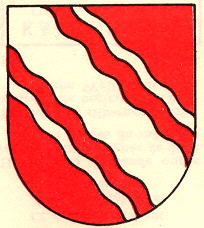
Coat of arms of Poliez-le-Grand
Gules, three bendlets wavy argent. These are the arms of the former municipality. Three wavy white bands run diagonally across a red field, from top left to bottom right. Adopted in 1929, they recall the village's three streams.[2]
Founding of Poliez-le-Grand
Neither a founder nor a foundation date is known for Poliez-le-Grand. As early as 1141 a parish attached to the abbey of Montbenoît, in the diocese of Besançon, shows that the village was already an organised community. In the Middle Ages several lords shared the territory, including the de Goumoëns and de Vulliens families. The priory of Lutry and the abbey of Montheron also held land there.[1]
History of Poliez-le-Grand
1141. A parish is attested at Poliez-le-Grand, attached to the abbey of Montbenoît, in the diocese of Besançon.[1]
around 1160-1179. First attested mention of the village in the Latinised form Poleto.[1]
1225. The village is mentioned in the form Pollie lo Grant.[1]
Middle Ages. The territory is divided among several lords (the de Goumoëns and de Vulliens families), the priory of Lutry and the abbey of Montheron, who hold land there.[1]
after 1475. Following the Burgundian War, the village comes under the joint rule of Berne and Fribourg.[1][2]
1481-1798. Poliez-le-Grand belongs to the joint bailiwick of Orbe-Échallens. The village is administered by two governors and a Council of Twelve.[1]
from 1531. The village experiences the tensions of the Reformation and finds itself torn between the Bernese and Fribourg authorities.[2]
12 August 1619. Catholic worship is abolished in Poliez-le-Grand, the village definitively moving over to the Reformation.[2]
1699. The village's parsonage is rebuilt.[1]
1708. The current form of the name, Poliez-le-Grand, reportedly becomes fixed.[2]
1711. The parish church, dedicated to the Virgin, is restored.[1]
1798-2007. The village is part of the district of Échallens, until the new Vaud districts come into force on 1 January 2008, placing it in the district of Gros-de-Vaud.
1923-2004. A dairy cooperative operates in the village, alongside construction, demolition and transport businesses.[1]
1929. The municipality adopts its coat of arms, gules three wavy bends argent, symbolising the local watercourses: the Talent, the Coruz and the Botterel.[2]
2000. More than three-quarters of the working population are commuters working mainly in the Lausanne conurbation.[1]
1 July 2011. Poliez-le-Grand merges with Dommartin, Naz and Sugnens to form the new municipality of Montilliez.[2]
Population of Poliez-le-Grand
Sources and references: [1]
| 1453 | 20 hearths |
| 1764 | 49 hearths |
| 1803 | 382 |
| 1850 | 470 |
| 1900 | 349 |
| 1950 | 329 |
| 2000 | 528 |
Families of Poliez-le-Grand
Citizen families before 1800. Six families, with no precise date: Curchod, Ménétrey, Mermoud, Panchaud, Panchaud-de-Bottens and Vincent.[4]
From 1901 to 1962. No registration in the 19th century. The Franzini, from Italy, are admitted in 1919, the Mage, from France, in 1922 and the Bureau, also from France, in 1953. The Rime of Gruyères FR close the list in 1956.[4]
Economy of Poliez-le-Grand, past and present
Crops and livestock. Poliez-le-Grand has traditionally lived from farming. In 2000 the municipality counts fourteen crop and livestock establishments, and the primary sector provides almost 20% of jobs in 2005. The dairy society operates from 1923 to 2004. Construction, demolition and transport firms are also based in the village.[1]
Historic sites in Poliez-le-Grand
Church of the Virgin. The village has had a parish church dependent on the abbey of Montbenoît since the 12th century. Dedicated to the Virgin, it was restored in 1711, while the neighbouring parsonage was rebuilt in 1699. Catholic worship was abolished there on 12 August 1619 after the upheavals of the Reformation.[1][2]
Communal dairy. A dairy cooperative operated in the village from 1923 to 2004, evidence of the traditional agricultural economy that long characterised Poliez-le-Grand, alongside construction, demolition and transport businesses.[1]
Remains in Poliez-le-Grand
Hypothesis of a shared Roman territory (Polliacum). No archaeological remains have so far been reported within Poliez-le-Grand. The idea of a shared Roman origin with the neighbouring but distinct village of Poliez-Pittet, under the name Polliacum, rests on Gallo-Roman remains found at Poliez-Pittet itself. This link is not established, and no Roman remains have been unearthed at Poliez-le-Grand.
Protected heritage in Poliez-le-Grand
Cultural property of regional significance (B objects)[3]
- Auberge communale
Sources
- Marianne Stubenvoll, « Poliez-le-Grand », Dictionnaire historique de la Suisse (DHS), version du 04.01.2017
- Commune de Montilliez, « Histoire de la commune »
- Federal Office for Civil Protection (FOCP), Swiss Inventory of Cultural Property (PCP), list for the canton of Vaud (as of 1.1.2026)
- Register of Swiss Surnames, 3rd edition (1989), search Commune "Poliez-le-Grand", Canton VD
Published by Sébastien Jörg ·
Other villages near Poliez-le-Grand
Missing information, or do you have a source? Suggest a correction or addition. Every submission is checked before it's published.
Suggest a change