Échallens
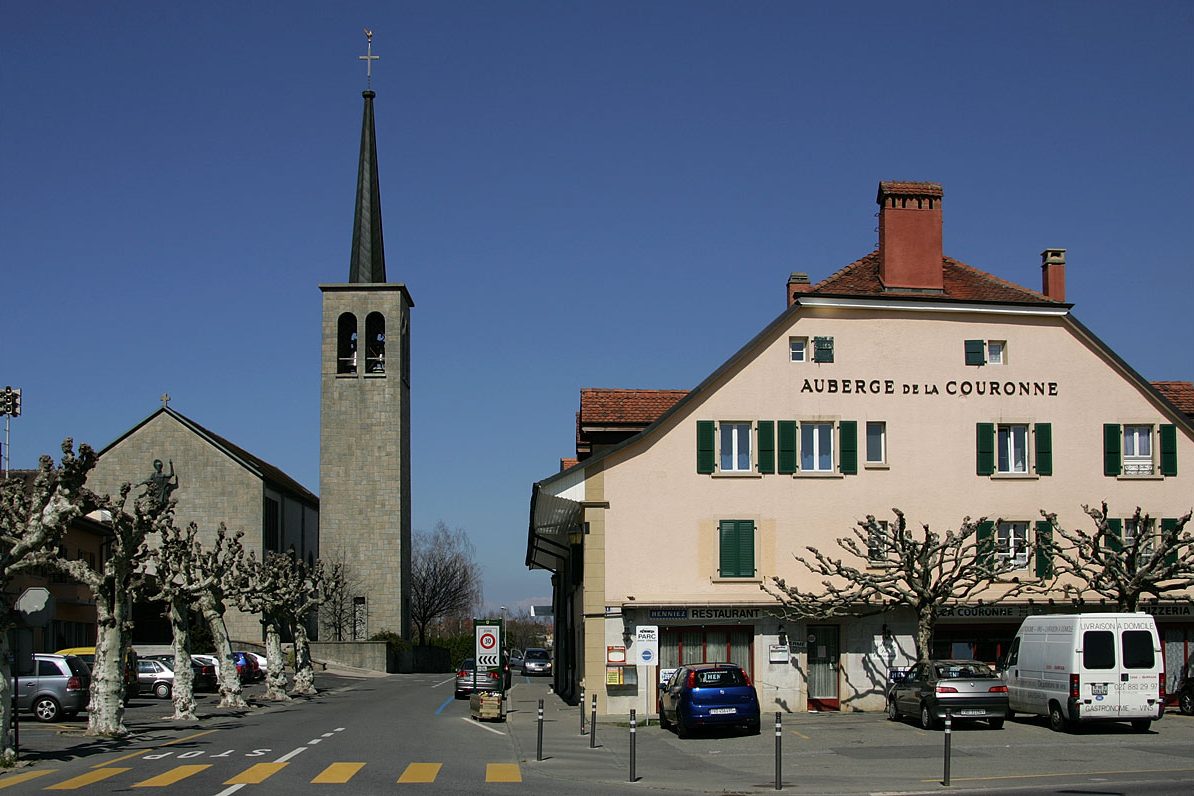
A common bailiwick of Reformed Bern and Catholic Fribourg until 1798, Échallens gained in 1726-1727 a place of worship shared by both confessions.
Entry based on 20 sources · Our method · Reusable text (CC BY-SA)
Origin of the name Échallens
The place appears as «Charlens» in 1141, «Escharlent» in 1177 and «Eschallens» in 1228. The name reportedly comes from the Germanic personal name «Scarilo» followed by the suffix «-ingos» («among the people of»), adopted in the Gallo-Roman area from the 6th century. The old German name is «Tscherlitz».[1][2]
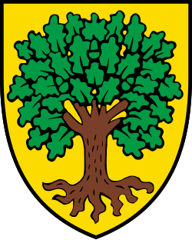
Coat of arms of Échallens
Or, an oak tree eradicated proper. On a yellow field, an oak in its natural colours is shown with its roots. The earliest known seal, from the 16th century, already bears a tree. The arms take up the emblems of the lordship of Montfaucon-Montbéliard, then overlord of Echallens.[14][2]
Founding of Échallens
Who founded Échallens, and when, is not known. At first the place had only a chapel, a filial of Goumoens-la-Ville. At the end of the 12th century the Montfaucon, counts of Montbéliard, dominated the region. In the 13th century Amédée III of Montfaucon-Montbéliard built a castle above the ravine of the Talent. The small town grew up around this fortress, and a wall later joined it to the castle.[1][3][5]
History of Échallens
Bronze Age. A Bronze Age foundry is attested by remains discovered in 1857 in the castle courtyard. La Tène and early medieval cemeteries have been located at the sites of En Argilliez, Condémines and Chatelard.[1]
1141. First mention, «Charlens», in a letter of protection from Pope Innocent II for the abbey of Montbenoît. The chapel is then a filial of Goumoens-la-Ville. Échallens becomes a parish before 1228.[1][2]
13th century. Construction of the castle by the lords of Montfaucon-Montbéliard (attributed to Amédée III). It is mentioned in a charter of 1273. From the 1270s, Amédée III acquires the rights over Échallens at the expense of the lords of Goumoens and Cheseaux.[1][3][5]
1291. A castellan and tax collectors are attested, again in 1313. A toll is established before 1346.[1]
1317. Jean de Montfaucon acknowledges holding Échallens from the Count of Savoy.[1]
1351-1352. Charter of franchises: Girard de Montfaucon and Jaquette de Grandson grant the town the franchises of Moudon. A wall encloses the town and the castle. A market is recorded from 1351.[1]
early 15th century. Through the marriage of Louis de Chalon to Jeanne de Montbéliard, the lordship passes to the house of Chalon. Louis becomes its sole lord in 1424.[3]
1451. Damaged in 1445, the castle is repaired, or even entirely rebuilt, by Louis de Chalon (large residential wing, second round tower).[1][3]
1464. First mention of syndics.[1]
1475. Burgundian Wars: the Swiss besiege and burn the castle. The lordship then forms, with Orbe, a common bailiwick of Bern and Fribourg.[1][2][3]
1484. Échallens becomes the centre of the bailiwick of Orbe-Échallens, administered jointly by Bern and Fribourg until 1798. The rights of the other cantons were reportedly bought out at that time by the Treaty of Beromünster.[1]
1536-1798. After the Bernese conquest of the Pays de Vaud, Échallens remains a common bailiwick of Bern (Reformed) and Fribourg (Catholic), an exceptional situation that allows the two confessions to coexist. The two confessions share the old church of Saint-Jean l'Évangéliste (simultaneum).[1]
1676. The Reformed Confraternity of Échallens is attested. Its archives begin in that year.[8]
1719. Construction of the north wing of the castle, at shared expense.[1][3]
1726-1727. Construction of a new church used by both confessions (simultaneum church).[1]
1738. Creation of a Council of twenty-four members. Under the Ancien Régime the town is administered by two governors and a Council of twelve members. These councils have as many Catholics as Protestants.[1]
1781. Construction of the town hall, financed by the burghers.[1][4]
1798. Vaudois Revolution: departure of the last Fribourg bailiff. Échallens becomes the chief town of the new district of Échallens.[1]
1816. The municipality buys the castle to house its services. The castle then houses the court, the prisons, the schools and, from 1842 to 1852, the deaconesses.[1][2][3]
1865. Construction of the Reformed church.[1]
1874. Arrival of the Lausanne-Échallens railway, extended to Bercher in 1889.[1]
1883. Construction of the Catholic church on the site of the shared church.[1]
1892. A mixed secondary school is founded in the castle. It becomes a science college in 1911.[1]
1989. Opening of the Maison du Blé et du Pain, a living crafts museum. The first Wheat and Bread Festival had been held in 1978.[1][9]
2008. The district of Échallens disappears with the Vaud territorial reorganisation that came into force on 1 January 2008. The commune joins the Gros-de-Vaud district, of which it is the chief town.[11][12]
Population of Échallens
Sources and references: [1][6][7]
| 1416 | 35 hearths (households) |
| 1453 | 32 hearths (households) |
| 1764 | 81 hearths (households), including 34 Catholic |
| 1850 | 957 |
| 1900 | 1'096 |
| 1950 | 1'324 |
| 1970 | 1'643 |
| 1980 | 2'163 |
| 1990 | 3'418 |
| 2000 | 4'281 |
| 2010 | 5'189 |
| 2020 | 5'729 |
| 2025 | 6'816 (31 December) |
Families of Échallens
Citizen families before 1800. Bavaud, Dallinge, Dallinges, de Goumoens, Favre, Gaillard, Gaudard, Gottofrey, Jaccottet, Maccaud, Mayor, Panchaud and Panchaud de Bottens, without a precise date. The Carey family (from Yverdon VD) obtains citizenship in 1712.[15]
In the 19th century. The Hack family (from Germany) obtains citizenship in 1850, the Huber family (from Germany) in 1855, the Payer family (from Germany) in 1860 and the Lamy family (from France) in 1866.[15]
From 1901 to 1962. 29 registrations. Several families come from abroad: from Italy (Ferrini in 1938, Pizzotti in 1950, Bandini in 1954 and Monti in 1957), from Germany (Schrade in 1905) and from France (Guyet in 1936). From Switzerland come the Maendly family from Fribourg FR (1943), the Benoit family from Schelten BE, the Bänziger family from Reute AR, the Chopard family from Sonvilier BE, the Dasen family from Täuffelen BE, the Frei family from Winterthur ZH, the Gnehm family from Le Locle NE, the Morand family from La Tour-de-Trême FR, the Neuenschwander family from Langnau im Emmental BE, the Richoz family from Vauderens FR, the Sandmeier family from Seengen AG, the Schneider family from Brügg BE, the Waldis family from Weggis LU and the Wallimann family from Alpnach OW (1956), the Nidegger family from Enney FR and the Wicht family from Praroman FR (1957), the Hammerer family from Rorschach SG, the Jost family from Attiswil BE and the Nicole family from Rochefort NE (1960) and the Weinmann family from Arni BE (1962). They are joined by the Coppex family (1914), the Hennard family (1936) and the Dory family (1943). The last family registered, in 1962, is the Weinmann family.[15]
Notable people of Échallens
Jules Roulet (1849-1918). Born in Echallens, this farmer headed the town's mixed and bi-denominational secondary school from 1893. A municipal councillor from 1875, he was syndic of Echallens from 1899 to 1911 and a Radical National Councillor (1902-1911). He chaired the board of the Lausanne-Echallens-Bercher railway.[16]
Xavier Gottofrey (1802-1868). A lawyer born in Echallens, he was a cantonal judge (1840-1847) and professor of civil law at the Lausanne academy. A Liberal member of the Vaud cantonal parliament (1854-1866), he sat in the Council of States from January to May 1862 and in 1860 co-founded the Société de construction in Lausanne, devoted to low-cost housing.[17]
Adolphe Panchaud (1850-1922). Born in Echallens, where he attended the collège, this pharmacist settled in Vevey in 1877 and became close to Henri Nestlé. Having invented a cattle feed meal, he founded the animal feed factory Lactina Suisse Panchaud in 1882, which later opened plants in Lyon, Kehl am Rhein and Strasbourg.[18]
Emile Gardaz (1931-2007). Born in Echallens, he joined Radio-Lausanne in 1951, hosting satirical and poetic programmes such as Le bateau d'Emile. Lyricist of several hundred songs, he won the Eurovision grand prix with Geo Voumard (1956). He was also a director, actor, playwright and poet.[19]
Victor Gaudard (1797-1871). A surveyor born in Echallens, he was syndic of Lausanne from 1848 to 1857. A liberal conservative heading a municipal government with a Radical majority, he opposed the Vaud government's decision in 1856 to place the city under state administration. He sat for many years in the Vaud cantonal parliament.[20]
Economy of Échallens, past and present
Markets and fairs. The market, attested from 1351, was held irregularly in the 16th century because of the town's poverty. In the 17th century Echallens had two annual fairs. Two more were added in 1708 and 1731, including a servants' fair that was also used to recruit mercenaries. According to the FAO, the market takes place on Thursday mornings and a regional trade fair brings many businesses together every November.[1][2]
On the road from Lausanne to Yverdon. For a long time the economy rested mainly on farming. The town's position on the Lausanne-Yverdon road favoured inns and transport. The Lausanne-Echallens railway of 1874 and its extension to Bercher in 1889 did not fundamentally change economic development.[1]
Industry and services. In 1910 Echallens had 440 jobs: 103 in farming, 162 in services and 175 in industry, mainly textiles, building, metalworking, mechanical engineering and food. The population doubled between 1970 and 1980. In 2000 about three quarters of jobs were in the service sector.[1]
Mills and farm machinery. Several businesses remain linked to farming: a farm machinery factory, mills, a grain collection centre and a sales centre for farm products.[1]
Disasters and major events in Échallens
The storm of 1445. A storm damaged the castle. It was repaired in 1451.[1]
Historic sites in Échallens
Échallens Castle. Fortress of the Montfaucon mentioned in 1273, with three towers. Damaged in 1445, repaired or rebuilt in 1451 by Louis de Chalon, who added a large residential wing and a second round tower. Burned by the Swiss in 1475, then partly rebuilt in the mid-16th century as the residence of the bailiffs of Bern and Fribourg. The north wing was added in 1719. Owned by the commune since 1816, it has housed the court, the prisons, the schools and the secondary college (1892). Cultural property of regional significance.[1][3][10]
Town hall. Built in 1781 at the expense of the burghers to replace a dilapidated building. After the Vaud Revolution its pediment was decorated with revolutionary emblems (Tell's hat and fasces). Cultural property of regional significance.[1][4][10]
Reformed church. Church built in 1865, cultural property of regional significance.[1][10]
Catholic church. Church built in 1883 on the site of the shared church of 1726-1727.[1]
Maison du Blé et du Pain. Living crafts museum devoted to cereals and bread, opened in 1989, cultural property of regional significance.[1][10]
Maison Bezançon. House at Grand-Rue 13, cultural property of regional significance.[10]
Remains in Échallens
Round tower and moat of the castle. Of the medieval castle a round tower survives, a form common in the 13th century. The fortress was protected to the north and west by the ravine of the Talent and, on the town side, by a dry moat that could be flooded, crossed by a drawbridge.[3][5]
Archaeological remains. Remains of a Bronze Age foundry discovered in 1857 in the castle courtyard. La Tène and early medieval cemeteries at the sites of En Argilliez, Condémines and Chatelard. A Roman road linking Lausanne to Yverdon is thought to have crossed the site, but its remains were destroyed at the end of the 19th century.[1]
Protected heritage in Échallens
Cultural property of regional significance (B objects)[13]
- Château
- Hôtel de Ville
- Hôtel des Balances
- Maison Bezançon
- Musée de la Maison du blé et du pain
- Temple
Traditions and festivals in Échallens
The Wheat and Bread Festival. Created in 1978, the festival has been held in 1978, 1998, 2008 and 2018. Each edition is an original creation, with a show, procession, music, costumes and sets, retracing the cycle of wheat from field to bread. In 2018 eight performances over ten days drew 29'000 spectators. Between festivals a standby committee keeps the association going.[9]
The folk markets. Every July five folk markets fill the streets of the town.[2]
Les Rondze-Mulets. The people of Échallens go by the nickname "Rondze-Mulets", also spelt "Ronges-Mulets" (mule-gnawers).[2]
Sources
- Dictionnaire historique de la Suisse, Marianne Stubenvoll, « Echallens (commune) », version du 28.02.2006
- Feuille des avis officiels du canton de Vaud, « Alphabet des communes vaudoises : Echallens »
- swisscastles.ch, « Le château d'Echallens »
- Echallens Région Tourisme, « Hôtel-de-Ville »
- Echallens Région Tourisme, « Château »
- City Population, « Echallens »
- Statistique Vaud, « Population résidante permanente au 31 décembre 2025 »
- Archives cantonales vaudoises, fonds « Confrérie réformée d'Echallens » (1676-2018)
- État de Vaud, « Fête du blé et du pain »
- Office fédéral de la protection de la population, Inventaire PBC, liste cantonale VD (état au 1.1.2026)
- Canton de Vaud, Loi sur le découpage territorial (LDecTer, RSV 132.15) du 30 mai 2006
- État de Vaud, communiqué du 12.07.2007, « Organisation des préfectures et adaptation au nouveau découpage territorial »
- Federal Office for Civil Protection (FOCP), Swiss Inventory of Cultural Property (PCP), list for the canton of Vaud (as of 1.1.2026)
- IPI, Swissreg, emblems database: coat of arms of Echallens (no. 101778)
- Register of Swiss Surnames, 3rd edition (1989), search Commune "Échallens", Canton VD
- Dictionnaire historique de la Suisse, « Roulet, Jules », version du 25.05.2010
- Dictionnaire historique de la Suisse, « Gottofrey, Xavier », version du 17.07.2007
- Dictionnaire historique de la Suisse, « Panchaud, Adolphe », version du 06.08.2008
- Dictionnaire historique de la Suisse, « Gardaz, Emile », version du 04.09.2008
- Dictionnaire historique de la Suisse, « Gaudard, Victor », version du 17.08.2005
Published by Sébastien Jörg ·
Other villages near Échallens
Missing information, or do you have a source? Suggest a correction or addition. Every submission is checked before it's published.
Suggest a change