Villars-le-Terroir
Its church of Saint-Nicolas has two pulpits, one Catholic and one Protestant. Its inhabitants are reportedly nicknamed «Molliets», «Râpes» and «Noyés».
Entry based on 6 sources · Our method · Reusable text (CC BY-SA)
Origin of the name Villars-le-Terroir
The village is mentioned in 1228 in the form «apud Vilaret devant Gumoens», then in 1438 as «Villart le Terrioux». The name is said to combine Gallo-Roman «villare» (rural estate) with Latin «territorium» (territory). In patois the village is called «Velâ-lou-Tèryâ».[1]
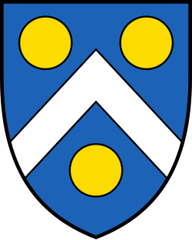
Coat of arms of Villars-le-Terroir
Azure, a chevron argent between three bezants. On a blue field, a white chevron is surrounded by three yellow discs. The chevron takes up the arms of the lords of Colombier, first known as the nobles of Villars-le-Terroir. Bezants are an attribute of Saint Nicholas of Myra, to whom the church is dedicated. The canton approves the arms in 1929.[5][3]
Founding of Villars-le-Terroir
An early medieval cemetery at the place called Sur le Châtelard shows that the site was already occupied. Before its first mention, Villars-le-Terroir formed a parish dependent on the abbey of Montbenoît, near Pontarlier. The abbey of Montheron, for its part, owned the estates of Buron and Montandrey. It is not known who founded Villars-le-Terroir, or when.[1]
History of Villars-le-Terroir
Early Middle Ages. A cemetery is laid out at the place called Sur le Châtelard.[1]
around 1150. A chapel dedicated to Saint Nicholas reportedly already exists. It may only be attested in the 13th century.[3]
before 1228. Villars-le-Terroir forms a parish dependent on the abbey of Montbenoît, near Pontarlier.[1]
1228. First mention in the form «apud Vilaret devant Gumoens» (or in 1222, date uncertain).[1][3]
Middle Ages. The abbey of Montheron owns the estates of Buron and Montandrey.[1]
1438. The village appears as «Villart le Terrioux».[1]
1453. The parish becomes a chapel of ease of that of Échallens.[1]
1475-1798. The village belongs to the common bailiwick of Orbe-Échallens, whose jurisdiction is shared between Bern and Fribourg.[1]
1764. The village has 33 hearths (households), 29 of them Catholic.[1]
1783. On 26 June 1783, during a storm, lightning strikes the bell tower and kills eleven people sheltering under the church porch.[3]
1798. Villars-le-Terroir is attached to the district of Échallens, until 31 December 2007.[1]
1811. A fever epidemic requires medical intervention by the State.[3]
1847. Villars-le-Terroir becomes a parish again.[1]
1908. Construction of the church of Saint-Nicolas, replacing the medieval chapel. It is restored in 1949, 1975 and 2009.[1]
1929. Adoption of the municipal coat of arms.[3]
1985. Agriculture still provides 74% of jobs (55% in 2005), but in 2000, 73% of the working population work outside the municipality.[1]
2008. Villars-le-Terroir joins the district of Gros-de-Vaud, created by the new territorial division of Vaud.[3][4]
2025. The municipality has 1'334 inhabitants on 31 December.[2]
Population of Villars-le-Terroir
Sources and references: [1][2]
| 1764 | 33 hearths (households) |
| 1798 | 410 |
| 1850 | 543 |
| 1900 | 581 |
| 1950 | 547 |
| 1970 | 499 |
| 2000 | 637 |
| 2025 | 1'334 |
Families of Villars-le-Terroir
Citizen families before 1800. Allaz, Dupuis, Dutoit, Gardaz, Jaunin, Juriens, Mettraux, Pittet and Vully, all with no precise date.[6]
In the 19th century. Seven families, all from abroad: the Savio (from Italy) in 1856, the Rogier (from France) in 1858 and the Devolz (from France) in 1859. They were followed by the Gamon (from France) in 1886, the Rouge (from France) in 1891, the Markert (from Germany) in 1894 and the Delmonaco (from Italy) in 1896.[6]
From 1901 to 1962. Nine entries, including four families from Italy: the Despont in 1938, the Chammartin in 1946, the Casotto (from Italy) in 1948, the Myhal in 1949, the Cazzaniga (from Italy) in 1953 and the Antonioli (from Italy) in 1954. Two Fribourg families came in 1956, the Brülhart of Ueberstorf FR and the Rime of Gruyères FR. The last to be entered, in 1959, were the Carcano, from Italy.[6]
Disasters and major events in Villars-le-Terroir
The lightning strike of 26 June 1783. On the feast of Corpus Christi, lightning strikes the bell tower. Eleven people sheltering under the porch are killed.[3]
The epidemic of winter 1811. An epidemic of nervous fever strikes the village during the winter.[3]
Historic sites in Villars-le-Terroir
Church of Saint-Nicolas. Built in 1908 in place of the medieval chapel, restored in 1949, 1975 and 2009. It has two pulpits, one Catholic and one Protestant, a feature reportedly now found only in the church of Assens.[1][3]
Hamlets of Buron and Montandrey. Grand Buron, Petit Buron and Montandrey were estates of the abbey of Montheron in the Middle Ages.[1]
Remains in Villars-le-Terroir
Cemetery of Sur le Châtelard. Early medieval cemetery at the place called Sur le Châtelard.[1]
Legends of Villars-le-Terroir
The inhabitants' nicknames. The inhabitants, called Villardiers, are reportedly nicknamed «Molliets» (the wet ones, or lovers of good food), «Râpes» and «Noyés».[3]
Sources
- Dictionnaire historique de la Suisse, « Villars-le-Terroir »
- Statistique Vaud, « Population résidante permanente au 31 décembre 2025 »
- Feuille des avis officiels du canton de Vaud, « Alphabet des communes vaudoises : Villars-le-Terroir »
- État de Vaud, communiqué du 12.07.2007, « Organisation des préfectures et adaptation au nouveau découpage territorial »
- IPI, Swissreg, emblems database: coat of arms of Villars-le-Terroir (no. 101991)
- Register of Swiss Surnames, 3rd edition (1989), search Commune "Villars-le-Terroir", Canton VD
Published by Sébastien Jörg ·
Other villages near Villars-le-Terroir
Missing information, or do you have a source? Suggest a correction or addition. Every submission is checked before it's published.
Suggest a change