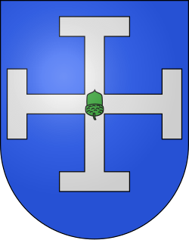
Goumoens-la-Ville
At Goumoens-la-Ville, the choir of the church of Saint-Théodule reportedly dates from Carolingian times, which would make it the oldest church in the canton of Vaud.
Entry based on 13 sources · Our method · Reusable text (CC BY-SA)
Origin of the name Goumoens-la-Ville
The village is first recorded in 1228 in the form «Guimuens li Vila». It bears the name of the old lordship of Goumoëns, whose castle, at Goumoens-le-Châtel, also gave its name to the noble de Goumoëns family. The element «la Ville» distinguishes it from Goumoens-le-Jux and Goumoens-le-Châtel.[1][3]
Founding of Goumoens-la-Ville
Goumoens-la-Ville emerged at the beginning of the 13th century from the division of the old lordship of Goumoëns, attested from 1097 by a castrum in the Talent valley, about ten kilometres north of Lausanne. According to tradition, the noble de Goumoëns family descends from Léotald de Goumoëns and his four nephews, around 1030. The territory was divided between the three branches descended from Guy de Goumoëns, known as Barata, the main founder of the abbey of Montheron: Goumoens-le-Jux, Goumoens-le-Châtel (now Saint-Barthélemy) and Goumoens-la-Ville, seat of a large parish from the 12th century. The Goumoëns were vassals of the bishop of Lausanne, of the Grandson, of the Cossonay and above all of the Montfaucon.[1][2][3][4]
History of Goumoens-la-Ville
around 1030. According to an unverified tradition, the noble de Goumoëns family goes back to Léotald de Goumoëns and his four nephews.[4]
1097. First attested mention of the lordship of Goumoëns, through the existence of a castrum in the Talent valley.[2]
1135. Guy de Goumoëns, known as Barata, is the main founder of the abbey of Montheron.[4]
early 13th century. Break-up of the lordship of Goumoëns into three lordships, shared between the branches descended from Guy Barata: Goumoens-le-Jux, Goumoens-la-Ville and Goumoens-le-Châtel.[2]
1228. First mention of the village under the name «Guimuens li Vila».[1]
13th century. Henri II de Goumoëns reportedly leads the seigneurial branch of Goumoens-la-Ville.[5]
1476-1798. The village belongs to the joint bailiwick of Orbe and Échallens, administered by Berne and Fribourg.[1]
1477. François de Goumoëns buys the château Dessus to make it his home.[4]
1501. A church bell is dated to this year.[4]
1536. End of the church's religious dependence on the abbey of Lac de Joux.[1]
1575. The community adopts the Protestant Reformation following a vote (plus).[1]
1614. Construction of the current residential building of the château Dessous.[4][5]
1798-2007. The village belongs to the district of Échallens.[1]
1888. Goumoens-la-Ville gets one of the first secondary-type schools in the canton of Vaud.[1]
1924. Madame Couvreu de Goumoëns, the last chatelaine, cedes the château Dessous to a foundation. It is now a medico-social institution (EMS).[4]
1940. A neo-medieval water tower that dominates the region is reportedly built this year.[6][7]
1 January 2008. With the new territorial division (law of 30 May 2006), the village moves from the abolished district of Échallens to the new district of Gros-de-Vaud.[9][10]
1 July 2011. Merger with Eclagnens and Goumoens-le-Jux to form the new municipality of Goumoëns.[1][9]
Population of Goumoens-la-Ville
Sources and references: [1]
| 1416 | 40 hearths (households) |
| 1764 | 64 communiers (holders of communal rights) |
| 1803 | 336 |
| 1850 | 443 |
| 1900 | 449 |
| 1920 | 392 |
| 1950 | 384 |
| 2000 | 611 |
Families of Goumoens-la-Ville
De Goumoëns. Noble family bearing the name of the old lordship and listed among the old burgher families of Goumoens-la-Ville. Alfred de Goumoëns died in 1876 and the Château Dessous passed to his only daughter, Madame Couvreu-de-Goumoëns.[4][13]
Burgher families before 1800. Basset, Bavaud, Bezençon, Bissat, Chaillet, de Goumoëns, Dufour, Favre, Jaquier, Jolimay, Logoz, Marguerat, Narbel and Thaler, with no precise date. No family was registered in the 19th century.[13]
From 1901 to 1962. Eight entries. The Schwartz, from Germany, opened the list in 1920, followed by the Caulet, from France, in 1929, then the Antoniazza, from Italy, in 1953. In 1956 the commune received the Janz from St. Stephan BE, the Morgenthaler from Staffelbach AG and the Romanens from Sorens FR, and in 1958 the Glauser from Zauggenried BE. The Aellen from Saanen BE closed the list in 1960.[13]
Economy of Goumoens-la-Ville, past and present
Cereals, beet and cattle. Goumoens-la-Ville has remained a farming village. Cereals, sugar beet and rapeseed are grown and cattle are raised. A land consolidation reorganised the fields between 1962 and 1979.[1]
Historic sites in Goumoens-la-Ville
Reformed church of Saint-Théodule. The church depended on the abbey of Montbenoît from the mid-12th century until 1476, then on the abbey of Lac de Joux until 1536. The parish adopted the Reformation in 1575. Its choir is a listed historic monument and the church is a cultural property of regional importance. It is said to be the oldest church in Vaud: parts of the choir reportedly date from the Carolingian period, i.e. the 9th century. It preserves 15th-century frescoes of musician angels, stained-glass windows by Jacques Wasem and Charles Clément, and a bell dated 1501.[1][4][6][7][8]
Dessus Castle. Castle that belonged to the lordship of Goumoens-le-Jux, bought in 1477 by François de Goumoëns to make it his home. The building now houses an inn.[1][4]
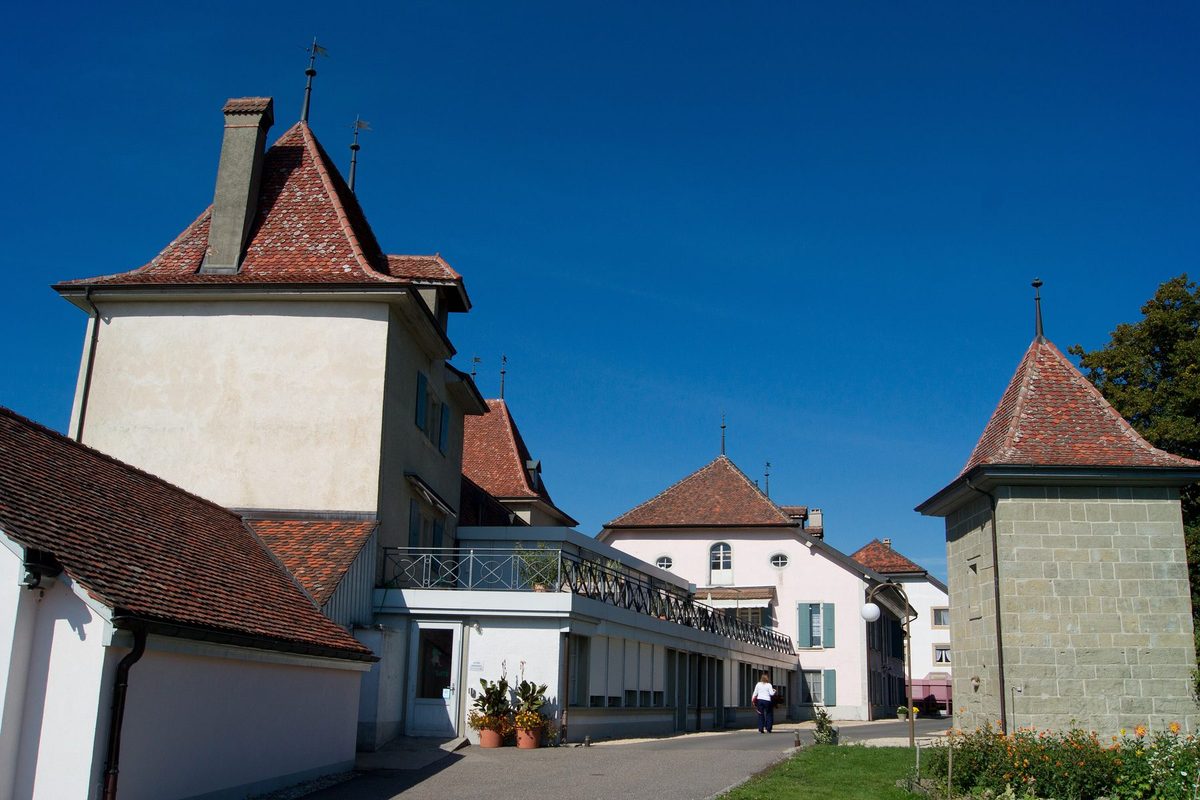
Dessous Castle. Residence of the lord of Goumoens-la-Ville, whose old towers survive with a residential wing built in 1614. Its last chatelaine, Madame Couvreu de Goumoëns, ceded it in 1924 to a foundation. It is now a medico-social institution (EMS). The castle, with its tower and fountain, is a cultural property of regional importance.[1][4][5][8]
Neo-medieval water tower. Neo-medieval water tower, nearly 40 metres high at its tip, which dominates the region. It reportedly dates from 1940, date uncertain.[4][6][7]
Remains in Goumoens-la-Ville
Remains of the two seigneurial castles. The Dessus and Dessous castles survive and have been converted, into an inn and a medico-social institution respectively. The Dessous castle keeps its old towers.[1][4]
Carolingian choir of the church of Saint-Théodule. Parts of the choir reportedly date from the Carolingian period (9th century), which would make Saint-Théodule the oldest church in the canton of Vaud. The choir is a listed historic monument.[4][6][7]
Protected heritage in Goumoens-la-Ville
Cultural property of regional significance (B objects)[12]
- Château (act. maison de repos) avec tour et fontaine
- Eglise réformée Saint-Théodule
Sources
- Dictionnaire historique de la Suisse, Marianne Stubenvoll, « Goumoens-la-Ville », version du 06.02.2017
- Dictionnaire historique de la Suisse, Jean-Jacques Bouquet, « Goumoëns (seigneurie) », version du 15.10.2009
- Dictionnaire historique de la Suisse, Marianne Stubenvoll, « Goumoëns, de », version du 08.10.2009
- Feuille des avis officiels du canton de Vaud, « Goumoëns », Alphabet des communes vaudoises
- swisscastles.ch, « Vaud : Le château de Goumoëns la Ville »
- Daniel Thomas, « Goumoens-la-Ville, ses trois châteaux et son église carolingienne / Visite guidée », carillons.ch, 22 septembre 2018
- Université populaire de Lausanne, cours « Goumoëns-la-Ville, ses trois châteaux et son église carolingienne »
- Office fédéral de la protection de la population, Inventaire PBC, liste cantonale VD (état au 1.1.2026)
- Canton de Vaud, Loi sur le découpage territorial (LDecTer, RSV 132.15) du 30 mai 2006
- État de Vaud, communiqué du 12.07.2007, « Organisation des préfectures et adaptation au nouveau découpage territorial »
- Statistique Vaud, « Population résidante permanente au 31 décembre 2025 »
- Federal Office for Civil Protection (FOCP), Swiss Inventory of Cultural Property (PCP), list for the canton of Vaud (as of 1.1.2026)
- Register of Swiss Surnames, 3rd edition (1989), search Commune "Goumoens-la-Ville", Canton VD
Published by Sébastien Jörg ·
Other villages near Goumoens-la-Ville
Missing information, or do you have a source? Suggest a correction or addition. Every submission is checked before it's published.
Suggest a change