Oulens-sous-Echallens
In 1553 Oulens adopted the Reformation by 24 votes to 18, the first village of the bailiwick of Orbe-Echallens to do so.
Entry based on 7 sources · Our method · Reusable text (CC BY-SA)
Origin of the name Oulens-sous-Echallens
The old form of the name is «Ollens». The place is said to be first mentioned in a donation by the Burgundian king Guntram to the abbey of Saint-Seine, dated 592 or 595; the date is uncertain. The name is said to be of Burgundian origin, «Ollingos», meaning «at the home of the Ollingi», the people of a certain Ollo, but this is not certain.[1][2]
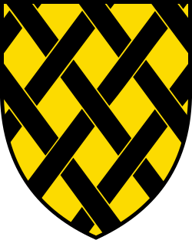
Coat of arms of Oulens-sous-Echallens
Or, fretty sable. On a yellow field, black strips crossing diagonally form a lattice. In 1921 the municipality took up these arms of the lords of Joux, in memory of its past. Early in the 12th century this family had founded the abbey of Montbenoît in Franche-Comté, on which the church of Oulens depended.[6][2][1]
Founding of Oulens-sous-Echallens
The area was occupied long before the Middle Ages: Hallstatt-period (Early Iron Age) burial mounds and an early medieval necropolis have been found there. If the Burgundian etymology is correct, the name would designate the settlement of the people of a certain Ollo. In the Middle Ages, Oulens depended on the lordship of Echallens. The abbey of Lac de Joux owned a grange (farm estate) there. Its chapel, first a dependency of Goumoens-la-Ville, belonged to the community of Montbenoît, founded in the early 12th century by the lords of Joux, which made it a parish before 1228. No founder is known for Oulens-sous-Echallens.[1][2]
History of Oulens-sous-Echallens
Early Iron Age. Hallstatt-period burial mounds are raised, probably in the Grand Bois.[1]
Early Middle Ages. A necropolis bears witness to the occupation of the site.[1]
592 or 595. A donation by King Guntram to the abbey of Saint-Seine is said to mention «Ollens».[2]
12th century. The chapel of Oulens is a dependency of Goumoens-la-Ville and belongs to the community of Montbenoît, founded by the lords of Joux. The Romanesque church is built.[1][2]
Before 1228. The abbey of Montbenoît, near Pontarlier, makes Oulens a parish.[1][2]
1453. The village has 20 hearths.[1]
1484. Oulens enters the common bailiwick of Orbe-Echallens, administered by Bern and Fribourg until 1798. The two states hold jurisdiction and part of the fief there, the rest belonging to the Thomasset, Mestrezat and de Martines families.[1]
1553. Oulens adopts the Reformation by 24 votes to 18, the first village of the bailiwick to do so.[1][2]
1640. The Protestants of Saint-Barthélemy are attached to the parish of Oulens.[1]
1764. The village has 52 hearths.[1]
1798. End of the common bailiwick. Oulens is attached to the district of Echallens, until 2007.[1]
1837. The dependency of Bettens is attached to the parish. A post office reportedly opened in the village the same year.[1]
1853. Forty-three inhabitants reportedly emigrated to Sétif, in Algeria.
1902-1904. The village is electrified. Running water reportedly follows in 1907.
1971-1987. Land consolidation.[1]
Late 1980s. The opening of the A1 motorway encourages commuters to settle.[1]
1997. Opening of the storage facility for stabilised waste of the French-speaking cantons (ISDS).[1]
2008. Oulens-sous-Echallens joins the district of Gros-de-Vaud.[1][3]
2025. The municipality has 609 inhabitants on 31 December.[4]
Population of Oulens-sous-Echallens
Sources and references: [1][4]
| 1453 | 20 hearths (households) |
| 1764 | 52 hearths (households) |
| 1803 | 330 |
| 1850 | 436 |
| 1900 | 396 |
| 1950 | 316 |
| 1970 | 266 |
| 2000 | 427 |
| 2025 | 609 |
Families of Oulens-sous-Echallens
Citizen families before 1800. Brun, Burnens, Chappuis, Chapuis, Clavel, Dufour, Dupraz, Mayor, Vulliamy and Vullyami are listed with no precise date.[7]
In the 19th century. The Brandt, from Lauperswil BE, are admitted in 1803. The Bezençon, from Eclagnens VD, also join during the century, with no precise date.[7]
1901 to 1962. Four registrations. The Bariatti, from Italy, open the series in 1955, followed by the Bigler of Muri bei Bern BE in 1956. A Chapuis family from Eclagnens VD is registered in 1956 and in 1958. The Kobel of Lauperswil BE follow in 1961.[7]
Economy of Oulens-sous-Echallens, past and present
Fields and forests. Oulens remains a farming municipality, with seventeen farms in 2000. In 2005 the primary sector provided 40% of jobs. The main crops are cereals, beet and potatoes. The municipality also owns large forests, shaped by human hands over time.[1][2]
Businesses and waste. Some twenty businesses operate in Oulens. Since 1997 the municipality has hosted the landfill for stabilised waste of the French-speaking cantons (ISDS). The village grocery closed in 2024.[2][1]
Historic sites in Oulens-sous-Echallens
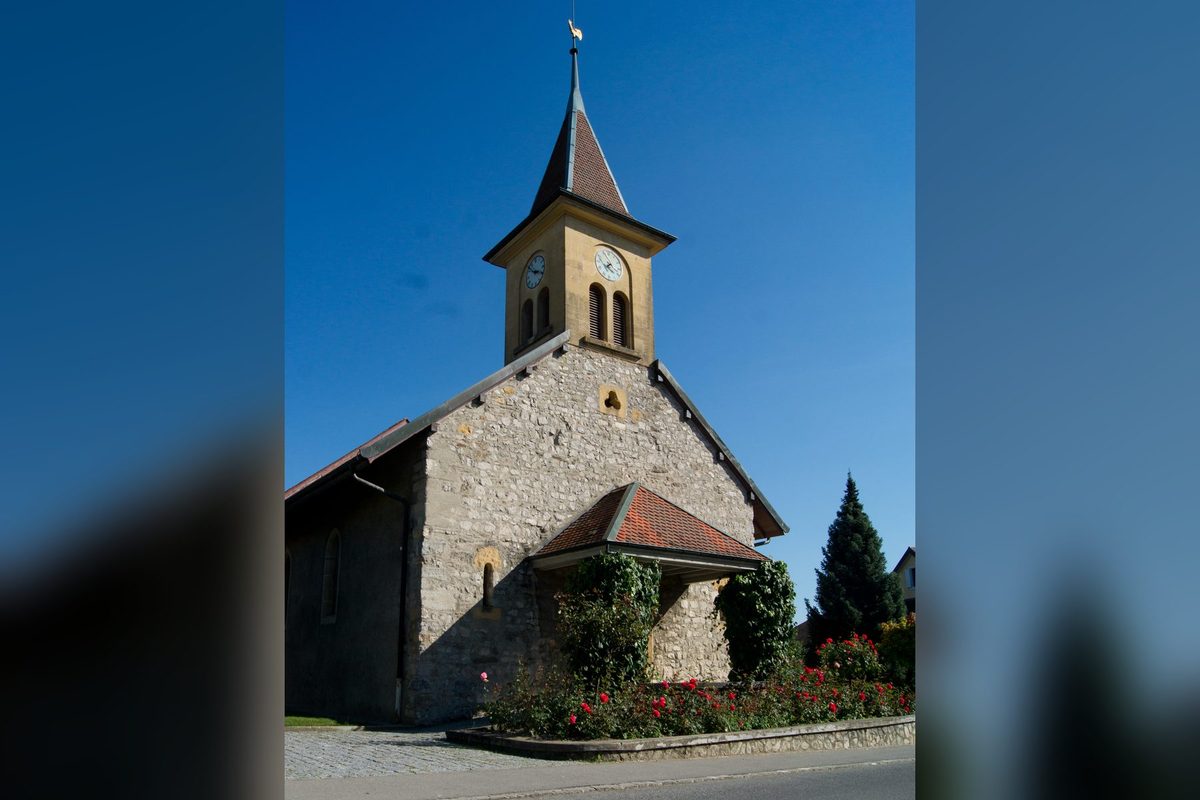
Church of Oulens. Romanesque church of the 12th century, whose choir dates from the early 16th century. Formerly a chapel of the community of Montbenoît, it became the parish church before 1228 and was renovated in 1964. It is reportedly listed as a cultural property of regional importance.[1][2]
Remains in Oulens-sous-Echallens
Grand Bois burial mounds. Protohistoric burial mounds of the Hallstatt period (Early Iron Age), reportedly located in the Grand Bois forest. They are reportedly listed as a cultural property of regional importance.[1]
Early medieval necropolis. An early medieval necropolis has been discovered in the municipal territory. Its exact location and the details of the finds are not recorded.[1]
Protected heritage in Oulens-sous-Echallens
Cultural property of regional significance (B objects)[5]
- Eglise réformée
- Le Grand Bois, tumuli de l'Age du Fer
Legends of Oulens-sous-Echallens
The nickname «Quicons». The inhabitants of Oulens are nicknamed the Quicons. The origin of this nickname is not known.[2]
Traditions and festivals in Oulens-sous-Echallens
The village societies. Throughout the year the Anim'Oulens events society organises activities for all ages, including an egg hunt. The Troupe théâtrale d'Oulens, known as TTO, and the youth society are also among the local societies. The «Coup de Balai» is part of the village calendar.[2]
Sources
- Dictionnaire historique de la Suisse, « Oulens-sous-Echallens » (Marianne Stubenvoll, version du 17.11.2009)
- Feuille des avis officiels du canton de Vaud, « Alphabet des communes vaudoises : Oulens-sous-Echallens »
- État de Vaud, communiqué du 12.07.2007, « Organisation des préfectures et adaptation au nouveau découpage territorial »
- Statistique Vaud, « Population résidante permanente au 31 décembre 2025 »
- Federal Office for Civil Protection (FOCP), Swiss Inventory of Cultural Property (PCP), list for the canton of Vaud (as of 1.1.2026)
- IPI, Swissreg, emblems database: coat of arms of Oulens-sous-Echallens (no. 101891)
- Register of Swiss Surnames, 3rd edition (1989), search Commune "Oulens-sous-Echallens", Canton VD
Published by Sébastien Jörg ·
Other villages near Oulens-sous-Echallens
Missing information, or do you have a source? Suggest a correction or addition. Every submission is checked before it's published.
Suggest a change