Bremblens
Between the Venoge and the Morges, a village of vines and fields that, in the early 1970s, chose houses over blocks of rented flats.
Entry based on 6 sources · Our method · Reusable text (CC BY-SA)
Coat of arms: Public domain, Wikimedia Commons
Origin of the name Bremblens
The name appears in 1177, already in its present form, «Bremblens». The meaning of «Bremblens» remains unknown.[1]
Coat of arms of Bremblens
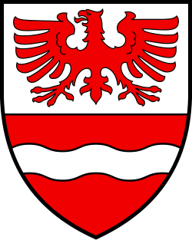
Per fess, argent an eagle gules, and gules a fess wavy argent. The shield is divided horizontally. At the top, a red eagle stands out on a white field. At the bottom, a wavy white band crosses a red field. Created in 1927, the arms are a variant of those of Morges. The eagle, attribute of Saint John, recalls the canons of Saint-Jean in Besançon, who owned the village in the 13th century.[4][5]
Founding of Bremblens
Nobody knows when or by whom Bremblens was founded. When it appears in the records, in 1177, the abbey of Lac de Joux owns land and vines there. In the 13th century the village has its own church, a parish church in 1228, and passes to the bishop of Lausanne, who buys it back from the chapter of Besançon in 1246.[1]
History of Bremblens
1177. The abbey of Lac de Joux owns land and vineyards at Bremblens. First mention of the place.[1]
1228. The church of Bremblens is a parish church.[1]
1246. The bishop of Lausanne buys Bremblens back from the chapter of Besançon.[1]
1285. It has lost its status as a parish church.[1]
1453. The church is a daughter church of Saint-Germain (Bussigny-près-Lausanne) and of Lonay.[1]
1536. Bernese conquest and Reformation: the church becomes a Protestant temple and depends on the parish of Lonay. The village belongs to the bailiwick of Morges.
1675. The lordship of Aclens, to which Bremblens belongs, is bought by the town of Morges.[2]
1798. Bremblens becomes part of the district of Morges.[1]
1809. The church tower is rebuilt. The church may also have been extended to the west, but this is not certain.[1]
early 1970s. The general council rejects a zone for apartment blocks and prefers a zone for detached houses.[1]
2000. The municipality has 360 inhabitants.[1]
Population of Bremblens
Sources and references: [1][3]
| 1764 | 107 |
| 1850 | 187 |
| 1870 | 158 |
| 1900 | 188 |
| 1950 | 183 |
| 1970 | 170 |
| 2000 | 360 |
| 2025 | 596 |
Families of Bremblens
Citizen families before 1800. Chabanel, Chambaz, Dapples, Ogiz and Perret, with no precise date.[6]
In the 19th century. The Clément, with no precise date, and the Bornand, from Sainte-Croix VD, in 1808.[6]
From 1901 to 1962. Four registrations: the Bettembos, from France, in 1915, the Albasini, from Italy, in 1941, then two Fribourg families, the Etter of Ried bei Kerzers in 1956 and the Grandjean of Le Crêt in 1957.[6]
Notable people of Bremblens
Gérard de Rougemont. Archbishop of Besançon, he gives the villa of Bremblens to the canons of Saint-Jean in Besançon in 1221.[5]
Jean de Cossonay. Bishop of Lausanne, he is the one who buys back Bremblens in 1246.[5]
Bernard de Budé. In 1675 he sells the lordship to which Bremblens belongs to the town of Morges for 70'000 florins.[5]
Economy of Bremblens, past and present
Fields, cattle and market gardens. Despite the growth of western Lausanne, Bremblens remains a village of farmers and winegrowers. Farmland and vineyards cover 67% of the territory and forest 20%, much of it owned by the municipality. Three farms raise cattle and three others are market gardens. On a vineyard plot of 2'034 m², the municipality makes its own wine.[1][5]
The Les Corbes craft zone. The Les Corbes craft zone covers just under 4 hectares and brings together 25 businesses.[5]
Disasters and major events in Bremblens
The fire of January 1862. Fire destroyed several houses in the village. A few old buildings in the centre escaped.[5]
The droughts of 1893 and 1895. Two droughts forced the municipal council to close the wells. The village then built a water pipeline. On 25 July 1902, at 1.15 pm, a cannon shot announced the arrival of water in Bremblens.[5]
Historic sites in Bremblens
Bremblens church (temple). The church dates from the 13th century and became a Reformed church in 1536. Its tower dates from 1809. It was restored in stages: the exterior in 1966-1971, the interior in 1975-1976, the tower in 1988-1990 (dates still to be confirmed).[1]
Village core. Despite the growth of western Lausanne, the village has remained agricultural and wine-growing. In the early 1970s the General Council preferred a villa zone to a zone for rental apartment buildings.[1]
Traditions and festivals in Bremblens
The communal oven. The village's communal oven is in use until 1948. Known for its tarts, it earned the inhabitants the nickname "Tâtris", the tart eaters.[5]
Sources
- François Béboux, « Bremblens », Dictionnaire historique de la Suisse, version du 04.05.2004
- François Béboux, « Aclens », Dictionnaire historique de la Suisse, version du 23.06.2009
- Statistique Vaud, « Population résidante permanente au 31 décembre 2025 »
- IPI, Swissreg, emblems database: coat of arms of Bremblens (no. 102079)
- Official Gazette of the Canton of Vaud (FAO), "Alphabet des communes vaudoises: Bremblens"
- Register of Swiss Surnames, 3rd edition (1989), search Commune "Bremblens", Canton VD
Published by Sébastien Jörg ·
Other villages near Bremblens
Missing information, or do you have a source? Suggest a correction or addition. Every submission is checked before it's published.
Suggest a change