Lonay
Built in 1437, the Lonay tile works was among the most important in French-speaking Switzerland until 1913. In 1981 a women's prison was built on its site.
Entry based on 11 sources · Our method · Reusable text (CC BY-SA)
Origin of the name Lonay
The name appears in 1152-1160 as «Lonna» (around 1155), then «Losnay» in 1177. The usual form «Lonay» prevails from 1262. For «Lonay», no etymology is certain. Suggestions include a Latin name, Lonus, with the suffix «-acum», or rather, judging by the old forms, a formation based on Lusenus.[1][2]
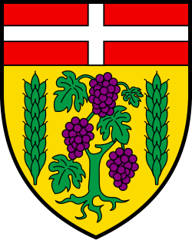
Coat of arms of Lonay
Or, a vine branch leaved and fructed of three proper, between two ears of wheat vert, on a chief gules a cross argent. On a yellow field, a vine branch with its leaves and three bunches of grapes, in natural colours, stands between two green ears of wheat. At the top, a red band bears a white cross. Adopted in 1925, the arms recall through their chief the Roman-Dessous vineyard estate, which the Templars of La Chaux received from the lords of Cossonay in the early 12th century. The Knights Hospitaller inherited it the following century and kept it until the Reformation. The vine branch and the ears stand for the local crops.[8][9]
Founding of Lonay
Lonay has no known founder. Yet the area was occupied in Roman times, as 1st-2nd century remains at Les Combes show, and then in the early Middle Ages, with the Roman-Dessus cemetery. In the Middle Ages Lonay was a rural parish of the diocese of Lausanne, whose church of Saint-Germain the bishop ceded to the chapter of Lausanne. Vines have been grown here since the 12th century. The municipality comprises the village and the hamlet of Roman.[1]
History of Lonay
1st-2nd century. Roman remains at Les Combes, including a late 1st-century tomb.[1]
Early Middle Ages. Cemetery at Roman-Dessus.[1]
12th century. Wine-growing begins.[1]
1152-1160. First mention, in the form «Lonna».[1]
1177. The name appears in the form «Losnay».[1]
1220. The bishop cedes the church of Saint-Germain to the chapter of Lausanne.[1]
1228. Saint-Germain is a parish church.[1]
1285. The parish of Echandens is attached to that of Lonay.
1342. Lonay reportedly belongs to the castellany of Morges.
1437. A tile works is built.[1]
1668. The parsonage, a winegrower's house, was reportedly rebuilt that year.
around 1677. The tower of Roman-Dessous was reportedly converted into a manor house at this time.
1740-1741. The nave of the church was reportedly rebuilt.
1798. Lonay becomes part of the district of Morges.[1]
1855. The railway arrives.[1]
1880. The tile works is mechanised. Until 1913 it is one of the largest in French-speaking Switzerland.[1]
1960s. The Lausanne-Geneva motorway and the marshalling yard transform the municipality.[2]
1981. The Hoffmann kiln of the tile works is demolished. A women's prison is built on the site.[2]
2016. A 6-metre giant steel ant, an allusion to the inhabitants' nickname, is set down by helicopter on the La Gracieuse roundabout.
2025. The municipality has 2'719 inhabitants.[3][6]
Population of Lonay
Sources and references: [1][3][6]
| 1764 | 276 |
| 1798 | 226 |
| 1850 | 439 |
| 1900 | 462 |
| 1950 | 534 |
| 1960 | 1'000 |
| 2000 | 1'900 |
| 2025 | 2'719 |
Families of Lonay
Forel. The Forel family owned from 1628 the small wood next to La Gracieuse, known as Bois Forel or bois Guebhardt. In 1914 the wood was bequeathed to the children of Georges de Goumoëns-Forel, and their heirs gave it to the commune in 1989.[2]
Citizen families before 1800. Eleven families, with no precise date: Brocard, Forel, Miéville, Régis, Rosset and Villard, as well as the Borboen and the Pête, of Morges VD, the Bressenel and the de Goumoëns, of Lausanne VD, and the Panchaud, of Poliez-le-Grand VD.[10]
From 1901 to 1962. Seventeen registrations. The Bonardel, from France, open the series in 1907, followed by the Geissmann from Germany (1908 and 1909), the Guichard from France (1916), the Mello from Italy (1930) and the Angel from Greece (1931). The Germann of Adelboden BE were registered in 1952 and 1958. In 1956 come the Coendet of Münchenwiler BE, the Gonnet from Italy and the Walthert of Oberdiessbach BE, in 1957 the Hans from Germany, the Maurer of Leimbach AG and the Müggler of Au TG, in 1959 the Graf of Uetendorf BE, and in 1961 the Circurel from Egypt, the Stettler of Worb BE and the Zumbrunnen of Zweisimmen BE. The last, in 1962, are the Pansky, from Austria.[10]
Notable people of Lonay
Auguste Forel (Morges 1848 - Yvorne 1931). Psychiatrist and naturalist. The ants of Lonay aroused his curiosity and then shaped his calling as a naturalist. His book "Les fourmis de la Suisse" earned him the Schläfli Prize in 1872. He later directed the Burghölzli asylum in Zurich and taught psychiatry at the university until 1898.[11][2]
Economy of Lonay, past and present
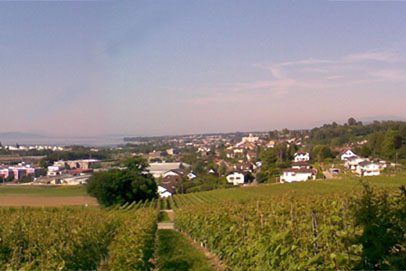
Farmers and winegrowers. From the Middle Ages, the people of Lonay were mostly farmers and winegrowers. This farming and winegrowing character shaped village life until the 1950s and 1960s. Its 372 hectares include 36 hectares of vines.[2][9]
The tile works. A tile works is recorded from the 15th century. Its last kiln operated until 1920. In autumn 1981, the buildings were demolished to make way for the prison, and the remains of the kiln were uncovered and recorded.[2]
Marshalling yard, motorway and industry. Once made up of separate hamlets, the village changed deeply from the 1960s. The regional boom set off by Expo 64, the Lonay-Denges marshalling yard and the Lausanne-Geneva motorway brought activity and jobs. The first industries arrived in the 1980s. The commune has two business zones.[2][9]
Disasters and major events in Lonay
The plague of 1439. A terrible winter of famine came before 1439, a year of plague. In 1438, the miller of Morges had only three sacks of wheat to grind. The plague then spread across the Pays de Vaud. The parish had 50 households in 1416. In 1453, the priest had only about 40 hearths, or 200 souls, under his authority.[2]
Historic sites in Lonay
Reformed church, former church of Saint-Germain. Church ceded in 1220 by the bishop to the chapter of Lausanne, a parish church in 1228. The vaulted choir dates back to the 12th century and the square tower to the second half of the 13th century. The nave is said to have been rebuilt in 1740-1741, date uncertain. Restored in 1951 by the Morges architect M. Cruchet, it has a stained-glass window by Yvon Monay, a native of Lonay.[1][2]
La Cure. Winegrower's house with a vast roof, reportedly rebuilt in 1668. Its outbuildings became a parish centre, and the canton of Vaud renovated the house.[2]
Roman-Dessous. Former tower reportedly converted into a manor house around 1677. The estate is listed as a cultural property of regional importance.[5]
The ant. Rusted steel sculpture of a giant ant, 6 metres high, installed in 2016 on the La Gracieuse roundabout. It recalls the inhabitants' nickname, «les Fourmis» (they are also called «les Branle-Cloches»).[3][4]
Remains in Lonay
Roman remains at Les Combes. 1st-2nd century remains, including a late 1st-century tomb, discovered between 1920 and 1940.[1]
Roman-Dessus cemetery. Early medieval cemetery in the hamlet of Roman.[1]
Former tile works. Tile works built in 1437, mechanised from 1880, one of the largest in French-speaking Switzerland until 1913. Its Hoffmann kiln was demolished in 1981.[1][2]
Protected heritage in Lonay
Cultural property of regional significance (B objects)[7]
- Roman-Dessous, maison de maître et rural
- Roman-Dessous, maison de maître, maison paysanne, rural et fontaine
- Roman-Dessus, maison de maître, dépendance, rural et maison d'habitation
- Roman-Dessus, maison vigneronne et rural
Traditions and festivals in Lonay
The Confraternity of the Holy Spirit. On 14 June 1342, Louis II of Savoy, lord of Vaud, granted the inhabitants the right to maintain and enlarge the Confraternity of the Holy Spirit founded in Lonay. Its members helped the poor and had services said for deceased brothers.[2]
The Abbaye and the village festival. The Abbaye de Lonay and the village festival take place every three years.[9]
Theatre and song. The Les Branle-Cloches theatre troupe, which bears one of the inhabitants' nicknames, and the La Vigneronne mixed choir enliven the village's cultural life.[9]
Sources
- Dictionnaire historique de la Suisse, « Lonay »
- Commune de Lonay, « Histoire »
- Commune de Lonay, page d'accueil (sobriquets, population)
- Julie Kummer, « La fourmi géante a rejoint son nid lonaysan », 24 heures, 1er décembre 2016 (reproduit par le Dictionnaire amoureux des fourmis)
- Office fédéral de la protection de la population, Inventaire PBC, liste du canton de Vaud (état au 1.1.2026)
- Statistique Vaud, « Population résidante permanente au 31 décembre 2025 »
- Federal Office for Civil Protection (FOCP), Swiss Inventory of Cultural Property (PCP), list for the canton of Vaud (as of 1.1.2026)
- IPI, Swissreg, emblems database: coat of arms of Lonay (no. 101383)
- Official Gazette of the Canton of Vaud (FAO), "Alphabet des communes vaudoises: Lonay"
- Register of Swiss Surnames, 3rd edition (1989), search Commune "Lonay", Canton VD
- Historical Dictionary of Switzerland (HDS), article "Forel, Auguste" (version of 08.12.2005)
Published by Sébastien Jörg ·
Localities of the municipality with a page
Other villages near Lonay
Missing information, or do you have a source? Suggest a correction or addition. Every submission is checked before it's published.
Suggest a change