Préverenges
Off Préverenges lie two prehistoric lakeside sites and the Île aux Oiseaux, an artificial islet built in 2001-2002 for migrating birds.
Entry based on 13 sources · Our method · Reusable text (CC BY-SA)
Origin of the name Préverenges
The name reportedly comes from the Burgundian personal name Berwer or Perwer, followed by the suffix «-enges», which renders the Germanic «-ing» and means roughly «among the people of». The place is first mentioned in 1224, in the form Preverenges. The inhabitants are called Préverengeois and Préverengeoises. In the patois the village is also said to have borne the nickname «Defrayguenies», roughly «the ragamuffins».[1]
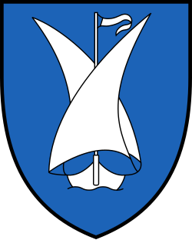
Coat of arms of Préverenges
Azure, a boat argent with two lateen sails, seen from the front. On a blue field a white boat seen from the front carries two triangular sails. The authorities chose to show not the village's history but the landscape before their eyes. The arms are registered in 1929.[11][12]
Founding of Préverenges
Préverenges has no founding act, but the site was inhabited long before the Middle Ages: two lakeside sites have been located offshore, one from the Final Neolithic, the other from the Early Bronze Age. In the Middle Ages the parish depended on the priory of Saint-Sulpice, while the lordship belonged among others to the lords of Colombier and to the chapter of Lausanne. Bern, master of the Pays de Vaud since 1536, bought this lordship in 1701, and Préverenges then came directly under the bailiff of Morges.[1][3]
History of Préverenges
Final Neolithic. A site is occupied on the lakeshore, at the location today called Préverenges II, west of the present-day village. It is dated to the Final Neolithic based on the lithic material found on the lake bed.[3]
Early Bronze Age. A lakeside village is established a little further east, at the site today called Préverenges I. Dendrochronological analysis of 809 piles distinguishes two successive habitation phases: the first with fourteen houses aligned perpendicular to the shore, the second, smaller, with only five huts.[3]
2nd century. Gallo-Roman objects, as well as later medieval artefacts, are found mixed with the remains of the lakeside village, a sign that the shore was used well after the prehistoric site was abandoned.[4]
1224. Earliest known mention of the place, in the form Preverenges.[1]
1238. It was reportedly at Préverenges that the bishop of Lausanne, Guillaume d'Écublens, and Aymon II of Faucigny signed the treaty settling the buyout of the Lausanne episcopal advocacy.
1481-1914. A tile works operates at Préverenges for more than four centuries.[1]
1536. The conquest of the Pays de Vaud by Berne places Préverenges under the administration of Berne. The Protestant Reformation is imposed there shortly afterwards.
16th century. At the Reformation, Préverenges is attached to the parish of Lonay.[1]
1701. The lordship of Préverenges is sold to Berne, which from then on administers it directly from the bailiwick of Morges.[1]
1791-1792. The church is remodelled in the Baroque style.[1]
1807. Birth in Préverenges of Louis-Henri Delarageaz, future councillor of state and a prominent figure of the 1845 Vaud revolution.
1956. The parish of Préverenges is attached to that of Morges.[1]
second half of the 20th century. The village experiences strong population growth, helped by its position between Lausanne and Morges and the nearby motorway. A few industries settle at the place called Le Trési.[1]
1969. An autonomous Reformed parish is re-established at Préverenges.[1]
1971. A Catholic community also organizes itself in the village.[1]
2001-2002. Construction of the Île aux Oiseaux, an artificial islet at the mouth of the Venoge intended as a stopover for migrating waders, between October 2001 and July 2002. The idea had arisen in 1984 within the Cercle ornithologique de Lausanne, and the project had been selected in 1997 by the Federal Office for the Environment, Forests and Landscape.[9]
2011. The Préverenges I lakeside site, together with several dozen other Swiss pile-dwelling sites, is inscribed by UNESCO on the World Heritage List, as part of the serial property "Prehistoric Pile Dwellings around the Alps".[4]
2015. A nesting platform is added to the Île aux Oiseaux. It reportedly helped make the islet the most important colony of common terns and black-headed gulls in the Lac Léman basin.
2020-2022. The Île aux Oiseaux nature reserve is redeveloped. An educational centre, the Maison de l'Île aux Oiseaux, was reportedly opened there in March 2022.
2026. In the municipal elections of 8 March, Virgile Perret is elected syndic (mayor). Préverenges remains, to this day, a municipality independent from the district of Morges. No merger project has been identified for this municipality, unlike several other Vaud municipalities at the foot of the Jura.
Population of Préverenges
Sources and references: [1][6][10]
| 1764 | 121 |
| 1850 | 229 |
| 1900 | 254 |
| 1950 | 486 |
| 1970 | 1'837 |
| 2000 | 4'078 |
| 2023 | 5'215 |
| 2025 | 5'236 |
Families of Préverenges
Citizen families before 1800. Bieler, Bolliet, Grand, Mermoud, Moyard and Paquier, with no precise date. The Delarageaz become citizens in 1606, the Groshaupt, from Germany, in 1782.[13]
In the 19th century. A single registration: the Stoudemann, from Wahlern BE, in 1838.[13]
From 1901 to 1962. Sixteen registrations. The Coen, from Italy, in 1922 and the Weiss, from Germany, in 1953 come before a series of Swiss families. In 1956: Bühlmann of Rubigen BE, Catillaz of Giffers FR, Steiner of Kandergrund BE and Wehrli of Küttigen AG. In 1957: Brügger of Reichenbach im Kandertal BE, Buchs of Lenk BE, Hédiger of Reinach AG and Hostettler of Guggisberg BE. In 1958: Begert of Ersigen BE and Gillard of Botterens FR. In 1959: Cornut of Vouvry VS, Küffer of Ins BE and Strähl of Saanen BE. The Müller of Rohrbach BE close the list in 1960.[13]
Notable people of Préverenges
Louis-Henri Delarageaz (Préverenges 1807 - Préverenges 1891). The son of a well-off farmer and innkeeper, he earns his surveyor's diploma in 1831 and opens his own business. In 1841 he enters the Vaud Grand Council as a radical. With Henri Druey, he becomes one of the leaders of the Vaud revolution of 1845, the year of his election to the Council of State.[2]
Economy of Préverenges, past and present
The tile works. A tile works is mentioned from 1481. Owned by Bern from 1536, it closes in 1914.[1]
From fields to housing. Préverenges has lost its rural character and become a major residential municipality. A few industries have settled at the place called Le Trési. On the Monteiron hill, vines still mark the landscape.[1][12]
Historic sites in Préverenges
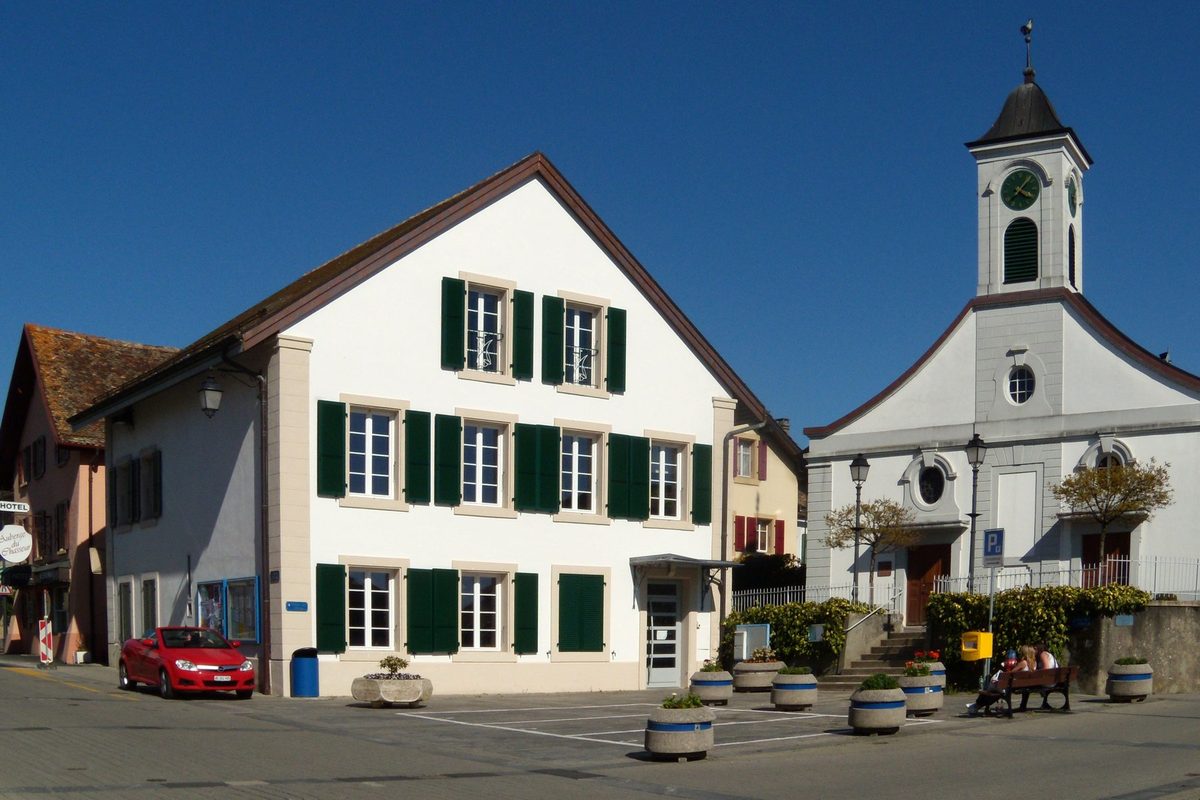
The church. A former parish church that depended on the priory of Saint-Sulpice in the Middle Ages, it was remodelled in 1791-1792 in the Baroque style.[1]
The Maison Muret. A large manor house built in molasse sandstone at the end of the 18th century. It has reportedly housed the seat of Préverenges's municipal administration since 1991.
The inn À l'Enseigne de l'Étoile d'Or. Built in 1797, this former inn is where Louis-Henri Delarageaz, a prominent figure of 19th-century Vaud political life, was born in 1807. The municipality reportedly bought it back in 1917, and the municipal council is said to have met there since 1918.
The Île aux Oiseaux. This artificial islet, built in 2001-2002 at the mouth of the Venoge as a stopover for migrating waders, grew out of a 1984 idea of the Cercle ornithologique de Lausanne. Now a nature reserve, the site reportedly received a nesting platform in 2015 and an educational centre, the Maison de l'Île aux Oiseaux, opened in March 2022.[9]
Remains in Préverenges
Préverenges I, Early Bronze Age lakeside village. Searched for in 1975 and surveyed in December 1977 by F. Vogt and G. Paillex, this submerged lakeside site off the village dates from the Early Bronze Age. Dendrochronological analysis of 809 piles distinguishes two phases of occupation: first fourteen houses 10 to 15 metres long and about 5 metres wide, aligned perpendicular to the shore, then, in the east of the site, five huts with the same orientation. A few later objects, including a Gallo-Roman pot rim from the late 2nd century and a dagger judged medieval, show later use of the shore. The site was inscribed on the UNESCO World Heritage List in 2011.[3][4]
Préverenges II, Final Neolithic site. Located 430 metres west of Préverenges I, this second site is dated to the Final Neolithic on the basis of lithic material collected on the surface. Its extent, marked by the spread of the piles, is clearly larger than that of Préverenges I.[3]
Sources
- François Béboux, « Préverenges », Dictionnaire historique de la Suisse (DHS), version du 17.02.2010
- Dictionnaire historique de la Suisse (DHS), « Delarageaz, Louis-Henri »
- État de Vaud, Section archéologie cantonale, « Candidature à l'UNESCO : les sites préhistoriques littoraux du canton de Vaud dans le cadre du projet Palafittes », 2010, mise à jour juin 2011
- Association pour la sauvegarde du patrimoine subaquatique lémanique (sub-leman.ch), « Préverenges I »
- citypopulation.de, données démographiques de Préverenges
- Localcities, fiche de la commune de Préverenges (population 2023, OFS)
- La Côte, article sur les élections communales 2026 à Préverenges
- Site officiel de la commune de Préverenges
- Lionel Maumary, Laurent Vallotton et Michel Baudraz, « Construction d'une île aux oiseaux à Préverenges : un nouveau site d'escale pour les limicoles migrateurs », Nos Oiseaux 50, 2003, p. 59-64
- Statistique Vaud, « Population résidante permanente au 31 décembre 2025 »
- IPI, Swissreg, emblems database: coat of arms of Préverenges (no. 101405)
- Official Gazette of the Canton of Vaud (FAO), "Alphabet des communes vaudoises: Préverenges"
- Register of Swiss Surnames, 3rd edition (1989), search Commune "Préverenges", Canton VD
Published by Sébastien Jörg ·
Other villages near Préverenges
Missing information, or do you have a source? Suggest a correction or addition. Every submission is checked before it's published.
Suggest a change