Morges
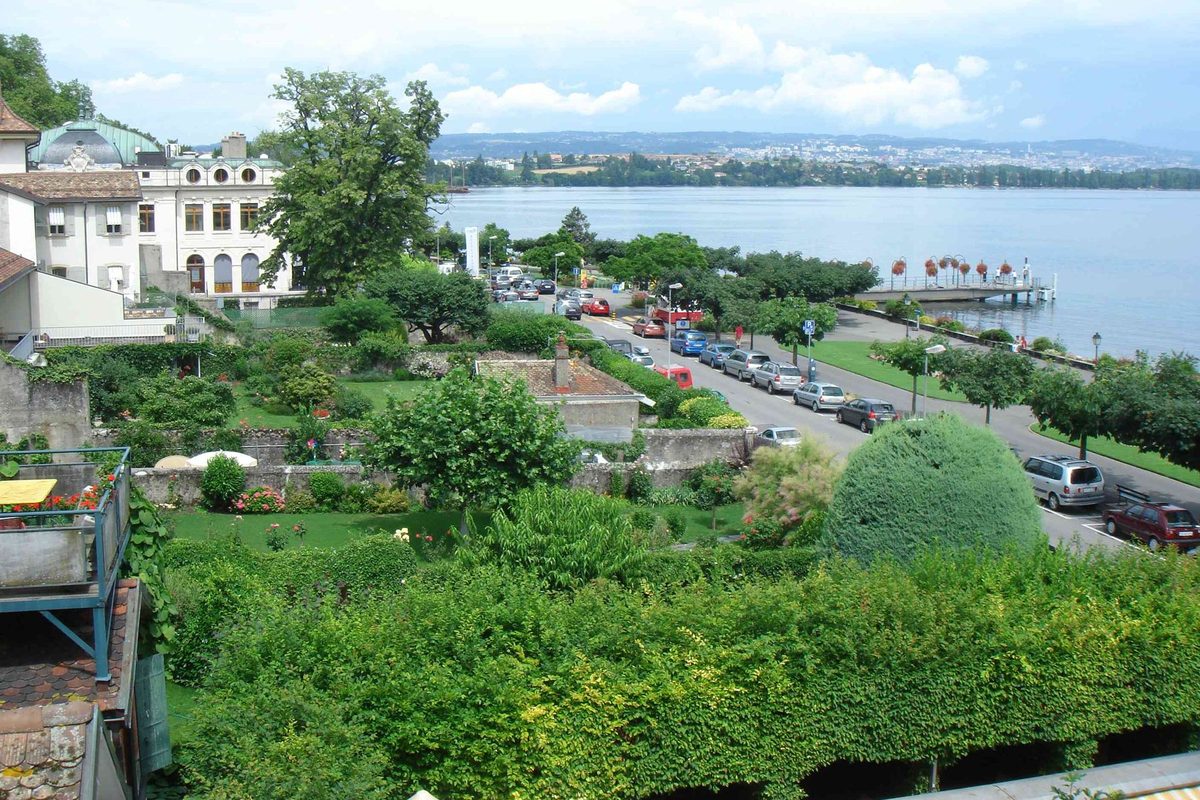
Louis I of Savoy founded it in 1286 around his castle. Its Bronze Age lakeshore villages have been on the World Heritage List since 2011.
Entry based on 19 sources · Our method · Reusable text (CC BY-SA)
Origin of the name Morges
The name appears in 1288 as "Morgia". It is also that of the river Morges, which flows into the lake here. The origin of this river name has not yet been explained. In German the town was formerly called "Morsee".[1]
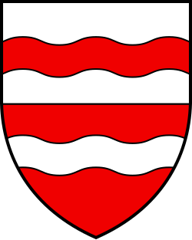
Coat of arms of Morges
Per fess argent and gules, two bars wavy counterchanged. The shield is divided horizontally, white above and red below. Two wavy bands cross it, red on the white and white on the red. Attested on seals from 1530, the arms echo in their colours the arms of the House of Savoy. The two wavy bars stand for the streams that bounded the town to the east and west.[14][15]
Founding of Morges
Lakeshore villages occupied the shore from the Bronze Age. The town itself is a Savoyard creation: Louis I of Savoy laid out a new town here on a regular Zähringen-type plan, protected by a castle. A few years later it had its liberties. Under Bernese rule Morges was one of the four "good towns" of Vaud, together with Moudon, Nyon and Yverdon. Their last assembly was held at Morges in 1728.[1][2]
History of Morges
Bronze Age. Lakeshore villages of Les Roseaux (Early Bronze Age), Grande-Cité and Vers-l'Église (Late Bronze Age), explored from 1854.[1]
1286. Louis I of Savoy founds the new town of Morges, protected by a castle.[1][7]
1288. First known mention of the name, in the form "Morgia".[1]
1293. The town's liberties are mentioned.[1]
1459. The town has 130 hearths (households).[1]
1536. Bernese conquest of Vaud; Morges becomes the seat of a bailiwick in 1539.[1]
around 1540-1550. The upper half of the castle is rebuilt to adapt it to artillery.[1][7]
1690-1692. Construction of the Bernese granary.[1]
1691-1696. The present harbour, with two curved breakwaters, is built.[1]
1721. The town has 1'942 inhabitants.[1]
1769-1776. Construction of the temple (Reformed church), regarded as one of the masterpieces of Reformed architecture in Switzerland.[1][6]
1855. Opening of the canton's first railway link, between Morges and Yverdon.[1]
1915-1920. The composer Igor Stravinsky lives in Morges.[3]
1922. Founding of the cantonal agricultural school.[1]
1925. The castle becomes home to the Vaud Military Museum.[1][7]
1936. The Polish pianist and statesman Ignacy Paderewski, who lived for 43 years at his Riond-Bosson estate in Morges, brings together Polish opposition leaders there in the Front de Morges.[5]
1964. The A1 motorway crosses the commune.[1]
2000. The town has 14'154 inhabitants.[1]
2011. The Morges lakeshore settlements are inscribed on the UNESCO World Heritage List as part of the "Prehistoric Pile Dwellings around the Alps".[9][10]
Population of Morges
Sources and references: [1][12]
| 1459 | 130 hearths (households) |
| 1721 | 1'942 |
| 1764 | 2'385 |
| 1850 | 3'241 |
| 1900 | 4'421 |
| 1950 | 6'456 |
| 2000 | 14'154 |
| 2010 | 14'744 |
| 2025 | 17'813 |
Families of Morges
Citizen families before 1800. Thirty-nine families. Fifteen are listed with no precise date: Blanchenay (from Savoy), Borboen, Cart, Chauvet, Dapples, de Beausobre (from France), Debrit, Dubosson (from Vevey VD), Gaudin, Gondoux, Marquis, Pache, Panchaud, Régis and Warnery. The others were admitted between 1549 and 1797: Mandrot from Rances VD (1549), Forel from Cully VD (1589), Fevot (1634), Boand (1638), Muret from Savoy (1640), Grivel from Saint-Livres VD (1645), Villard (1652) and Pête (1668) from Lonay VD, Hunziker (1670), von Grenus (1676), Rosset (1677), Perret (1693) and Monod from Vullierens VD (1741). In 1760 three names from France were registered: du Plessis-Gouret, Duplessis and Duplessis-Gouret. Huc-Mazelet (1762) and Reboul (1769), also from France, follow. The year 1791 has five: Hochreutiner from St. Gallen, Hugonnet, Mercier from Echichens VD, Mousson from France and Valloton from Vallorbe VD. The Despland, from Grandson VD, close the list in 1797.[16]
In the 19th century. Nineteen registrations, all dated: Kuntzy from Erlach BE (1810), Foltz from Duillier VD (1812), Kraemer from Germany and Soutter from Kölliken AG (1818), Renevier from Mont-sur-Rolle VD (1819), Reymond from Le Chenit VD (1825), Klöpfer from Germany (1831), Callet from France (1833), Wild from St. Gallen (1838), Andersen from Denmark (1841), Portner from Wattenwil BE (1860), Mundler from Germany (1883), Lipp from Germany and Suhitilar from France (1885), Crosasso from Italy (1888), Dieterle (1891) and Dreyfus (1893) from Germany, Dissard from France (1895) and Trivelli from Italy (1896 and 1898).[16]
From 1901 to 1962. With 212 registrations, this century dominates the list. Seventy-eight families come from the canton of Bern, twenty-six from Fribourg and twenty-two from Italy. There are also the Pilosoff, from Bulgaria (1925), the Buck (1927) and the Maniakine (1951), from the Soviet Union, and the Gansgof van der Meersch, from Belgium (1959). The last registrations, in 1962, concern ten families, including the Cegielski from Poland, the Georgi from Germany and the Zweigart from Italy.[16]
Notable people of Morges
Jean-Jacques Cart, Henri Monod and Jules Muret. Morges, one of the centres of the Vaud revolution, produced many patriots, among them these three men.[1]
François-Alphonse Forel (Morges 1841 - Morges 1912). At thirteen he was already taking part in excavations at the lake-dwelling sites of Morges. A professor in Lausanne from 1871, he published Le Léman in three volumes (1892, 1896 and 1904), thereby founding limnology. He sat on the Morges municipal council from 1867 to 1909.[17][19]
Ignacy Jan Paderewski (Kurylowka 1860 - New York 1941). He settled at Riond-Bosson in 1897, bought the estate in 1899 and left it only in 1940, for the United States. In 1919 he was Prime Minister and Foreign Minister of Poland.[5]
Pierre Monay (Nancy 1896 - Morges 1974). Trained at the Lausanne School of Fine Arts, the artist returned to Switzerland in 1943 and settled in Morges, where he opened the Galerie 53.[18]
Economy of Morges, past and present
Fairs, transit and port. The streets of the medieval town were laid out to host the great annual fairs. The Place du Marché gathered the market halls, the granary and the butchery. Under the Ancien Régime, Morges lived more from transit than from production: salt, wine and grain passed through its commercial and military port. In 1798 people living on private income were the largest group, ahead of merchants, winegrowers and farmers.[1]
Tanneries, shipyard and factories. Tanneries long formed a significant part of local industry. Steam navigation revived activity in the second half of the 19th century, and the Compagnie générale de navigation sur le lac Léman had its shipyard in Morges from 1858 to 1889. The Oulevay biscuit factory (1899-1992) and the metal construction works of the Société industrielle de Morges (1907-1979) then shaped the town's industry.[1]
Services and shops. Morges has 9'300 jobs. The Ensemble hospitalier de la Côte and the headquarters of Romande Énergie and of Incyte Biosciences Europe sit alongside small businesses. Nearly 180 small shops liven up the town centre.[15]
Disasters and major events in Morges
The sackings of 1475 and 1530. The town and its castle were sacked in 1475 and in 1530. The convent was devastated by Confederate troops in 1530 and again in 1536. Punished for not joining the Bernese quickly enough, Morges then had to raze its two town gates.[1]
The explosion of 1871. The castle, then the cantonal arsenal, was hit by an explosion in 1871.[1]
Historic sites in Morges
Morges Castle. Founded in 1286 by Louis I of Savoy and its upper half rebuilt around 1540-1550 by the Bernese for artillery, it has housed the Vaud Military Museum and other collections since 1925.[1][7]
Grand-Rue. The main street of the new town keeps several listed buildings, including the former Croix-Blanche inn (no. 70-72), largely rebuilt in 1549-1551 with a late Gothic façade, and the house at no. 54, from around 1560, home of the Musée Alexis Forel.[1][8][9]
Temple. Built from 1769 to 1776, it is one of the masterpieces of Reformed architecture in Switzerland.[1][6]
Harbour and Bernese granary. The harbour with two curved breakwaters (1691-1696) and the Bernese granary (1690-1692) recall the commercial role of Morges under Bern.[1]
Fête de la Tulipe. A flower show held every spring in the Parc de l'Indépendance since 1971, the 50th anniversary of the Vaud Horticultural Society; more than 140,000 tulips. It is listed in the canton of Vaud's inventory of intangible heritage.[11]
Remains in Morges
Morges lakeshore settlements. The Bronze Age villages of Les Roseaux, Grande-Cité and Vers-l'Église lie under water. Vers-l'Église also had a first phase of settlement in the Late Neolithic, around 2900-2700 BC. Since 2011 they have been part of the Prehistoric Pile Dwellings around the Alps on the UNESCO World Heritage List, and they are cultural properties of national importance.[1][9][10]
Protected heritage in Morges
Cultural property of national significance (A objects in the PCP inventory)[13]
- Ancienne Auberge de la Croix Blanche
- Bâtiment
- Casino-théâtre
- Château et arsenal
- Hôtel de Ville
- Les Roseaux (CH-VD-11), site du patrimoine mondial de l’UNESCO «Sites palafittiques préhistoriques autour des Alpes»
- Musées dans le Château de Morges
- Stations de Morges (CH-VD-12), site du patrimoine mondial de l’UNESCO «Sites palafittiques préhistoriques autour des Alpes»
- Temple
Cultural property of regional significance (B objects)[13]
- Ancienne maison Redard
- Archives communales de Morges
- Bibliothèque municipale
- Cure
- Eglise Saint-François-de-Sales
- Grenier à sel
- La Gottaz, maison de campagne
- La Gracieuse, maison de maître avec maison d'habitation et rural
- Maison
- Maison de Seigneux
Show the other 6
- Maison Monod
- Musée Alexis Forel
- Musée Paderewski
- Port avec tourelles et jetée
- Préfecture, anciennes halles
- Tribunal
Traditions and festivals in Morges
The papegay shoot. The papegay shooting festival of Morges is recorded in 1518. The crowns of its shooting kings are among the oldest preserved in the canton of Vaud.[1]
The shoemakers' confraternity. Very influential in the 16th and 17th centuries, the shoemakers had their own confraternity and their own shooting abbaye.[1]
Sources
- Dictionnaire historique de la Suisse, « Morges (commune) » (Pierre Corboud, Paul Bissegger, version du 03.04.2019)
- Dictionnaire historique de la Suisse, « Vaud »
- Dictionnaire historique de la Suisse, « Stravinski, Igor » (Ulrich Mosch, version du 03.12.2013)
- Dictionnaire historique de la Suisse, « Paderewski, Ignacy Jan » (Halina Florkowska-Frančić, version du 21.12.2010)
- Association Paderewski Morges, page « Paderewski »
- Inventaire PBC, fiche 6281 « Temple » de Morges (Société d'histoire de l'art en Suisse)
- Inventaire PBC, fiche 6277 « Château et arsenal » de Morges (Société d'histoire de l'art en Suisse)
- Inventaire PBC, fiche 6276 « Ancienne auberge de la Croix Blanche » de Morges (Société d'histoire de l'art en Suisse)
- Office fédéral de la protection de la population, Inventaire PBC, liste du canton de Vaud (état au 1.1.2026)
- UNESCO, Centre du patrimoine mondial, « Sites palafittiques préhistoriques autour des Alpes » (inscrits en 2011)
- État de Vaud, inventaire du patrimoine immatériel, « Fête de la Tulipe »
- Statistique Vaud, « Population résidante permanente au 31 décembre 2025 »
- Federal Office for Civil Protection (FOCP), Swiss Inventory of Cultural Property (PCP), list for the canton of Vaud (as of 1.1.2026)
- IPI, Swissreg, emblems database: coat of arms of Morges (no. 101427)
- Official Gazette of the Canton of Vaud (FAO), "Alphabet des communes vaudoises: Morges"
- Register of Swiss Surnames, 3rd edition (1989), search Commune "Morges", Canton VD
- Historical Dictionary of Switzerland, « Forel, François-Alphonse » (Paul-Emile Pilet, version of 01.05.2007)
- Cantonal and University Library of Lausanne, Patrinum, record « Pierre Monay »
- Cantonal and University Library of Lausanne, Patrinum, record « François-Alphonse Forel »
Published by Sébastien Jörg ·
Other villages near Morges
Missing information, or do you have a source? Suggest a correction or addition. Every submission is checked before it's published.
Suggest a change