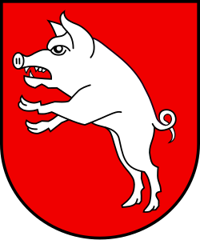
Bure
Origin of the name Bure
The village first appears in 1139 as « Bures ». Its old German name is « Burnen ». Where does the name come from? That is still unknown.[1]
Founding of Bure
Neither the founder of Bure nor the date of its creation is known. Close by stood another medieval village, Buratte, now abandoned. In the Middle Ages Bure was the centre of a district, the advocacy of Bure or Haute-Ajoie, held by the counts of Montbéliard and Ferrette and later by the prince-bishops of Basel. Under the Ancien Régime it was the seat of one of the great mairies of Ajoie.[1]
History of Bure
1139. First recorded: « Bures ».[1]
Middle Ages. Bure is the seat of the advocacy of Bure, or Haute-Ajoie, which belongs to the counts of Montbéliard and Ferrette.[1]
Late 13th century. The advocacy passes to the prince-bishops of Basel.[1]
1454. Construction of the tower of the church of Saint-Amand, which then depends on the parish of Saint-Dizier-l'Évêque in Franche-Comté.[1]
Ancien Régime. Bure is the seat of one of the great mairies of the Ajoie.[1]
1698. Creation of the parish of Bure, which also includes Villars-le-Sec (France) until 1828.[1]
1779. The parish moves from the diocese of Besançon to that of Basel.[1]
1792-1815. Bure belongs to the French departments of Mont-Terrible, then Haut-Rhin.[1]
1815. Union with the canton of Bern (bailiwick, then district of Porrentruy).[1]
1852. Bure becomes a mixed municipality.[1]
1957. Land consolidation; the municipality remains mainly agricultural.[1]
1968. Opening of a controversial federal training ground for armoured troops.[1]
1979. Bure becomes part of the new canton of Jura (district of Porrentruy).
1990. The service sector, driven by the training ground, provides 63 % of jobs.[1]
Population of Bure
Sources and references: [1]
| 1770 | 429 |
| 1818 | 676 |
| 1850 | 798 |
| 1900 | 607 |
| 1950 | 613 |
| 1960 | 558 |
| 2000 | 684 |
| 2010 | 664 |
| 2025 | 660 |
Historic sites in Bure
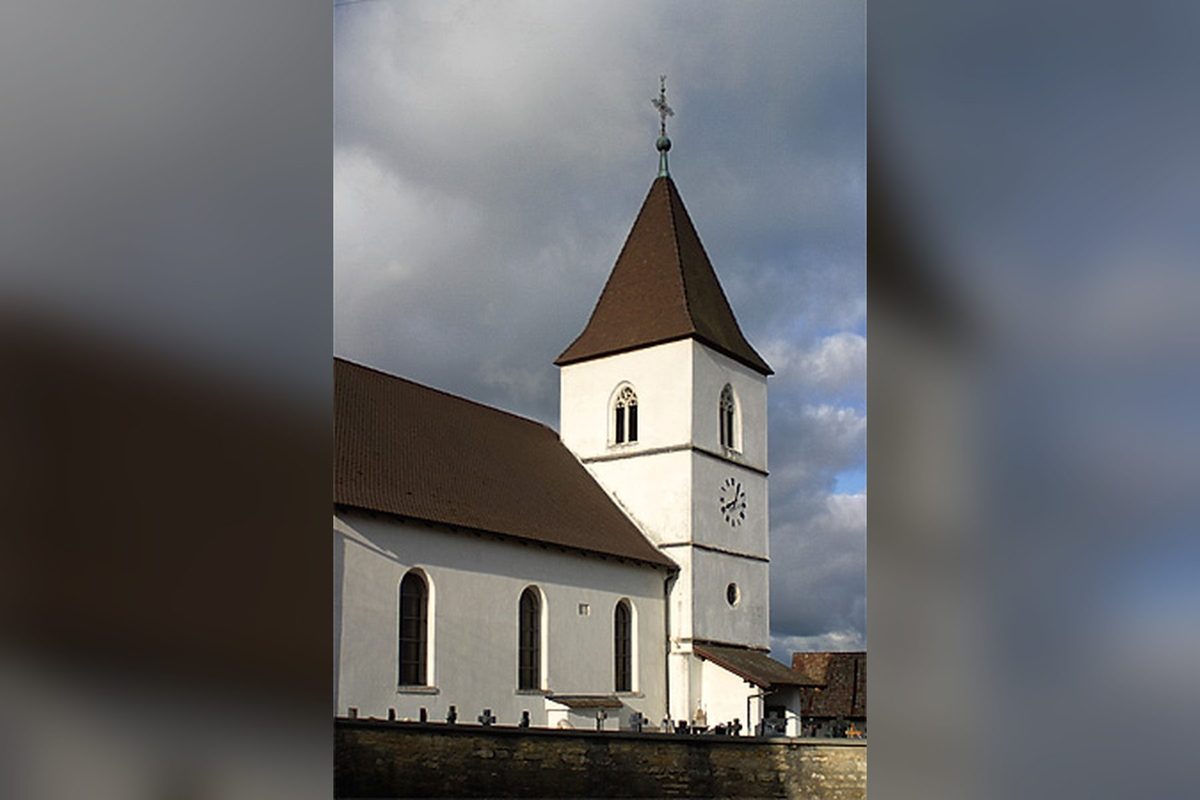
Church of Saint-Amand. Its tower dates from 1454. The church first depended on the parish of Saint-Dizier-l'Évêque in Franche-Comté, before the parish of Bure was created in 1698.[1]
Bure training ground. Federal training ground for armoured troops opened in 1968, which transformed the village economy.[1]
Remains in Bure
Deserted village of Buratte. Abandoned medieval village located near present-day Bure.[1]
Sources
- Dictionnaire historique de la Suisse, « Bure » (Dominique Prongué), version remaniée du 25.05.2020
- Statistique Jura, tableau JU-T.01.01.03, population résidante permanente au 31 décembre 2025
- geo.admin.ch (swisstopo), recherche de lieux « Bure »
Localities of the municipality with a page
Other villages near Bure
Missing information, or do you have a source? Suggest a correction or addition. Every submission is checked before it's published.
Suggest a change