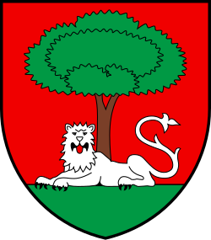
Carouge
Origin of the name Carouge
The name comes from the Latin « quadrivium », the crossroads. The oldest forms are « Quadruvium » or « Quatruvio »: the Burgundian king Sigismund was crowned in 516 at the « villa quadruvio ». Then come « Carrogium » in 1248, « Quarrouiz » or « Quarroggi » in the 14th century and « Quaroggio » in 1445.[1]
Founding of Carouge
The site owes its importance to the crossing of the Arve: two successive parallel bridges, dated to around 100 BC, attest an early settlement linked to the Gallic oppidum of Genua and then to the Roman town of Genava. Two villae, a sanctuary and workshops point to a vicus. In the Middle Ages the settlement at the Arve bridge belonged to the parish of Lancy and the leper house to that of Saint-Léger. Local lords and the House of Savoy disputed tolls and roads, and the wars between Genève and Savoy emptied the place after 1596. The present town is a creation of the Sardinian monarchy at the end of the 18th century: conceived as a rival to Genève, it received from 1772 a series of plans (Garella, Piacenza, Manera, then the Robilant plan of 1781) that laid out a grid of streets lined with neoclassical houses, and it was raised to a royal town by letters patent of January 1786. Open to Protestants and Jews, it attracted a cosmopolitan population.[1]
History of Carouge
around 100 BC. Two successive parallel bridges are built over the Arve, a sign of early settlement.[1]
14 BC. The posts of the outer wall (murus) of an enclosure older than the Burgundian period are dated to this year by dendrochronology.[1]
516. Sigismund is crowned king of the Burgundians at the « villa quadruvio ».[1]
1247. First mention of the leper house, which belongs to the parish of Saint-Léger.[1]
1394. Gérard de Ternier receives the bridge toll right, which later passes to Duke Amadeus VIII of Savoy.[1]
1446. The « Livre des Ladres » is written, describing how the leper house works. It stops taking in patients in 1558.[1]
1534-1535. Deliberate demolition of the suburbs, including the settlement of the Pont d'Arve, to strengthen the defence of Genève.[1]
1589. War against Savoy: the Fort d'Arve is built on the left bank and bloody fighting takes place at Carouge. The fort is dismantled in 1596.[1]
1754. The Treaty of Turin untangles the web of fiefs. Carouge has 24 houses, 87 in 1765.[1]
1772. Town plan by Francesco Luigi Garella.[1]
1777. Two annual fairs and a weekly market are authorised. Carouge separates from the parish of Lancy and work begins on the church of Sainte-Croix.[1]
1780. Carouge becomes the capital of a province bearing its name. The Robilant plan of 1781 is the basis of the new town.[1]
1783. Protestants obtain the right of worship and to have a pastor.[1]
1786. Letters patent of January raise Carouge to a royal town.[1]
1787. The Jews, many of them from Alsace, obtain freedom of worship and the right to a cemetery.[1]
1792. Annexation to France on 2 October; 143 inns and taverns are counted.[1]
1808-1811. Construction of the Pont-Neuf by Nicolas Céard.[1]
1816. The Treaty of Turin of 16 March joins Carouge to Genève and the Confederation. The Protestant temple is built in 1818-1822.[1]
1862. Horse-drawn rail omnibus, forerunner of tram 12: Carouge is the fourth European town to have one.[1]
1950. First law protecting the Vieux-Carouge, after the fountains of Jean-Daniel Blavignac (1867-1868) were listed in the 1920s.[1]
1958. Creation of the Fondation des terrains industriels Praille-Acacias (FIPA). Construction of the quartier des Tours (1958-1973).[1]
Population of Carouge
Sources and references: [1][2]
| 1772 | 567 |
| 1779 | 1'155 |
| 1786 | 3'188 |
| 1792 | 4'672 |
| 1795 | 3'594 |
| 1799 | 2'935 |
| 1822 | 3'571 |
| 1850 | 4'403 |
| 1900 | 7'437 |
| 1950 | 9'290 |
| 2000 | 17'590 |
| 2010 | 18'629 |
| 2020 | 21'454 |
| 2025 | 23'050 |
Historic sites in Carouge
Vieux-Carouge. New Sardinian town of the late 18th century, with a grid plan and neoclassical houses, protected by law since 1950.[1]
Church of Sainte-Croix. Church begun in 1777 under the Sardinian authorities. During the revolutionary period it hosted the meetings of the revolutionary clubs.[1]
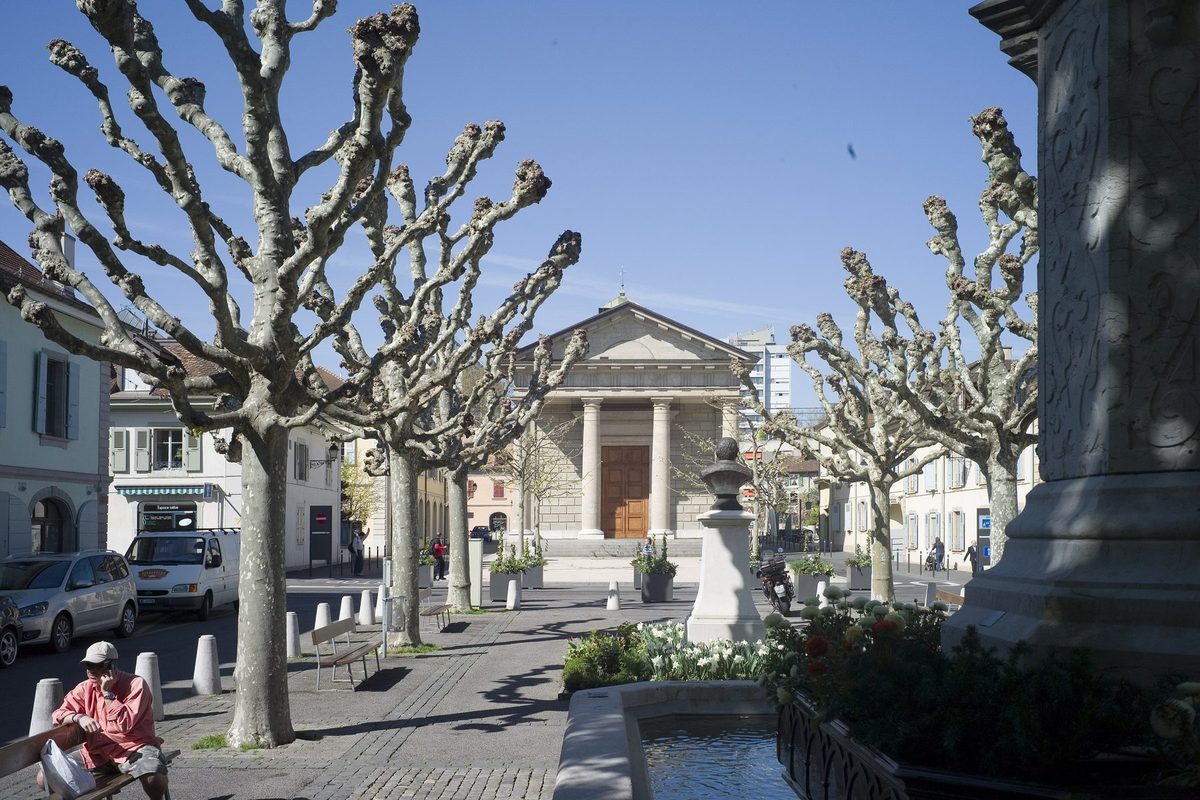
Temple of Carouge. Protestant church built in 1818-1822, after the union with Genève.[1]
Blavignac fountains. Fountains built in 1867-1868 by Jean-Daniel Blavignac, listed in the 1920s.[1]
Pont-Neuf. Bridge over the Arve built in 1808-1811 by Nicolas Céard, during the French period.[1]
Chapel of Saint-Nicolas. Chapel opposite the former leper house, the only survivor of the hamlet of Saint-Nicolas-le-Vieux, which disappeared in the 13th century.[1]
Remains in Carouge
Ancient bridges over the Arve. Two successive parallel bridges dated to around 100 BC, linked to the Gallic oppidum of Genua and then to the Roman town of Genava.[1]
Ancient enclosures and vicus. Two successive enclosures older than the Burgundian period (posts of the outer wall dated to 14 BC), two villae, the oldest from the second half of the 1st century AD, a sanctuary and workshops.[1]
Sources
- Dictionnaire historique de la Suisse, « Carouge (GE) » (Dominique Zumkeller)
- Office cantonal de la statistique (OCSTAT), Mémento statistique du canton de Genève 2026, tableau Population résidante par commune, en 2025
Localities of the municipality with a page
Other villages near Carouge
Missing information, or do you have a source? Suggest a correction or addition. Every submission is checked before it's published.
Suggest a change