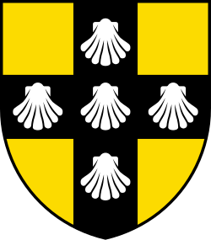
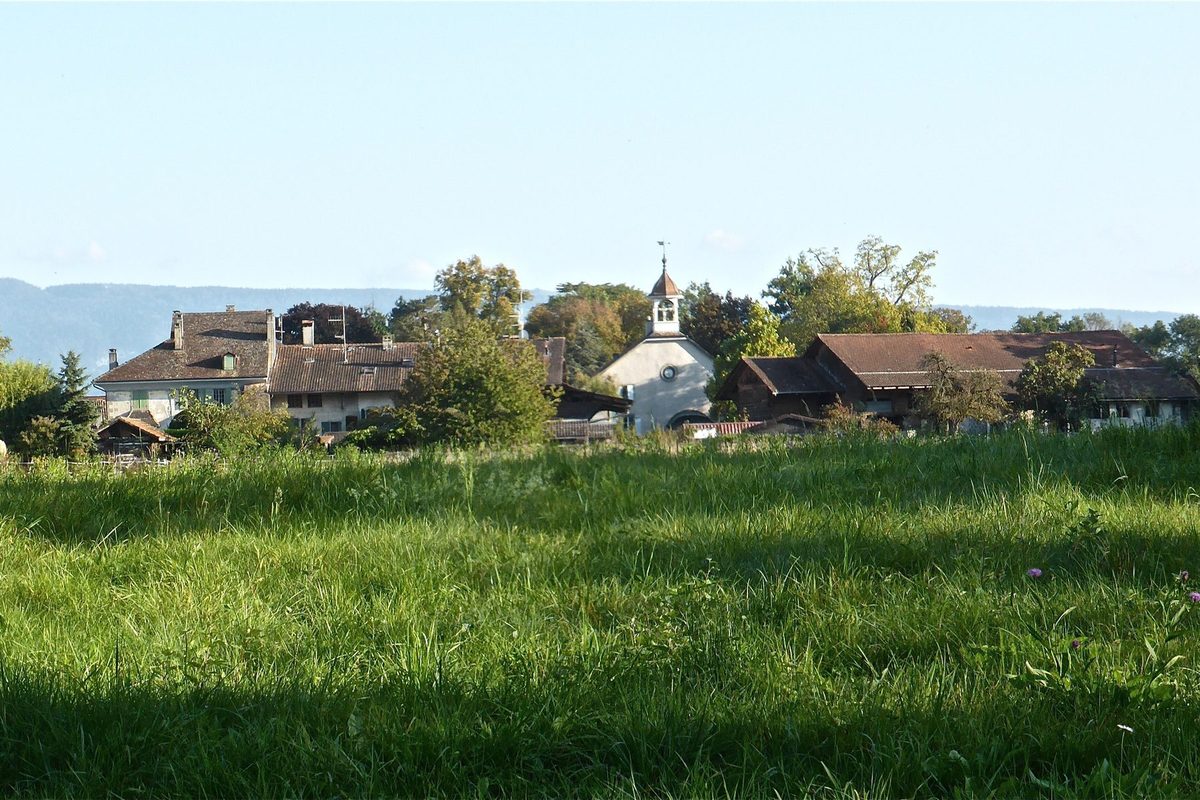
Cartigny
Origin of the name Cartigny
The name appears in 1220 in the forms « Cartiniacum » and « Quartinie ». No explanation has yet been found for this name.[1]
Founding of Cartigny
In the Middle Ages Cartigny belonged to the counts of Genève, who gradually ceded their rights to the priory of Saint-Victor in exchange for financial advantages. North of the village, at the place called Les Roches, the priors owned the Châtelard fortified house, which served as the castellan's residence, as a prison and, incidentally, as a second home. After the Châtelard was taken by Savoyard troops and Genève was relieved by the Bernese, the procurators of Cartigny recognised themselves as subjects of Genève. The village then shared the fate of the Saint-Victor lands, before becoming a district and then, under French rule, a municipality. From the 17th century, Genevan bourgeois families acquired estates there. The municipality comprises the villages of Cartigny and La Petite-Grave. Who founded the village, where traces from the Roman period have been found, is not known.[1]
History of Cartigny
Roman period. Traces of Roman occupation have been found in the area.[1]
1220. First mentions of the name, as « Cartiniacum » and « Quartinie ».[1]
Middle Ages. The counts of Genève gradually cede their rights over Cartigny to the priory of Saint-Victor in exchange for financial advantages. The parish is at first shared with Chancy and Valleiry.[1]
1351. First mention of the Châtelard fortified house, owned by the priors of Saint-Victor.[1]
1412. The church of Saint-Georges, the present Protestant temple, is recorded.[1]
1528. The troops of Duke Charles III of Savoy, an opponent of Prior François Bonivard, take the Châtelard.[1]
1536. After Bernese troops relieve Genève, the procurators of Cartigny recognise themselves as subjects of Genève. The Council of Two Hundred then imposes the Reformation there, on a 5 April of an uncertain year.[1]
1598. The parish is joined with those of Avully and Onex.[1]
1716. The parish is joined only with Avully.[1]
1754. End of the period in which Cartigny shares the fate of the Saint-Victor lands.[1]
1757. Charles Pictet, father of Charles Pictet-de Rochemont, has « le château » built.[1]
1772. The temple, the former church of Saint-Georges, is extensively remodelled.[1]
1794. The Constitution makes Cartigny a district of the Genève-Sud arrondissement.[1]
1800. Cartigny becomes a municipality under the French law of 17 February 1800.[1]
1838. Cartigny and Avully each form their own parish.[1]
1909. The writer Philippe Monnier immortalises the village in « Mon Village ».[1]
1939. The Moulin de Vert, built on the old bed of the Rhône, disappears.[1]
1970. A nature reserve is created at the Moulin de Vert.[1]
Population of Cartigny
Sources and references: [1][2]
| 1850 | 497 |
| 1900 | 385 |
| 1930 | 325 |
| 1950 | 398 |
| 2000 | 748 |
| 2010 | 849 |
| 2020 | 965 |
| 2025 | 1'047 |
Historic sites in Cartigny
Temple of Cartigny. Former church of Saint-Georges, recorded in 1412 and extensively remodelled in 1772.[1]
Le château. Residence built in 1757 by Charles Pictet, father of Charles Pictet-de Rochemont. It now houses the Association l'Ange de l'Eternel.[1]
Moulin de Vert. Mill built on the old bed of the Rhône, gone since 1939. A nature reserve was created there in 1970.[1]
La Petite-Grave. Second village of the municipality, next to Cartigny.[1]
Bourgeois estates. From the 17th century, Genevan bourgeois families, the Bordier and the Duval, acquire estates around the village. Another house is home to the meeting centre of the Église nationale protestante.[1]
Feuillu festival. On the first Sunday in May the « feuillu » is celebrated, preceded by the washing of the fountains, an old custom linked to the pagan cult of the waters.[1]
Remains in Cartigny
Châtelard fortified house. Fortified house of the priors of Saint-Victor at Les Roches, north of the village, mentioned from 1351. It served as the castellan's residence, as a prison and as a second home for the priors, and was taken in 1528 by the troops of the Duke of Savoy. What survives of it today is not known.[1]
Sources
- Dictionnaire historique de la Suisse, « Cartigny » (Catherine Santschi)
- Office cantonal de la statistique (OCSTAT), Mémento statistique du canton de Genève 2026, tableau Population résidante par commune, en 2025
- geo.admin.ch, service de recherche de swisstopo (coordonnées)
Localities of the municipality with a page
Other villages near Cartigny
Missing information, or do you have a source? Suggest a correction or addition. Every submission is checked before it's published.
Suggest a change