Château de Dardagny
Origin of the name Château de Dardagny
The castle bears the name of the village of Dardagny, mentioned in 1093 in the form « Dardaniacum ». The name may derive from the Latin personal name Dardanius or Dardanus, echoing the Gallo-Roman villa attested on the site of the castle.[1][3]
Founding of Château de Dardagny
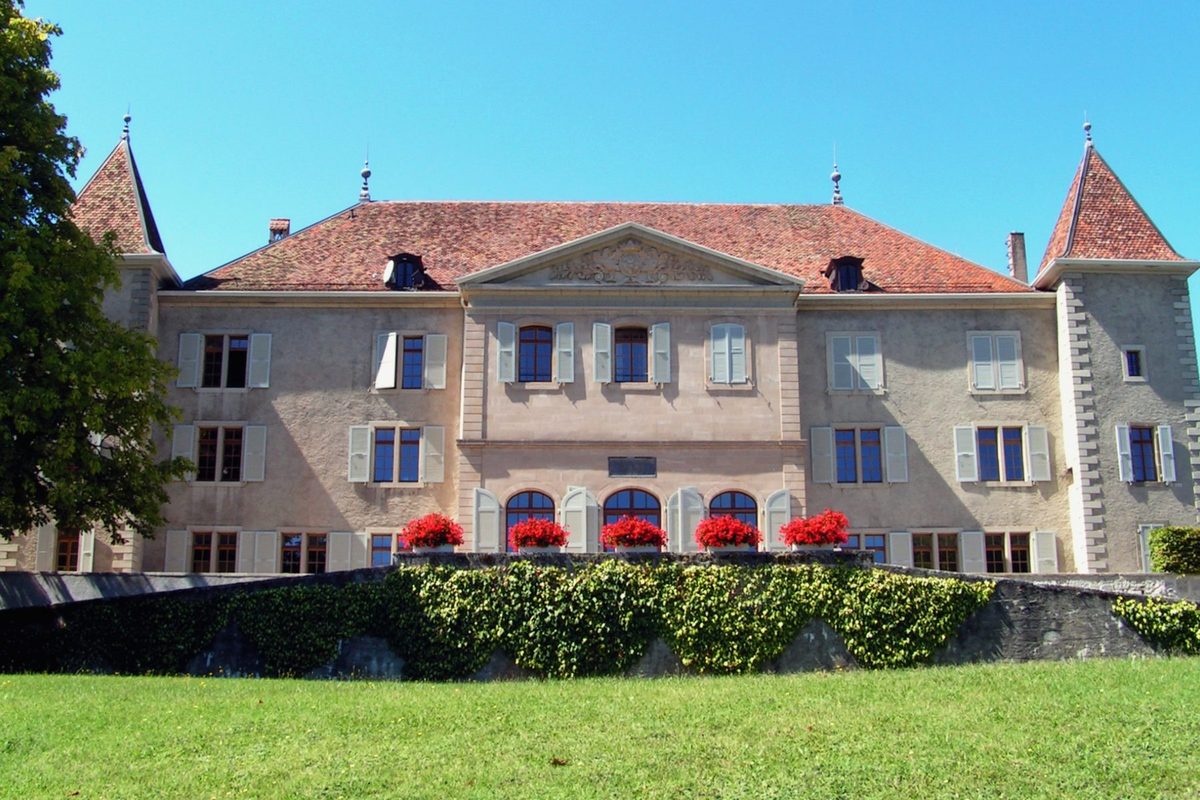
The Château de Dardagny, in the municipality of Dardagny, stands on the site of an attested Gallo-Roman villa. In the 14th century two fortified houses stood there, separated by a lane and belonging to two lordships. Ami Favre united the two lordships. His son Daniel Favre, lord of Châteauvieux, sealed this union in 1655 by linking the two buildings with a wooden gallery. Raising the building and adding new towers at the three other corners then gave it a new silhouette. Enlarged by the Vasserot family in the 18th century, the castle lost all political significance in 1795. Owned by the municipality since 1904, saved from demolition and restored from 1926 to 1932, it houses the town hall and the school.[1][2]
History of Château de Dardagny
Gallo-Roman period. A Gallo-Roman villa is attested on the site of the present castle.[1]
1298. Two lordships hold jurisdiction over Dardagny.[3]
1356. First mention of the noble family of Dardagny.[2]
14th century. Two fortified houses stand on the site of the present building.[1]
1648. The two lordships are united by the lord of Châteauvieux and Confignon, vassal of the Republic of Genève.[3]
1655. Daniel Favre, lord of Châteauvieux, links the two fortified houses with a wooden gallery: start of the castle's construction.[1][2]
1683. Jean-Antoine Lullin buys the castle and the title.[1][2]
1699. The sundial is painted on the façade.[2]
1721. Jean Vasserot, a banker from Amsterdam, acquires the castle.[1][2]
1735-1740. His son Jean has a ballroom created in the inner courtyard. The Vasserot family also gives the estate terraced gardens with ornamental pools.[1][2]
1780-1781. New embellishments of the façades, under Jacques-Antoine Horngacher.[2]
1786. Date inscribed on the fountain.[1][2]
1795. The Horngacher family sells the rights of its lordship to the Republic of Genève. The castle loses all political significance.[1]
1904. The municipality acquires the badly dilapidated castle. A plan to demolish it and replace it with a new building is considered.[1]
1926-1932. Restoration by Frédéric Mezger; the castle houses the town hall, the school and the ballroom.[1][2]
1962. Further restoration.[1]
Historic sites in Château de Dardagny
Château de Dardagny. The largest castle in the canton of Genève: a rectangular three-storey building flanked by square towers under pavilion roofs, whose silhouette results from the alterations of the 17th and 18th centuries. It houses the town hall and the school.[1]
Esplanade and gardens. Wide platform bounded by retaining walls to the south and east, with two ramps leading down to the terraced gardens.[1]
Remains in Château de Dardagny
Sundial. Sundial painted on the façade in 1699.[2]
Fountain. Fountain dated « 1786 ».[1][2]
Sources
- Office fédéral de la culture, Inventaire fédéral des sites construits d'importance nationale à protéger en Suisse (ISOS), « Dardagny » (3e version, février 2019)
- Inventaire suisse des biens culturels d'importance nationale et régionale (PBC), « Château de Dardagny » (texte du Guide artistique de la Suisse, SHAS)
- Dictionnaire historique de la Suisse, « Dardagny (commune) » (Jacques Davier), version du 22.08.2005
- geo.admin.ch, service de recherche de swisstopo (route du Mandement 520, Dardagny, coordonnées)
Other villages near Château de Dardagny
Missing information, or do you have a source? Suggest a correction or addition. Every submission is checked before it's published.
Suggest a change