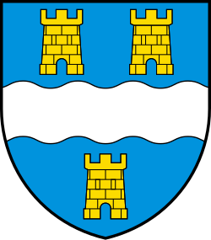
Dardagny
Origin of the name Dardagny
The name appears in 1093 as « Dardaniacum », the same year the parish is cited. Where does the name come from? That is still unknown.[1]
Founding of Dardagny
Who founded Dardagny is not known. The site was occupied by the 1st century BC at the latest: the Gallo-Roman remains range from the late La Tène period to the 4th century AD. From the 11th century the village depended on the bishop of Genève, in the mandement of Peney. It had its parish and its church of Saint-Pierre, whose priest was presented by the priory of Saint-Victor. In the early 14th century a rural community was already managing its common lands. Enclosed in lands that passed from the counts of Genève to Savoy, to Bern and then to the kings of France, Dardagny had no direct link with Genève until the political municipality was created, its territory matching that of the lordship of Châteauvieux.[1]
History of Dardagny
1st century BC. The site is occupied by this time at the latest. Gallo-Roman remains range from the late La Tène period to the 4th century AD.[1]
11th century. From this time, Dardagny depends on the bishop of Genève (mandement of Peney).[1]
1093. First mention in the form « Dardaniacum ». The parish is cited, with the church of Saint-Pierre, whose right of presentation belongs to the priory of Saint-Victor.[1]
13th century. The castle is part, with Bruël, La Corbière and Malval, of a group of castles protecting the western border of the bishop of Genève's lands.[2]
1298. Two lordships hold jurisdiction over Dardagny. The site has two fortified houses separated by a lane.[1][2]
1321. A rural community already manages its common lands. A grain mill is recorded.[1]
14th century. Settlement of Essertines begins; the southern fortified house has more than two storeys and a tower.[1][2]
1544. Creation of the Reformed parish of Dardagny-Malval-Russin.[1][6]
1545. Paper stamping mills are recorded. Paper mills operate until 1850.[1]
1646. The Favre family inherits both parts of the fief.[2]
1648. The two lordships are united by the lord of Châteauvieux and Confignon, a vassal of the Republic of Genève.[1]
1655. Daniel Favre links the two manor houses with a gallery, adds three corner towers and raises the whole building.[2]
1721. Dardagny passes to Jean Vasserot, who encloses the castle's inner courtyard to create a banqueting hall decorated with Italian-style paintings.[2]
1723. Completion of the new temple.[1]
1798. Creation of the political municipality, its territory matching that of the lordship of Châteauvieux.[1]
1858. Opening of the Lyon-Genève railway and inauguration of La Plaine station, which allows the industrialisation of the place.[1][3]
1860. The Rhône-Poulenc chemical plant (1860-1938) is established at La Plaine, succeeded by Firmenich in 1938.[1][3]
1889. Creation of the Catholic parish of Dardagny-Russin, whose church at La Plaine is dedicated to Saints Peter and Lawrence.[1][3]
1904. The municipality buys back the castle, restored in 1926-1932 after its demolition had been considered.[2]
1978. The municipality receives the Wakker Prize.[1]
Population of Dardagny
Sources and references: [1][4]
| 1413 | 250 |
| 1797 | 454 |
| 1850 | 462 |
| 1900 | 781 |
| 1950 | 686 |
| 1980 | 678 |
| 2000 | 1'284 |
| 2025 | 1'863 |
Historic sites in Dardagny
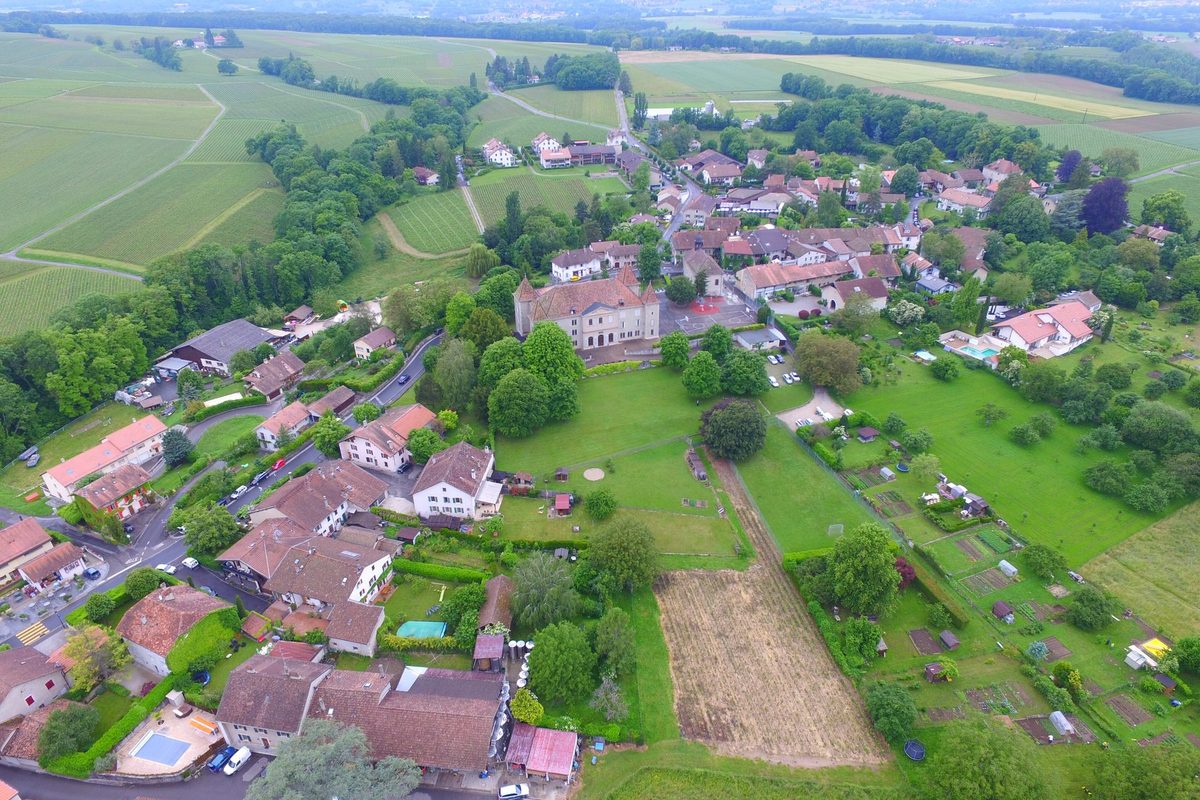
Dardagny Castle. Formed from two fortified houses attested in 1298, linked in 1655 by Daniel Favre, then transformed by Jean Vasserot after 1721. In 1740 the central turret gave way to an internal staircase, giving the castle its present appearance. Bought back by the municipality in 1904 and restored in 1926-1932, this listed monument houses the town hall and the school.[2]
Dardagny temple. Temple of the Reformed parish created in 1544, completed in 1723. Cultural property of regional importance (PCP inventory).[1][7]
La Plaine. Locality of the municipality mentioned in 1321 (« Planum »). A paper mill and a tilt hammer operated there in 1797. The station on the Genève-Lyon line was inaugurated in 1858 and a bridge over the Rhône was built in 1859. The Rhône-Poulenc chemical plant employed up to 450 people there, then Firmenich developed a large factory from 1938.[3][5]
Malval chapel. Chapel of Sainte-Marie-Madeleine, isolated at the bottom of a small valley near the hamlet of Malval. Its oldest parts date from the 10th century. Cultural property of regional importance (PCP inventory).[6][7]
Allondon valley. Landscape listed in the Federal Inventory of Landscapes (BLN, object 1204 « Rhône genevois - Vallons de l'Allondon et de la Laire ») and included in the Ramsar site « Le Rhône genevois - Vallons de l'Allondon et de la Laire ».[8][9]
Remains in Dardagny
Gallo-Roman remains. The municipal territory has yielded Gallo-Roman remains from the late La Tène period to the 4th century AD, attesting occupation by the 1st century BC at the latest.[1]
Sources
- Dictionnaire historique de la Suisse, « Dardagny (commune) » (Jacques Davier), version du 22.08.2005
- Dictionnaire historique de la Suisse, « Dardagny (château) » (Jacques Davier), version du 22.08.2005
- Dictionnaire historique de la Suisse, « Plaine, La » (Pierre Flückiger)
- Office cantonal de la statistique (OCSTAT), Mémento statistique du canton de Genève 2026, tableau Population résidante par commune, en 2025
- geo.admin.ch, service de recherche de swisstopo (coordonnées)
- Dictionnaire historique de la Suisse, « Malval » (Martine Piguet), version du 03.12.2009
- Inventaire PBC, liste cantonale Genève (état au 1.1.2026)
- Office fédéral de l'environnement (OFEV), Inventaire fédéral des paysages (IFP), objet 1204 « Rhône genevois - Vallons de l'Allondon et de la Laire » (2017)
- Convention de Ramsar, Ramsar Sites Information Service, « Le Rhône genevois - Vallons de l'Allondon et de la Laire »
Localities of the municipality with a page
Other villages near Dardagny
Missing information, or do you have a source? Suggest a correction or addition. Every submission is checked before it's published.
Suggest a change