Chaumont
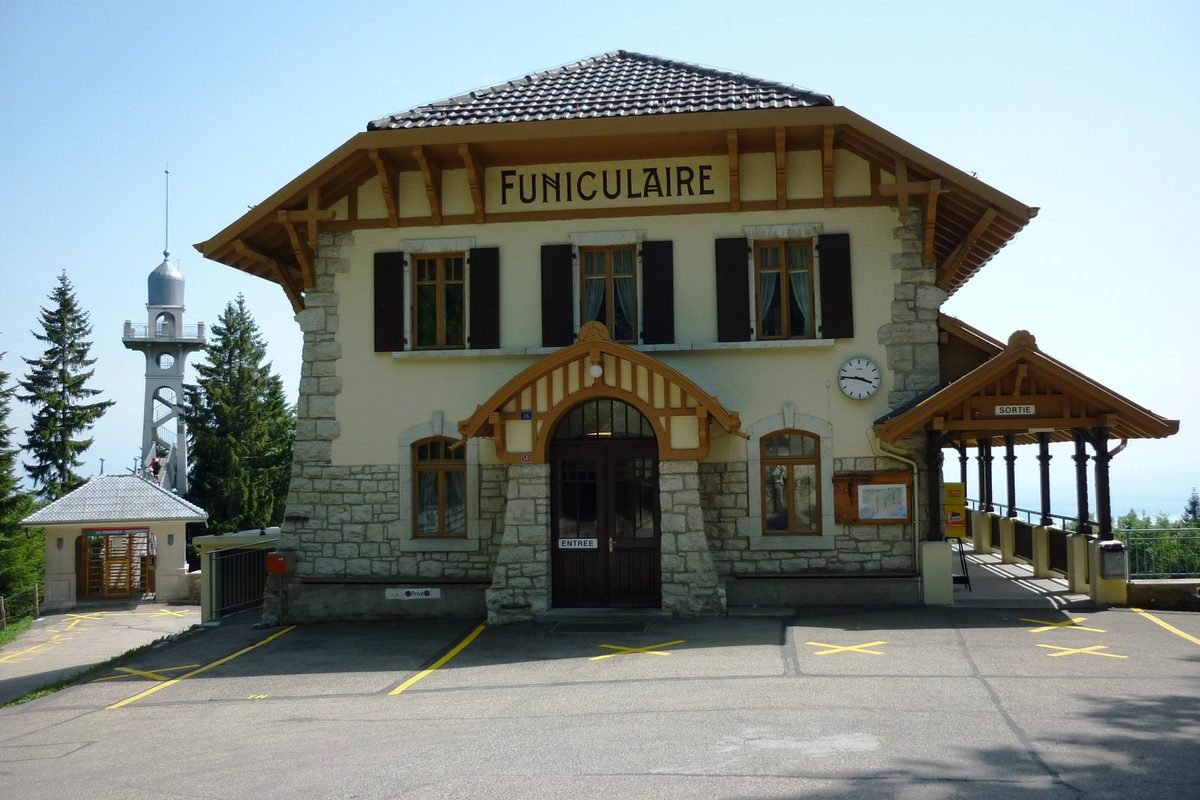
Since 1910 a funicular has climbed from La Coudre to Chaumont, the wooded mountain above Neuchâtel where summer visitors settled for good in the 19th century.
Entry based on 17 sources · Our method · Reusable text (CC BY-SA)
Origin of the name Chaumont
In Neuchâtel patois the place is said to be called « Tchumon », and its old German name is said to have been « Zöumot »; neither form is confirmed. Common in French-speaking areas, the name Chaumont generally comes from the Latin calvus mons, « bald mountain », a bare height. No study specific to the Neuchâtel mountain has yet established this explanation.
Founding of Chaumont
There is no known founder or founding act for Chaumont. The mountain rises to 1'171 metres above the town, and its scattered dwellings belong to the municipality of Neuchâtel. At first a summer resort, Chaumont became a permanent community in the mid-19th century. In 1873 the residents asserted their identity by having a building put up that combined a place of worship, a classroom, a refectory and a teacher's flat. The Belle Époque hotels, the funicular and the lookout tower then turned the mountain into an excursion destination. Tourism and farming remain the main activities.[1][3][6][7]
History of Chaumont
before the 19th century. The mountain was reportedly used mainly as pasture, a place of seasonal stays rather than permanent settlement.
mid-19th century. Once a summer resort, Chaumont becomes a permanent community.[6]
1873. Construction, to plans by the architect Léo Châtelain, of a building combining a place of worship, a classroom, a refectory and a teacher's flat. The future Federal Councillor Numa Droz teaches there briefly.[6]
1876. Inauguration of the chapel, ecumenical from the outset.[6]
around 1905. The Grand Hôtel de Chaumont appears on a postcard by the Attinger photographic office, a witness to Belle Époque holidaymaking.[9]
1909. On 1 February the Grand Hôtel de Chaumont is hit by a fire.[8]
1910. Opening of the La Coudre-Chaumont funicular, built by the Neuchâtel-Chaumont company, with two cars and a passing loop. A tram links La Coudre to central Neuchâtel.[3][14]
1912. Construction of the reinforced concrete lookout tower, about 40 metres high.[7]
1930. La Coudre, where the funicular starts, is merged with Neuchâtel (merger voted in February 1929, effective 1 January 1930).[1][2]
1943. The Transports neuchâtelois take over operation of the funicular.[14]
1970-1983. The project file of the Hôtel Chaumont & Golf, kept in the archive of the architect André Gaillard, runs from 6 November 1970 to 16 March 1983.[10]
1995. The funicular receives new cars, replacing those of 1910.[14]
2007. The winch is replaced and one car withdrawn: the funicular now runs with a single car, without a passing loop.[14]
2012. Closure of the Hôtel Chaumont & Golf, which had 88 rooms. It may already have stood deserted since the early 2000s.[11]
2020. Left empty, the former hotel, owned by a limited company formed mainly of Egyptian nationals, suffers break-ins and vandalism in June.[12]
2021. The former hotel is put up for sale for 12 million francs. The same year the municipality of Neuchâtel, to which Chaumont belongs, merges with Corcelles-Cormondrèche, Peseux and Valangin.[1][11]
Notable people of Chaumont
Numa Droz (La Chaux-de-Fonds 1844 - Bern 1899). Trained as a watch engraver, he prepared on his own for his teaching certificate, obtained in 1862. He taught first at Chaumont, then in Neuchâtel until 1864. Elected to the Federal Council in 1875, he sat on it until 1892 and was President of the Confederation in 1881 and 1887.[16][6]
Economy of Chaumont, past and present
The funicular and tourism. Since 1910 the funicular has climbed from La Coudre, at 590 metres, to 1'160 metres in nine minutes. According to the City of Neuchâtel, it helped tourism develop on the heights above the town. The Chaumont tower opened two years later.[3]
Forest and leisure. The Chaumont forest district covers 808 hectares above the town. People come to walk, follow the Sentier du Temps, ride down by mountain bike or visit the adventure park with its zip lines.[5]
Disasters and major events in Chaumont
The Grand Hôtel fire (1909). On 1 February 1909 fire struck the Grand Hôtel de Chaumont. The Musée d'art et d'histoire de Neuchâtel holds a postcard showing the building just after the fire.[8]
Historic sites in Chaumont
The Chaumont funicular. Running since 1910 between La Coudre and Chaumont, it remains the main public access to the mountain. It climbs about 570 metres over some 2 kilometres, in nine minutes. Fitted with new cars in 1995 and modernised in 2007, it has since run with a single car and is operated by TransN.[3][14]
The Chaumont lookout tower. Built in 1912 of reinforced concrete and about 40 metres high, it offers a view over the whole Three Lakes region and the Alps. It was erected by the Compagnie Neuchâtel-Chaumont to boost the site's appeal to tourists.[7]
The Chaumont chapel. Inaugurated in 1876 in the building erected in 1873 by the architect Léo Châtelain, whose sobriety is enlivened by polychrome materials such as brick, it combined a place of worship, a classroom and a teacher's flat. Its stained-glass windows were made by the schoolchildren in 1984-1985. Dedicated to ecumenism from the outset, it hosts an annual service with the Anglican Church. Owned by the municipality of Neuchâtel, it is made available to the Reformed Evangelical Church of Neuchâtel under a concordat.[6]
The Sentier du Temps. This 4.5 kilometre educational trail links Chaumont to the Rocher de l'Ermitage through the forest. Twenty-three illustrated panels trace the history of the Earth from the last ice age back to the formation of the solar system, one metre walked for every million years.
Remains in Chaumont
The Belle Époque Grand Hôtel. Photographed around 1905 by the Attinger office, this hotel was hit by a fire on 1 February 1909. Its later fate remains to be clarified.[8][9]
The former Hôtel Chaumont & Golf. Hotel complex whose project file (1970-1983) is kept in the archive of the architect André Gaillard, closed in 2012. Owned by a limited company formed mainly of Egyptian nationals and left empty, it suffered break-ins and vandalism in 2020 and was put up for sale for 12 million francs in 2021.[10][11][12]
Traditions and festivals in Chaumont
The Chaumont festival. The Société d'intérêt public de Chaumont holds a festival in a tent put up on the football pitch. The 2011 edition was the eighth organised in this form, with two meals, a toy swap for children and a jazz band in the evening.[17]
Sources
- Dictionnaire historique de la Suisse, article « Neuchâtel (commune) »
- Dictionnaire historique de la Suisse, « Coudre, La »
- Ville de Neuchâtel, « Les funiculaires »
- Ville de Neuchâtel, « Repères historiques »
- Ville de Neuchâtel, « La forêt » (cantonnement de Chaumont)
- Paroisse de Neuchâtel (EREN), « La Chapelle de Chaumont »
- photos-neuch.net, « Sur une tour à Chaumont »
- Musée d'art et d'histoire de Neuchâtel (collections), carte postale du Grand Hôtel de Chaumont après l'incendie du 1er février 1909
- Société d'histoire et d'archéologie du canton de Neuchâtel (Images du patrimoine), notice « Chaumont, entre tourisme et agriculture »
- EPFL, base patrimoniale Morphé, « Grand Hôtel Chaumont + Golf, à Neuchâtel » (fonds André Gaillard)
- RTN, « Chaumont : un hôtel à 12 millions de francs » (24.03.2021)
- Canal Alpha, « Le Grand Hôtel de Chaumont, abandonné aux vandales » (2020)
- Le Sentier du Temps, site officiel
- Histoire ferroviaire suisse, « 100 ans funiculaire La Coudre-Chaumont »
- État de Neuchâtel, arrêté du 4 février 2026 homologuant le recensement cantonal de la population au 31 décembre 2025
- Historical Dictionary of Switzerland (HDS), article "Droz, Numa"
- City of Neuchâtel, press release of 21 June 2011, "Fête de Chaumont"
Published by Sébastien Jörg ·
Other villages near Chaumont
Missing information, or do you have a source? Suggest a correction or addition. Every submission is checked before it's published.
Suggest a change