Chavannes-le-Veyron
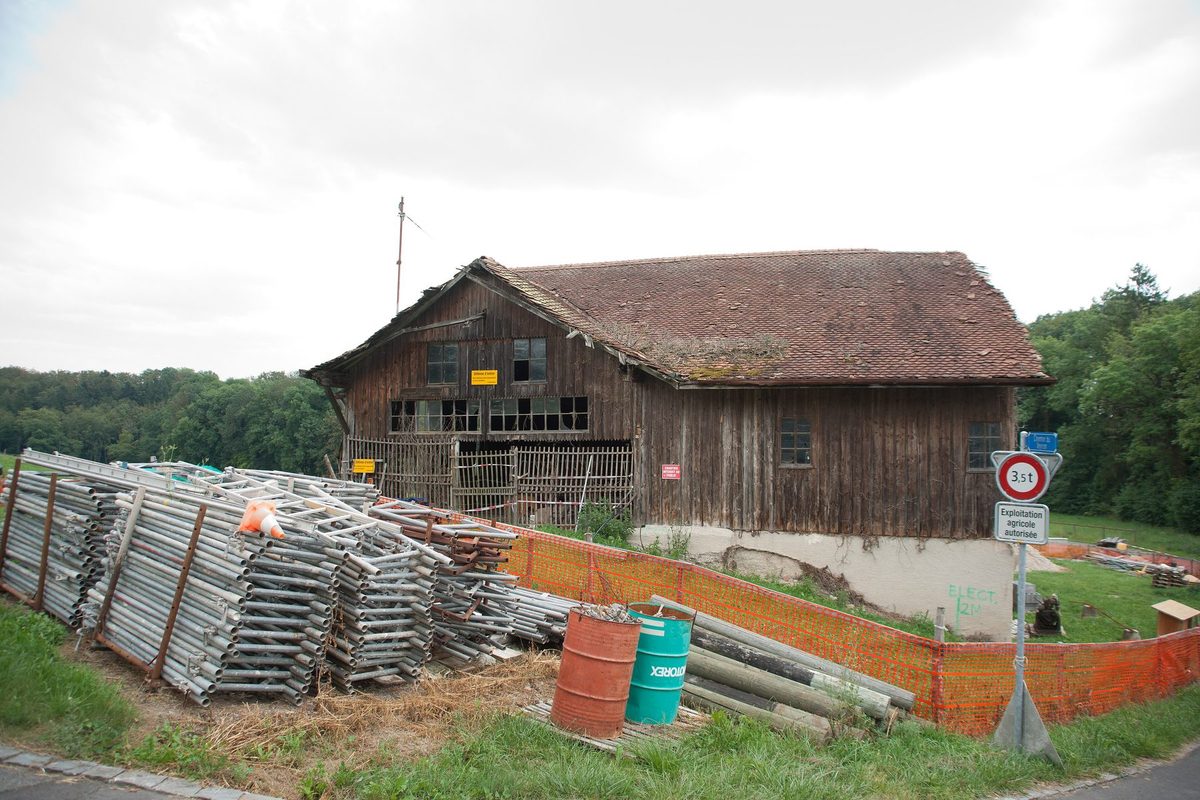
On the bank of the Veyron the village housed the medieval leper house of Cossonay, and later a water-powered sawmill still working in the 1960s. A Hallstatt burial mound lies at la Motte.
Entry based on 8 sources · Our method · Reusable text (CC BY-SA)
Origin of the name Chavannes-le-Veyron
The village is first mentioned in writing in 1285. Its early form is not known and the origin of the name has not yet been explained. The addition «le-Veyron» refers to the river flowing at the foot of the village.[1]
Coat of arms of Chavannes-le-Veyron
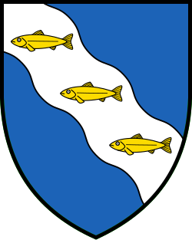
Azure, a bend wavy Argent charged with three minnows proper fesswise. On a blue field, a wavy white band runs diagonally from upper left to lower right. It bears three minnows, small fish in their natural colours, set horizontally. The municipality adopted these arms in 1924. The blue takes up the field of the arms of the Crinsoz and Forel families. The band stands for the Veyron, which flows through the village, and the minnows (vairons) play on the municipality's name.[6][7]
Founding of Chavannes-le-Veyron
When and by whom Chavannes-le-Veyron was founded remains unknown. Yet the place was frequented long before the Middle Ages, as the Hallstatt-period burial mound (early Iron Age) at la Motte shows. In the Middle Ages two powers shared its revenues: the abbey of the Lac de Joux owned land and rights at Chavannes, and the lords of Cossonay levied a hearth tax there. The village later formed a small lordship, until 1798.[1]
History of Chavannes-le-Veyron
early Iron Age. A Hallstatt-period burial mound is raised at the place called la Motte.[1]
Middle Ages. The abbey of the Lac de Joux owns land and rights at Chavannes. The lords of Cossonay levy a hearth tax there.[1]
Middle Ages. The medieval leper house of Cossonay stands on the bank of the Veyron. It is abandoned from the 17th century.[1]
1285. First written mention of the village.[1]
Bernese period. Under Bernese rule, Chavannes belongs to the bailiwick of Morges and is run by the assembly of commune citizens. The village forms a small lordship until 1798.[1]
1636. The village builds its first place of worship, attached to the parish of Cuarnens. Since that year it has reportedly observed its own fast day every 21 June, though this is not certain.[1]
1798. Chavannes-le-Veyron becomes part of the district of Cossonay.[1]
1844. The dilapidated place of worship is rebuilt.[1]
1846. The land register records a water-powered installation (sawmill, forge and press) on the bank of the Veyron.[1]
1898. Construction of the school.[1]
1960s. The water-powered installation on the Veyron is still in operation.[1]
1981. Renovation of the 1898 school.[1]
2008. With the new territorial division of Vaud, the commune moves from the abolished district of Cossonay to the district of Morges.
Population of Chavannes-le-Veyron
Sources and references: [1][4]
| 1764 | 74 |
| 1798 | 91 |
| 1850 | 136 |
| 1900 | 162 |
| 1950 | 103 |
| 1970 | 86 |
| 2000 | 125 |
| 2025 | 160 |
Families of Chavannes-le-Veyron
Crinsoz. The small lordship of Chavannes first belonged to the lords of Joux, then to the de Gléresse family. In 1700 the estate passed to the Crinsoz, then by inheritance to the Forel.[7]
Citizen families before 1800. Bettens, Bourl'honne, David, Favre, Hugonet, Hugonnet, Longchamp, Nerny and Rochat, as well as the Courvoisier family (from Le Locle NE), without a precise date. The Zimmermann family (from Wattenwil BE) obtains citizenship in 1778.[8]
In the 19th century. Duvanney, as well as the Lesquereux family (from Le Locle NE), without a precise date. Then the Jantet family (from France) obtains citizenship in 1897.[8]
Show more families (1)
From 1901 to 1962. They are joined by the Jousson family (1931).[8]
Notable people of Chavannes-le-Veyron
Charles Dutoit. The world-famous conductor lived in the village for a few years.[7]
Economy of Chavannes-le-Veyron, past and present
Milk, poultry and cattle. Seven farmers work in the municipality. Three deliver their milk for Gruyère AOP. There are also a laying-hen farm, a pullet farm, a broiler farm and three beef-fattening farms, as well as various crops.[7]
Along the Veyron. The water-powered installation that drove the sawmill, the forge and the wine press is a cultural property of national importance. A village family runs the mill. The FSC-certified forest is marked for felling every year.[7]
Historic sites in Chavannes-le-Veyron
Chavannes-le-Veyron church (temple). The first place of worship, attached to the parish of Cuarnens, dates from 1636. Having fallen into disrepair, it was rebuilt in 1844.[1]
Chavannes-le-Veyron sawmill. Water-powered installation on the bank of the Veyron (sawmill, forge and press) recorded in the 1846 land register and still in operation in the 1960s.[1]
School. School building of 1898, renovated in 1981.[1]
Remains in Chavannes-le-Veyron
La Motte burial mound. Hallstatt-period (early Iron Age) burial mound at the place called la Motte. The La Motte site (Hallstatt burial mound and medieval archaeological site) is a cultural property of regional importance.[1][2]
Cossonay leper house. The medieval leper house of Cossonay stood on the bank of the Veyron, on the territory of Chavannes. It was abandoned from the 17th century. No visible remains are recorded.[1]
Protected heritage in Chavannes-le-Veyron
Cultural property of regional significance (B objects)[5]
- La Motte, tumulus de la période de Hallstatt / site archéologique médiéval
Traditions and festivals in Chavannes-le-Veyron
The Chavannes Fast. Every 21 June, for several centuries, Chavannes has kept its own day of fasting. The day is a public holiday in the commune, with two services, one of repentance and one of thanksgiving.[7]
Sources
- François Béboux, « Chavannes-le-Veyron », Dictionnaire historique de la Suisse (version du 29.12.2003)
- Office fédéral de la protection de la population, Inventaire PBC, liste cantonale VD (état au 1.1.2026)
- État de Vaud, communiqué du 12.07.2007, « Organisation des préfectures et adaptation au nouveau découpage territorial »
- Statistique Vaud, « Population résidante permanente au 31 décembre 2025 »
- Federal Office for Civil Protection (FOCP), Swiss Inventory of Cultural Property (PCP), list for the canton of Vaud (as of 1.1.2026)
- IPI, Swissreg, emblems database: coat of arms of Chavannes-le-Veyron (no. 101823)
- Feuille des avis officiels du canton de Vaud, "Alphabet des communes vaudoises: Chavannes-le-Veyron"
- Register of Swiss Surnames, 3rd edition (1989), search Commune "Chavannes-le-Veyron", Canton VD
Published by Sébastien Jörg ·
Other villages near Chavannes-le-Veyron
Missing information, or do you have a source? Suggest a correction or addition. Every submission is checked before it's published.
Suggest a change