La Chaux (Cossonay)
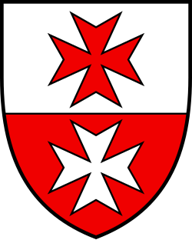
Given to the Templars before 1223, then passed to the Hospitallers, La Chaux housed the main commandery of the Order of St John in the Pays de Vaud. Two Maltese crosses adorn its coat of arms.
Entry based on 10 sources · Our method · Reusable text (CC BY-SA)
Origin of the name La Chaux (Cossonay)
The hamlet of Ittens is mentioned from 964 («Villa Ittinges»). La Chaux appears later, in 1228 («La Chaus») and in 1277 («de Calce»). The origin of these names has not yet been explained.[1][4]
Coat of arms of La Chaux (Cossonay)
Per fess argent and gules, two Maltese crosses counterchanged. The shield is divided horizontally, white above and red below. A red Maltese cross stands out on the white, a white Maltese cross on the red. Adopted in 1922, the arms recall the two orders that held the commandery: the red cross the Templars, the white cross the Hospitallers.[8][9]
Founding of La Chaux (Cossonay)
Romans were present in the area, where a large settlement at the place called Les Chambres has been known since 1842. In the Middle Ages La Chaux and Ittens formed two separate lordships. The lords of Cossonay gave La Chaux to the Templars before 1223, who established a commandery there. After the order was suppressed in 1312, it passed in 1315 to the Knights of St John of Jerusalem (Hospitallers). The two lordships were united in 1674.[1][4]
History of La Chaux (Cossonay)
Roman period. Roman presence at several sites in the area, including the Les Chambres settlement.
Early Middle Ages. Burgundian cemetery, discovered in 1842 and 1847, now vanished.[1]
964. First mention of Ittens as «Villa Ittinges».[1][4]
before 1223. The lords of Cossonay give La Chaux to the Templars.[1][4]
1228. Mention of «La Chaus».[1]
1277. Mention of «de Calce».[1]
1312. Suppression of the Templar order. In 1315 the commandery passes to the Knights of St John of Jerusalem, who manage the hospices of Orbe, Villars-Sainte-Croix and Montbrelloz from La Chaux.[1]
1474. La Chaux has 14 hearths.[1][4]
15th century. Construction of the chapel of Saint-Michel, the future church.[1][4]
1536. Bernese conquest and Reformation: the commandery is secularised.
1540. The commandery is sold to Robert du Gard.[1][4]
1560. La Chaux has 29 hearths.[1][4]
1613. The church is enlarged.[1][4]
1674. Through her marriage to Daniel de Chandieu, Anne du Gard unites the lordships of La Chaux and Ittens.[1][4]
1764. The village has 235 inhabitants.[1]
1781. The church is enlarged again.[1]
1798. La Chaux becomes part of the district of Cossonay.[1]
1858. Rebuilding of the Lausanne-Vallée de Joux road over the Mollendruz, which runs through the municipality.[1]
1922. Adoption of the coat of arms with two Maltese crosses, recalling the Templars and the Hospitallers.
2008. On 1 January the district of Cossonay is abolished. La Chaux now belongs to the district of Morges.
Population of La Chaux (Cossonay)
Sources and references: [1][2][4]
| 1474 | 14 hearths (households) |
| 1560 | 29 hearths (households) |
| 1764 | 235 |
| 1850 | 484 |
| 1900 | 364 |
| 1950 | 320 |
| 1970 | 214 |
| 2000 | 352 |
| 2025 | 421 |
Families of La Chaux (Cossonay)
Burgher families before 1800. Bubloz, Chamot, Guex, Humbert, Renaud, Rosset, Voland and Wuichet.[10]
In the 19th century. The Clément and the Duboux, with no precise date. The Rossy, from Italy, were admitted in 1819.[10]
From 1901 to 1962. The Gays, from Italy, in 1927 and the Burger, from France, in 1934.[10]
Economy of La Chaux (Cossonay), past and present
Mixed farming and milk. La Chaux lives from farming, mixed crops and dairy cattle, and from small crafts. The village has 8 farmers on 514 hectares of agricultural zone, but no milk producer any more. At the Domaine des Cageoles farm, a butcher sells meat in a self-service shop open every day.[1][9]
The mill. East of the hamlet of Le Château, the mill remained an industrial site until the early 20th century. It housed in turn a grain mill, a sawmill, an oil mill and a threshing mill. Alterations in the 1970s erased most of these traces.[9]
Inn, dairy and workshops. Since the 19th century the meadows between La Chaux and Ittens, where the Veyron used to wander, have filled with municipal buildings: inn, post office, school and dairy. The village grocery has settled next to the dairy. The municipality also has the La Commanderie hotel, two garages, a joinery, a painting firm, a landscaper and a professional Lake Geneva fisherman who sells his catch at the grocery.[1][9]
Disasters and major events in La Chaux (Cossonay)
The castle fires of 1947 and 1961. The present castle is not the Templars' fortified house but a country residence from the late 15th century. Two successive fires, in 1947 and then in 1961, ravaged its roof and its farm building.[9]
Historic sites in La Chaux (Cossonay)
The Commandery. Seat of the commandery of the Templars and then of the Hospitallers, the main house of the Order of St John in the Pays de Vaud until the early 16th century, secularised at the Reformation and sold in 1540. Converted into a country house around 1676, listed as a historic monument in 1960 and damaged by fires in 1947 and 1961, it retains an eastern facade in Flamboyant Gothic style. Cultural property of regional importance (Swiss PCP inventory).[1][4][5]
Church. Former 15th-century chapel of Saint-Michel, enlarged in 1613 and 1781. It holds two bells of 1621 and 1730 that came from Burgundy (Saulieu and Thil) after the French Revolution.[1][4]
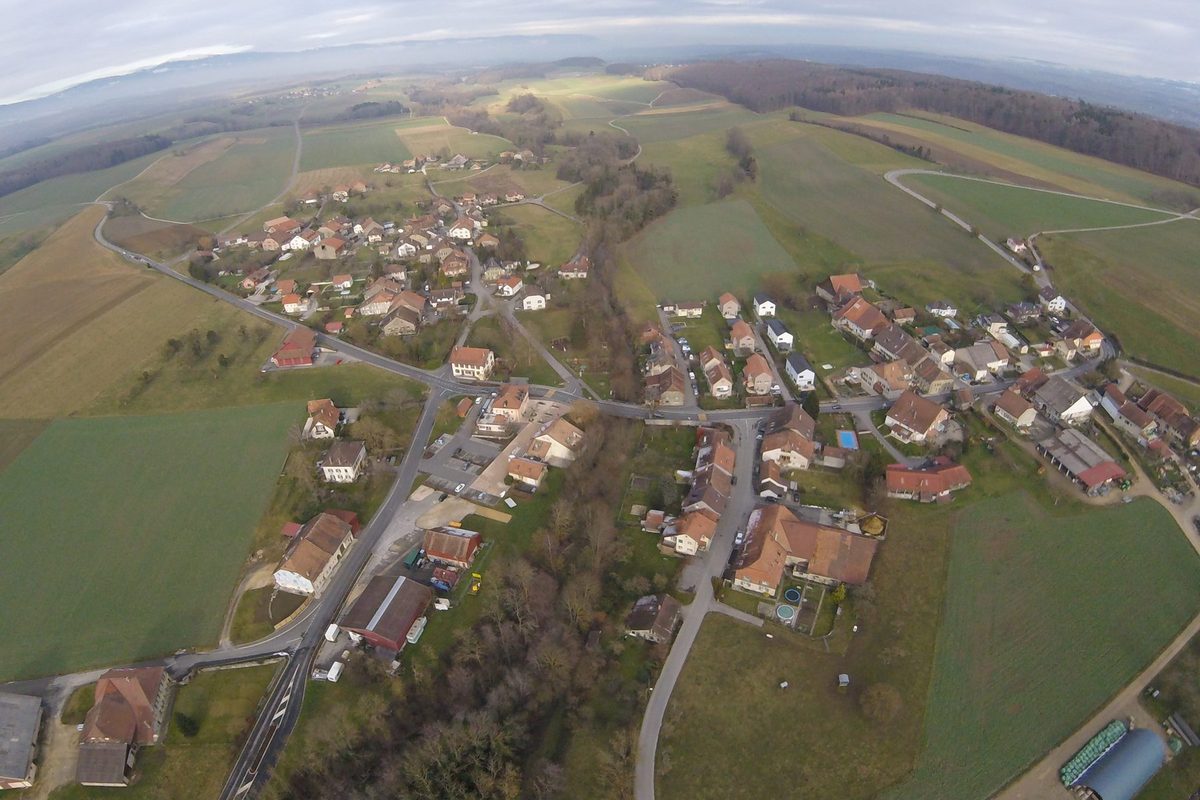
Villages of La Chaux and Ittens. The municipality brings together two villages, La Chaux on the left bank of the Veyron and Ittens on the right bank, formerly separate lordships united in 1674.[4]
The mill. On the Veyron, it successively housed a mill, a sawmill, an oil mill and a threshing mill until the early 20th century.
Remains in La Chaux (Cossonay)
Roman settlement of Les Chambres. Large Roman settlement known since 1842, one of four Roman sites identified in the area. Cultural property of regional importance (Swiss PCP inventory).[5]
Burgundian cemetery. Early medieval cemetery discovered in 1842 and 1847; it has since vanished.[1]
Gothic facade of the Commandery. The only witness to the commandery's former grandeur, the Gothic eastern facade has survived conversions and fires.
Protected heritage in La Chaux (Cossonay)
Cultural property of regional significance (B objects)[7]
- Ancienne Commanderie
- Les Chambres, villa gallo-romaine
Traditions and festivals in La Chaux (Cossonay)
The Festival des Granges. This theatre festival is held in even-numbered years and lasts ten days.[9]
The youth society. La Chaux has its own youth society. In 1983 the village hosted the cantonal festival of rural youth societies.[9]
The twinning with Saoû. Since 1 September 2001, La Chaux has been twinned with Saoû, in the Drôme valley.[9]
Sources
- Eric Vion, « Chaux, La (Cossonay) », Dictionnaire historique de la Suisse, version du 03.05.2005
- Statistique Vaud, « Population résidante permanente au 31 décembre 2025 »
- Feuille des avis officiels du canton de Vaud, « Alphabet des communes vaudoises : La Chaux »
- Office fédéral de la culture, Inventaire fédéral des sites construits d'importance nationale à protéger en Suisse (ISOS), « La Chaux » (2e version, 04.2013)
- Office fédéral de la protection de la population, Inventaire PBC, liste cantonale VD (état au 1.1.2026)
- État de Vaud, communiqué du 12.07.2007, « Organisation des préfectures et adaptation au nouveau découpage territorial »
- Federal Office for Civil Protection (FOCP), Swiss Inventory of Cultural Property (PCP), list for the canton of Vaud (as of 1.1.2026)
- IPI, Swissreg, emblems database: coat of arms of La Chaux (no. 102013)
- Official Gazette of the Canton of Vaud (FAO), "Alphabet des communes vaudoises: La Chaux"
- Register of Swiss Surnames, 3rd edition (1989), search Commune "La Chaux (Cossonay)", Canton VD
Published by Sébastien Jörg ·
Other villages near La Chaux (Cossonay)
Missing information, or do you have a source? Suggest a correction or addition. Every submission is checked before it's published.
Suggest a change