Cossonay
The town of the lords of Cossonay looks down on its station: since 1897 a funicular has linked the two, originally running on water counterweights.
Entry based on 19 sources · Our method · Reusable text (CC BY-SA)
Origin of the name Cossonay
The oldest document naming Cossonay dates from 1096 and calls it, in Latin, Cochoniacum. Cosonai follows in 1164. Other forms, «de Cossonay» around 1142 and Cossonai in 1228, are still uncertain. The name goes back to a Gallo-Roman estate called after its owner, Cossinus or Cossonus, with the Celtic suffix -acum: Cossinacum or Cossonacum became Cossonay. It would thus mean «the estate of Cossinus» or «of Cossonus». The inhabitants of Cossonay are nicknamed the «Traîne-Gourdins», a nickname whose origin has not yet been explained.[1][4][5][10][16]
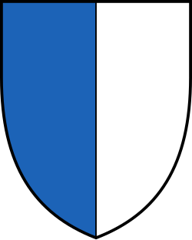
Coat of arms of Cossonay
Per pale azure and argent. The shield is divided vertically, blue on the left and white on the right. The oldest certain record dates from 1697, when François Charrière de Mex, an officer in foreign service, gave the Council a silver seal bearing the town's arms.[18][4]
Founding of Cossonay
Cossonay was not founded on a particular date. The town took shape gradually around a castle, on a promontory overlooking the Veyron valley. The site was occupied long before: a Roman villa has been identified at the place called Ouffemaz, and an early medieval necropolis between Cossonay and Allens. The first text to name the place, in 1096, records a donation: Uldric, lord of Cossonay, gives the church built on his allod to the monastery of Romainmôtier. It becomes a priory, probably shortly before the middle of the 12th century. The lords of Cossonay, a branch of the house of Grandson, build an extensive lordship around their castle, though its exact extent is not known. Three fortified enclosures follow one another in the 11th, 13th and 14th centuries, and from the 13th century the inhabitants have burgher status and franchises. Two members of the family rise to the see of Lausanne: Jean de Cossonay, son of the lord Jean, from 1240 to 1273, and reportedly Aymon de Cossonay, from 1355 to 1375. The line dies out at the beginning of the 15th century with Jeanne de Cossonay. In 1406 the place passes to the House of Savoy, which keeps it until the Bernese conquest of 1536.[1][4][5][11]
History of Cossonay
Roman period. A Roman villa stands at the place called Ouffemaz. A Roman road reportedly also crossed the area.[1]
Early Middle Ages. A necropolis of the early Middle Ages, brought to light during excavations in 1828, points to a continuous occupation of the site between the Roman period and the founding of the feudal town.[1]
1096. First written mention of the place, in the Latin form Cochoniacum. The lord Uldric (or Ulrich) of Cossonay gives the church built on his allod to the Benedictine convent of Romainmôtier.[1][4][5]
11th-12th century. The castle of Cossonay develops and becomes one of the most important in the region. A priory, probably founded by the lords of Cossonay in the first half of the 12th century, is established there and will later fall under the Benedictine priory of Lutry until the Reformation.[1]
around 1142-1228. The name appears as Cosonai in 1164. The spellings «de Cossonay» around 1142 and Cossonai in 1228 are uncertain.
1240-1273. Jean de Cossonay, son of the lord Jean de Cossonay, holds the episcopal see of Lausanne. He dies in Lausanne on 18 June 1273.[11]
13th century. The inhabitants obtain burgher status and franchises, perhaps in 1264 (date uncertain).[1]
11th-14th century. Three fortified enclosures succeed one another around the town, built respectively in the 11th, 13th and 14th centuries, as the settlement develops at the foot of the castle.[1]
1355-1375. A canon and then bishop of Lausanne, Aymon de Cossonay reportedly occupied the episcopal see in his turn. He is said to have died in 1375.
second half of the 13th century. The town church is completely rebuilt, with a rectangular choir of Cistercian influence.
late 14th century. A fire destroys a large part of the town and its old charters. The church is damaged and partly rebuilt.[1]
1398. Jeanne de Cossonay grants the inhabitants new liberties.[1]
1407. At Easter, work begins on the church bell tower, still standing today. It is reportedly the work of the priest Jean de Lilaz.[1]
1414. The Count of Savoy confirms the franchises of the inhabitants of Cossonay.[1]
early 15th century. Death of Jeanne de Cossonay, the last of her line, without descendants. Her succession passes to her husband, Jean de Rougemont.[4][5]
1406. Cossonay passes to the House of Savoy.[1]
from 1430. Cossonay sends representatives to the Estates of Vaud as a «bonne ville» (good town).[1]
1475. During the Burgundian Wars, Bernese troops reportedly set fire to the town and the castle.
1536. The Bernese conquest of Vaud brings Cossonay under Bernese administration, in the bailiwick of Morges. The Reformation takes hold and the church becomes a Protestant temple.[1][4][5]
1550. The town has 111 hearths (households), according to a census of the time, which gives an idea of the size of the locality in the mid-16th century.[1]
1664-1668. The building that will become the Auberge du Cerf is built and serves at the time as the town house. Its arcaded ground floor still survives, though the dates are uncertain.
1693. Jean-Jacques Delessert (1643-1704), already châtelain of L'Isle and governor of Cossonay, buys the castle of Cossonay from the estate of the de Penthaz family. The estate will remain in the hands of his family for nearly two centuries.[1][3]
1712. The west façade of the church of Cossonay is rebuilt.
1756-1779. The Cure (parsonage) is built, to plans attributed to the architect Gabriel Delagrange (uncertain).
18th century. The château was reportedly rebuilt in the broad lines of its present form, though this is not certain.
1798. With the end of the seigneurial regime and the creation of the canton of Léman then, from 1803, of the canton of Vaud, Cossonay becomes the chief town of the new district of Cossonay, an administrative status it will retain for more than two centuries.[1][5]
1803. Without a religious function since the Reformation, the former priory reportedly becomes the district prison, and remains so until 1970.
1815-1816. New doors and windows are opened up in the church of Cossonay.
1826-1831. Cossonay builds its present town hall in a neoclassical style, to plans attributed to the architect Jean-Siméon Descombes (uncertain).
1855. The Morges-Yverdon railway line opens and serves the region. The station was reportedly first called Penthalaz-Cossonay.[1][7]
1879. The castle of Cossonay leaves the estate of the Delessert family, which had owned it since 1693.[1][3]
1892-1897. An initiative committee is formed in 1891 to link the old town, up on the height, with the railway station, down below. The Compagnie du chemin de fer funiculaire de Cossonay is founded on 30 August 1892, and the funicular makes its first regular run on 28 August 1897, with two wooden carriages using water counterweights.[1][4][5][7]
1901. The Cossonay church is listed as a cantonal historic monument.[1]
1913. The station takes the name Cossonay, which it will bear for a century.
1970. The prison in the former priory reportedly closes this year. The building was then apparently put to other uses, notably housing.
1982. The funicular of Cossonay switches from hydraulic to electric traction: last run with the old system on 22 February, resumption of service on 18 June of the same year.[7]
2000. The district court of Cossonay is transferred to Nyon, a development that comes shortly before the complete disappearance of the district.[1]
1 January 2008. The new Vaud districts come into force: the district of Cossonay disappears and Cossonay joins the district of Morges.[5]
2011-2014. In 2011 Penthalaz asks for the station to take its name. The Federal Office of Transport sets the name Cossonay-Penthalaz on 13 September 2012, and the Federal Council rejects Penthalaz's appeal on 14 March 2014.
2012-2014. The funicular of Cossonay undergoes a complete renovation, with new rolling stock in the colours of the regional company.[7]
2020-2021. The funicular closes temporarily for works aimed at increasing its capacity, the line then carrying around 330,000 passengers per year.[4][7]
2021. The municipality has 4'233 inhabitants on 1 January 2021.[6]
2026. Twenty years after its district disappeared, Cossonay remains an independent municipality of the district of Morges, with no known merger with a neighbour. Its population is growing strongly.
Population of Cossonay
Sources and references: [1][5][6][9][10][15]
| 1764 | 507 |
| 1798 | 702 |
| 1850 | 938 |
| 1900 | 1'060 |
| 1910 | 1'108 |
| 1950 | 1'214 |
| 1970 | 1'529 |
| 1980 | 1'553 |
| 1990 | 2'043 |
| 2000 | 2'558 |
| 2010 | 3'315 (unconfirmed) |
| 2021 | 4'233 |
| 2025 | 4'974 |
| 2026 | 5'018 |
Families of Cossonay
Citizen families before 1800. Barrillier, Bernard, Bonnard, Brun, Caille, Cailler, Champoud, Crinsoz de Cottens, de Charrière de Sévery, de Lessert, Despland, Desponds, Ducret, Guex, Guillemin, Jöl, Perey, Prenleloup and Richard, as well as the Kuffer dit Barrillier family (from Ins BE), without a precise date. The Gaulis family (from Lausanne VD) obtains citizenship in 1732.[19]
In the 19th century. Landry and Leubaz, as well as the Matthey family (from Vallorbe VD) and the Perreten family (from Saanen BE), without a precise date. Then the Steinmetz family (from France) obtains citizenship in 1823, the Baitinger family (from Germany) in 1844 and the Conrad family (from Germany) in 1859.[19]
From 1901 to 1962. 24 registrations. Several families come from abroad: from Italy (Ramoni in 1931, Tessa in 1946, De Ambrogi in 1953, Comoli in 1954 and Bordet in 1958) and from France (Jaquemard in 1926). From Switzerland come the Dorsaz family from Vollèges VS, the Grob family from Lütisburg SG, the Roseng family from Erlach BE, the Sauser family from Sigriswil BE, the Schläppi family from Lenk BE, the Schmutz family from Worb BE, the Schumacher family from Boltigen BE, the Schärer family from Möriken-Wildegg AG and the Zaugg family from Langnau im Emmental BE (1955), the Zwahlen family from Saanen BE (1955 and 1961), the Furrer family from Turbenthal ZH and the Schläfli family from Albligen BE (1957), the Pasquier family from Maules FR, the Pittet family from La Joux FR and the Schneider family from Niedererlinsbach SO (1959), the Genoud family from Châtel-Saint-Denis FR (1960) and the Michel family from Villarlod FR (1962). They are joined by the Rogivue family (1956). The last family registered, in 1962, is the Michel family.[19]
Notable people of Cossonay
Jean Lecomte. After the Bernese invasion of 1536 he was the first reformer to preach in Cossonay. The town's altars were then pulled down, and the town received a share of the Church's property.[5]
Alberto Sartoris. In 1982 the architect gave the Confederation his house in Cossonay and his archives, which are managed by EPFL in Lausanne. The Alberto Sartoris house is a cultural property of regional importance.[1][17]
Economy of Cossonay, past and present
Livestock, grain and fairs. Livestock and cereals have always dominated, and vines are still present in the 15th century. Until the Comptoir suisse was founded in 1920, Cossonay's cattle fairs and markets rank among the most important in the canton. A market is held on Friday mornings, and the Expo de Coss, a regional fair, every October.[1][4]
The Venoge mills. From the Middle Ages, craftsmen settle along the Venoge, on what is now Penthalaz land. The mills, called the Grands Moulins from the 17th century, probably date back to the early 15th century. The L'Ilette mill is also medieval. The Entreroches canal and the mills use a great deal of timber. In the 17th century, Bern grants the canal company part of the Sépey oak wood as a fief, which becomes the "Bois du canal".[1]
Factories and cables. The Morges-Yverdon line in 1855 and the Cossonay-Vallorbe line in 1870 favour factories: enlarged mills, a condensed milk plant, a cable works, a broom factory. Workers join the farmers and small craftsmen. Founded in 1923, the Société des Câbleries et Tréfileries has 650 workers and staff in 1948. It has become Nexans Suisse SA. In the early 20th century, Cossonay is also home to one of the five French-speaking sections of the Swiss metalworkers' and watchmakers' union.[1]
Brickworks and motorway. A former clay pit of the brickworks, abandoned after the First World War, has become the Étang du Sépey nature reserve. In the 1980s, the Lausanne-Yverdon motorway draws many commuters.[1]
Disasters and major events in Cossonay
The plague of 1565 to 1638. The town, then prosperous, is struck by plague from 1565. The disease returns six or seven times until 1638, when it disappears from the region. The sick are taken to the Notre-Dame chapel or to the Saint-Denis lazar house.[4]
Historic sites in Cossonay
The Priory. Uldric, lord of Cossonay, gave the local church to the monastery of Romainmôtier in 1096. It became a priory probably shortly before the middle of the 12th century, then depended on the priory of Lutry until the Reformation. In 1387 Louis III of Cossonay raised the number of monks from three to six. The building reportedly served as the district prison from 1803 to 1970, before being converted into housing.[1]
The church (former church of Saint-Pierre-et-Saint-Paul). Dedicated to Saints Peter and Paul and documented from 1096, the church was preceded by several buildings: a first early medieval church, a second with three apses (probably 9th century) and a third with three aisles (11th-12th centuries). Completely rebuilt in the second half of the 13th century, with a rectangular choir of Cistercian influence, it was partly rebuilt after the fire of the late 14th century. The bell tower was then begun, at Easter 1407. Having become a Protestant church at the Reformation, it received a new west façade in 1712 and new doors and windows in 1815-1816. It was restored notably in 1921-1923 (or 1921-1924) and given stained glass by Louis Rivier (1924-1928). Listed as a cantonal historic monument in 1901, it is a cultural property of national importance (federal PCP inventory).[1][13]
The Château de Cossonay (Château Delessert). The château was the seat of the lords of Cossonay. The medieval castle, mentioned from 1096 east of the town, was in ruins in the modern period. Jean-Jacques Delessert (1643-1704), castellan of L'Isle and governor of Cossonay, bought the château from the heirs of Penthaz in 1693, and his family kept it until 1879. It was reportedly rebuilt in its present form in the 18th century. The château with its outbuilding is a cultural property of regional importance (federal PCP inventory).[1][3][13]
L'Auberge du Cerf. The former Hôtel du Cerf is a cultural property of regional importance (federal PCP inventory). It was reportedly built in 1664-1668 as a town house, with an arcaded ground floor.[13]
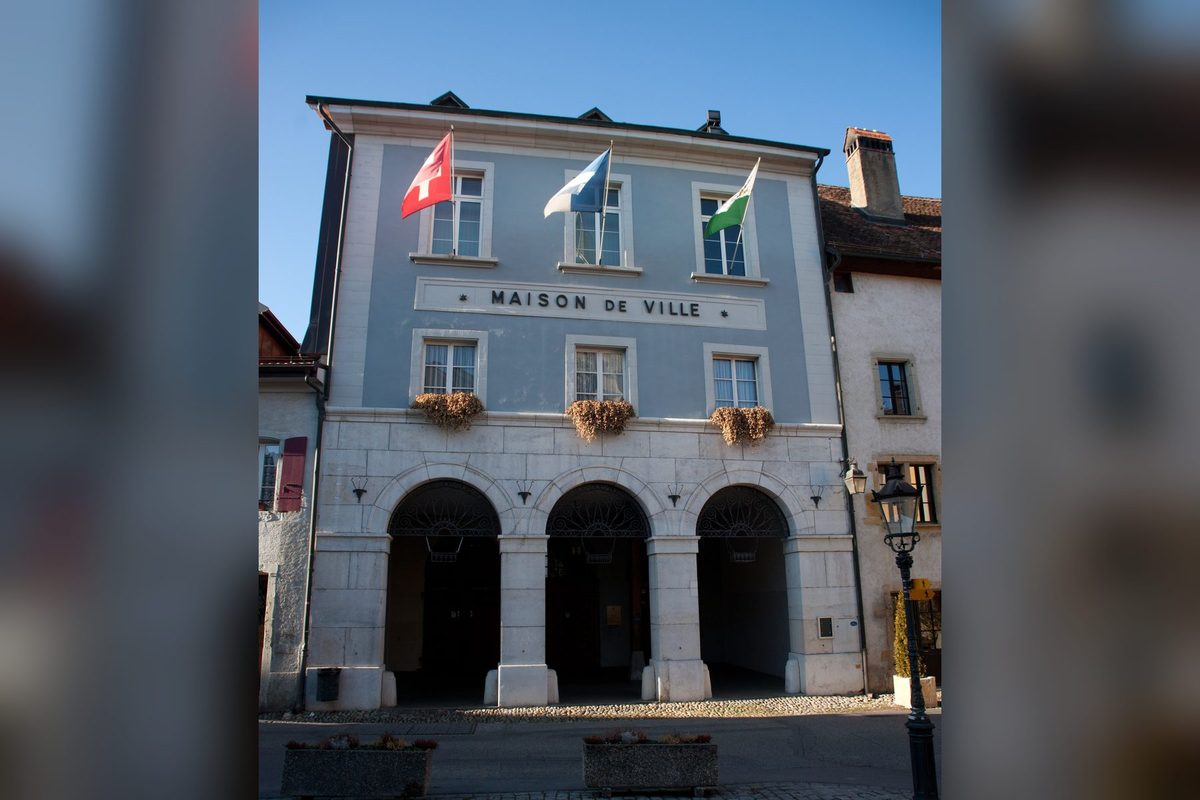
The Town Hall. The Town Hall was reportedly built between 1826 and 1831, in a neoclassical style, by the architect Jean-Siméon Descombes. It long housed the authorities of the district chief town, then those of the municipality, and still houses the municipal administration.
The old town and its ramparts. The historic heart of Cossonay preserves the layout of the fortified medieval settlement, protected by three successive enclosures built in the 11th, 13th and 14th centuries. The narrow streets and rows of buildings of the old town, today perched above the more recent station district, still fairly well convey the silhouette of the town as it developed around its castle.[1]
Le funiculaire de Cossonay. Put into service on 28 August 1897 to link the old town, up on the height, with the railway station, down below, this funicular originally operated with water counterweights before switching to electric traction in 1982. Renovated between 2012 and 2014 and then temporarily closed in 2020-2021 for capacity works, it remains in service today and carries several hundred thousand passengers a year, making it one of the historic facilities most used daily by residents.[4][7]
Remains in Cossonay
Gallo-Roman remains. Remains of a Roman villa have been identified at the place called Ouffemaz, on Cossonay's territory. The site was thus occupied several centuries before the first written mention of the medieval town. A Roman road reportedly also crossed the area.[1]
Necropolis of the early Middle Ages. An early medieval necropolis was discovered in 1828 between Cossonay and Allens. Nothing is known of the extent of the excavations or the number of burials found.[1]
Remains of the former medieval fortress. The medieval castle, mentioned from 1096 east of the town and counted among the largest in the region, was in ruins in the modern period. It has now disappeared. The present Château Delessert is reportedly, for the most part, the result of an 18th-century rebuilding.[1]
Traces of the three fortified enclosures. The layout of the three successive enclosures that protected the town between the 11th and 14th centuries remains partly legible in the plan of today's old town, even though the walls themselves now survive only in fragments, integrated into more recent buildings.[1]
Protected heritage in Cossonay
Cultural property of national significance (A objects in the PCP inventory)[17]
- Eglise réformée Saint-Pierre et Saint-Paul
Cultural property of regional significance (B objects)[17]
- Ancien Hôtel du Cerf
- Archives communales
- Château avec dépendance
- Maison Alberto Sartoris
- Tuilerie
Traditions and festivals in Cossonay
The Papagey and the Abbaye. Around 1560 the Council put up a large tent for shooting contests and for the Papagey festival, from which the present-day abbayes descend. The tradition lives on in the Abbaye of Cossonay, whose festival is held every three years.[5][4]
Sources
- Paola Crivelli, « Cossonay (commune) », Dictionnaire historique de la Suisse (DHS), version du 05.02.2018
- Dictionnaire historique de la Suisse, article La Chaux (Cossonay)
- Paola Crivelli, « Delessert », Dictionnaire historique de la Suisse (DHS), version du 22.08.2005
- Feuille des Avis Officiels du canton de Vaud, Alphabet des communes vaudoises, Cossonay
- Site officiel de la commune de Cossonay, page Histoire
- Site officiel de la commune de Cossonay, Données et statistiques
- Claude-Alain Monnard, « Penthalaz & Cossonay. Légendaire funiculaire », Journal de Cossonay, 22.03.2021
- 24 heures, Cossonay-gare est mort, vive Cossonay-Penthalaz
- City Population, données démographiques de Cossonay
- Union des communes vaudoises, annuaire, fiche Cossonay
- Ansgar Wildermann, « Cossonay, Jean de », Dictionnaire historique de la Suisse (DHS), version du 02.02.2011
- Inventaire fédéral des biens culturels (PBC), fiche 6029 « Église réformée, ancien St-Pierre-et-Paul », texte de la Société d'histoire de l'art en Suisse
- Office fédéral de la protection de la population, Inventaire suisse des biens culturels d'importance nationale et régionale, liste du canton de Vaud (état au 1.1.2026)
- Conseil fédéral, décision du 14 mars 2014 sur le recours de la commune de Penthalaz contre la décision du DETEC du 21 août 2013 (nom de la gare)
- Statistique Vaud, « Population résidante permanente au 31 décembre 2025 »
- Habitants.ch, noms des habitants du canton de Vaud
- Federal Office for Civil Protection (FOCP), Swiss Inventory of Cultural Property (PCP), list for the canton of Vaud (as of 1.1.2026)
- IPI, Swissreg, emblems database: coat of arms of Cossonay (no. 102084)
- Register of Swiss Surnames, 3rd edition (1989), search Commune "Cossonay", Canton VD
Published by Sébastien Jörg ·
Other villages near Cossonay
Missing information, or do you have a source? Suggest a correction or addition. Every submission is checked before it's published.
Suggest a change