Grancy
At En Allaz, the remains of a Roman villa built near the Yverdon-Aubonne road show an occupation that lasted into Burgundian times.
Entry based on 11 sources · Our method · Reusable text (CC BY-SA)
Origin of the name Grancy
The name appears in writing in 1141 as «Granci», then in 1202 as «Grantie». The name «Grancy» has not yet been explained.[1]
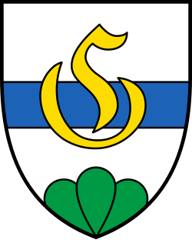
Coat of arms of Grancy
Argent, a fess azure, overall a Gothic letter G Or, in base a mount of three hillocks vert. On a white field, a blue horizontal band crosses the shield. A yellow Gothic G lies over it, and three green hills fill the base. The blue band stands for the stream near the village, the G is the initial of Grancy and the three hills recall the heights around it. The arms decorated the church ceiling until its restoration in 1933. A local tradition dates them to 1764.[8][9]
Founding of Grancy
The site was occupied long before: at the place called En Allaz a Roman villa stood near the Yverdon-Aubonne road, and occupation continued there into the early Middle Ages, with a Burgundian cemetery. In the Middle Ages Grancy was split into several fiefs held by various families, including the Senarclens. The commune comprises the village of Grancy and the hamlet of Saint-Denis, on the bank of the Veyron. Who founded the medieval village, and when, is unknown.[1]
History of Grancy
Roman times. A villa is built at En Allaz, near the Roman road from Yverdon to Aubonne.
early Middle Ages. The En Allaz site remains occupied. A Burgundian cemetery is laid out there.[1]
1141. First written mention as «Granci».[1]
1202. Mention as «Grantie».[1]
1228. Grancy is the seat of a parish.[1]
1351. First mention of the castle.[1]
1416. The village has 17 hearths (households).[1]
1536. With the Reformation, Grancy is attached to the parish of Vullierens.[1]
Bernese period. Grancy belongs to the bailiwick of Morges. The village is governed by a Council of Ten.[1]
1570. Grancy becomes a parish again.[1]
1677-1798. The neighbouring village of Gollion is part of the lordship of Grancy.[2]
1696. First mill mentioned at Saint-Denis. It remains in operation until the 19th century.[1]
1745. Construction of the town house (Maison de Ville).[1]
1764-1770. The church is rebuilt on the basis of the medieval church.[1]
1798. Grancy becomes part of the district of Cossonay.
1967. Closure of the second mill at Saint-Denis.[1]
2008. On 1 January, with the new territorial division of Vaud (law of 30 May 2006), the municipality moves from the abolished district of Cossonay to the district of Morges.[4][5]
Population of Grancy
Sources and references: [1][6]
| 1416 | 17 hearths (households) |
| 1453 | 12 hearths (households) |
| 1550 | 10 hearths (households) |
| 1764 | 279 |
| 1870 | 350 |
| 1970 | 226 |
| 2000 | 328 |
| 2025 | 541 |
Families of Grancy
De Senarclens. In the Middle Ages Grancy was divided into several fiefs. One of them passed from the feudal Dullit family to the Senarclens through the marriage of Guillaume de Senarclens to Jeannette, daughter of Pierre de Dullit. In the 17th century Isaac de Senarclens, husband of Suzanne de Mestral, united the two fiefs of Grancy. In 1798 the castle belonged to Auguste Victor de Senarclens, and his son César Auguste sold it with the estate in 1819 to Count Louis de Pourtalès.[1][9]
Burgher families before 1800. Clerc, de Senarclens, Devantay, Monnet and Tissot, with no precise date.[10]
In the 19th century. Demont (from Vullierens VD) and Recordon (from Sainte-Croix VD), with no precise date.[10]
Show more families (1)
From 1901 to 1962. The Claus, from France, were admitted in 1905 and the Nendaz in 1947. Two Italian families followed, the Caprara in 1953 and the Tedeschi in 1959.[10]
Notable people of Grancy
Auguste Tissot (Grancy 1728 - Lausanne 1797). Physician, citizen of Morges and Grancy. Appointed physician to the poor of Lausanne in 1752, he published "L'inoculation justifiée" in 1754, and his "Avis au peuple sur sa santé" (1761) brought him fame across Europe. Since the village streets were named in 2009, a plaque in Grancy bears his name.[11][9]
Auguste Pidou. Born in Grancy, this Landammann was one of the first magistrates of the canton of Vaud from 1803 to 1821. A second plaque, put up in 2009, honours his memory in the village.[9]
Economy of Grancy, past and present
The municipal forest. Forestry was long the municipality's main resource. The 150 hectares of municipal forest overlook the village to the west. They no longer bring in as much to the municipal finances as they once did, and the bark beetle has settled there in recent years.[1][9]
Milk, apples and potatoes. Of its 587 hectares, Grancy has 400 hectares of farmland. Eight farms are still active. Three produce milk, mostly for Gruyère cheese, one makes apple juice and another runs a small grocery. The village is home to the association of new potato producers of the Lake Geneva region (APPNAL). About twenty firms listed in the commercial register work in construction, catering and services.[9]
Historic sites in Grancy
Grancy Castle. Castle recorded from 1351; the present building dates from the 17th century, under Bernese rule. The castle, with its farm building, granary, orangery with oven and coach house, well and garden, is a cultural property of regional importance.[1][3]
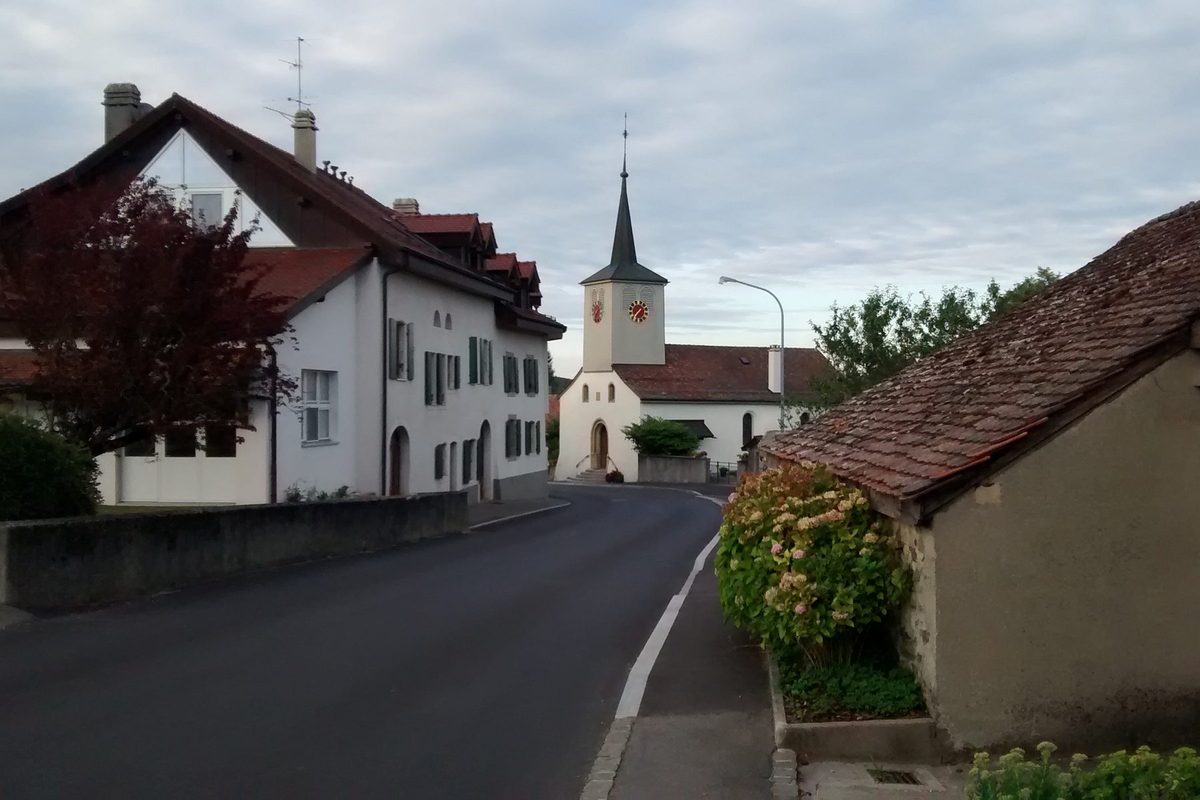
Grancy church (temple). Church rebuilt between 1764 and 1770 on the basis of the medieval church. Grancy has been a parish since 1228.[1]
Town house (Maison de Ville). Communal building of 1745, a witness of the Bernese period.[1]
Saint-Denis mills. Two mills on the bank of the Veyron, in the hamlet of Saint-Denis: the first, mentioned in 1696, operated until the 19th century. The second closed in 1967.[1]
Remains in Grancy
En Allaz Roman villa. Important remains of a Roman villa built near the Roman road from Yverdon to Aubonne. The site was occupied until the early Middle Ages, as a Burgundian cemetery attests.[1]
Protected heritage in Grancy
Cultural property of regional significance (B objects)[7]
- Château avec rural, grenier, orangerie avec four et remise, puits et jardin
Sources
- Dictionnaire historique de la Suisse, François Béboux, « Grancy », version du 15.06.2005
- Dictionnaire historique de la Suisse, François Béboux, « Gollion », version du 05.04.2007
- Office fédéral de la protection de la population, Inventaire PBC, liste cantonale VD (état au 1.1.2026)
- Canton de Vaud, Loi sur le découpage territorial (LDecTer, RSV 132.15) du 30 mai 2006
- État de Vaud, communiqué du 12.07.2007, « Organisation des préfectures et adaptation au nouveau découpage territorial »
- Statistique Vaud, « Population résidante permanente au 31 décembre 2025 »
- Federal Office for Civil Protection (FOCP), Swiss Inventory of Cultural Property (PCP), list for the canton of Vaud (as of 1.1.2026)
- IPI, Swissreg, emblems database: coat of arms of Grancy (no. 101366)
- Official Gazette of the Canton of Vaud (FAO), "Alphabet des communes vaudoises: Grancy"
- Register of Swiss Surnames, 3rd edition (1989), search Commune "Grancy", Canton VD
- Historical Dictionary of Switzerland, Guy Saudan, "Tissot, Auguste", version of 29.10.2012
Published by Sébastien Jörg ·
Other villages near Grancy
Missing information, or do you have a source? Suggest a correction or addition. Every submission is checked before it's published.
Suggest a change