Cheseaux-sur-Lausanne
Built on the ruins of a Roman villa, Cheseaux received in 1736 the observatory of the astronomer Jean-Philippe Loys de Cheseaux, known across Europe for his « Traité de la comète ».
Entry based on 10 sources · Our method · Reusable text (CC BY-SA)
Origin of the name Cheseaux-sur-Lausanne
The name is said to come from Old French « Cheseaulx », plural of « chesal », a word for a building plot or the ruins of a building. The village would thus have taken its name from the Roman ruins on which it grew up. A church is mentioned there before 1174, and the form « Chesaus » appears in 1228.[1][4]
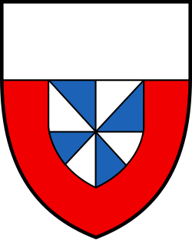
Coat of arms of Cheseaux-sur-Lausanne
Gules, a chief argent, an inescutcheon gyronny azure and argent. The shield is red, with a white band across the top. In the centre, a small shield is divided into triangles, alternately blue and white, meeting in the middle. Adopted in 1922, the arms set those of the greatest known lords of the place at the heart of the arms of Lausanne, the district capital. From the 12th century, the land of Cheseaux belonged to a family of the same name, to whom gyronny arms of argent and azure are attributed.[8][9]
Founding of Cheseaux-sur-Lausanne
Exactly who founded the village is not known. Near its site stood a Roman villa in the 3rd century AD, from which columns and a mosaic have been recovered. Fragments of Roman tiles and pottery still turn up in the fields. Burgundian graves of the 5th century show that the place was occupied in the early Middle Ages. Cheseaux probably grew up on these ruins in the 10th or 11th century. In the 12th century it was under a local lord, the knights of Cheseaux, who held the lordship as an allod.[1][4]
History of Cheseaux-sur-Lausanne
3rd century. Roman villa near the present village. Remains of columns and a mosaic.[1][4]
5th century. Burgundian graves.[1]
10th-11th century. The village probably grows up on the ruins of the Roman settlement.[4]
before 1174. A church dedicated to Saint Nicholas exists in Cheseaux.[1]
around 1179. Cheseaux is the property of the knights of Cheseaux. The community then had 60 to 80 inhabitants.[4]
1216. The lordship of Cheseaux is an allod belonging to the knights of the same name.[1]
1228. Mention as « Chesaus »; Cheseaux is a parish.[1]
15th century. The de Cheseaux family dies out in the middle of the century. The village then passes through several seigneurial families.[4]
1515. The village becomes the possession of Jean Champion.[4]
1557. Cheseaux becomes a fief, held by the Loys family until 1769. It belongs to the Bernese bailiwick of Lausanne.[1]
1736. The astronomer Jean-Philippe Loys de Cheseaux (1718-1751) has an observatory set up in Cheseaux.[2]
1741. Construction of the present church.[1]
1744. Jean-Philippe Loys de Cheseaux publishes his « Traité de la comète », which earns him a European reputation.[2]
1764. Cheseaux is a seigneurial estate of 55 hearths, run by a council known as « des Douze ».[4]
1769. Charles-Louis Loys de Cheseaux (1730-1789), who had inherited it, sells the lordship.[3]
1874. Opening of the Lausanne-Echallens-Bercher (LEB) railway line.[1]
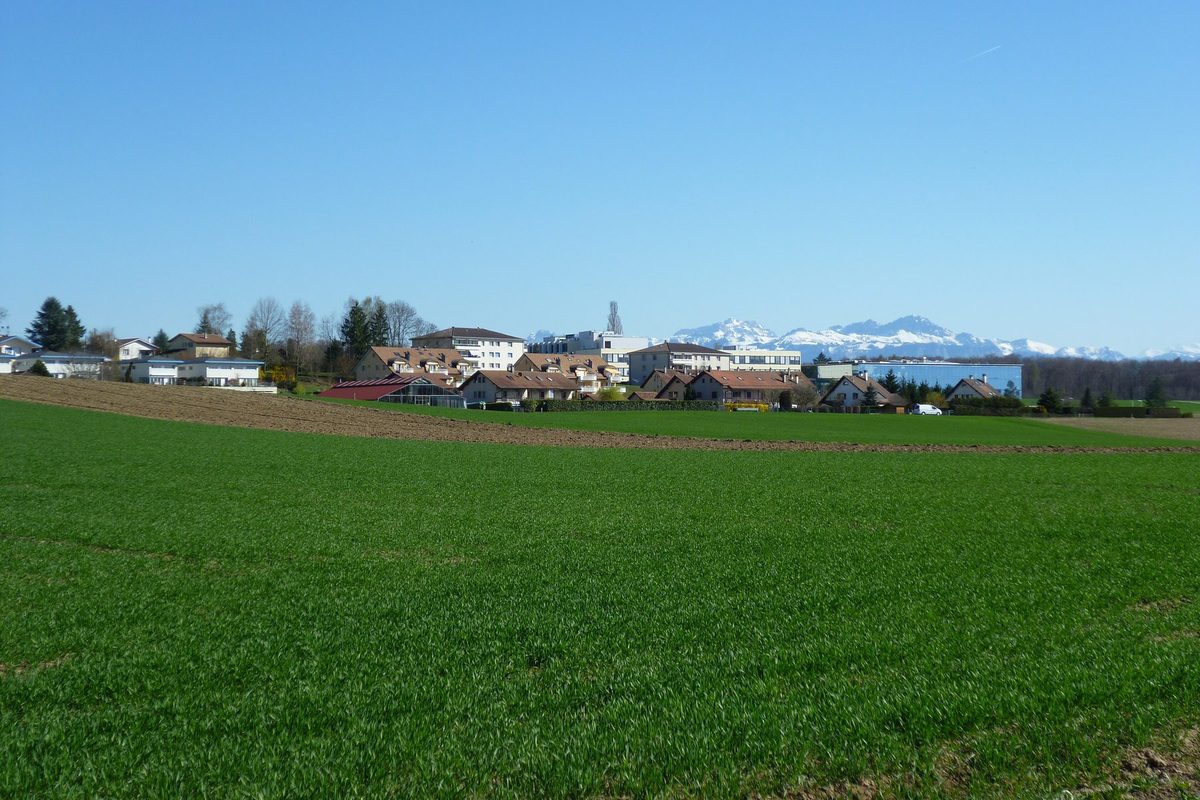
1960. Long agricultural, Cheseaux becomes an industrial municipality. Today it is part of the Lausanne conurbation.[1]
1969. The Kudelski company (Nagra recorders) settles here.[1]
2001. Opening of the village bypass road, with a tunnel.[4]
2002. Opening of the new LEB station.[4]
Population of Cheseaux-sur-Lausanne
Sources and references: [1][4][5]
| 1709 | 212 |
| 1764 | 229 (or 243) |
| 1850 | 421 |
| 1900 | 399 |
| 1930 | 358 |
| 1950 | 409 |
| 1960 | 491 |
| 1970 | 1'579 |
| 1980 | 2'393 |
| 1990 | 2'857 |
| 2000 | 2'939 |
| 2025 | 4'870 |
Families of Cheseaux-sur-Lausanne
Bovey, Cevey, Joyet, Juat, Perrochon, Troyon and Vez. These families belong to the present-day burghers of Cheseaux. Documents from 1550 already name them.[9]
Citizen families before 1800. The seven families already named in 1550 are joined by the Ducertot family, without a precise date.[10]
In the 19th century. The Binggeli family (from Wahlern BE) obtains citizenship in 1835 and the Bobaing family (from Germany) in 1868.[10]
Show more families (1)
From 1901 to 1962. 11 registrations. Several families come from abroad: from Italy (Borgnana in 1908, Barone in 1916 and Saldarini in 1917), from France (Droetto in 1920, Rosset in 1944 and Astier in 1958) and from Hungary (Biro in 1953). From Switzerland come the Küffer family from Ins BE (1956), the Bovey family from Neyruz FR (1957) and the Zeder family from Entlebuch LU (1958). They are joined by the Christoforoff family (1920). The last registrations date from 1958 (Astier and Zeder).[10]
Notable people of Cheseaux-sur-Lausanne
Jean-Philippe Loys de Cheseaux (Lausanne 1718 - Paris 1751). The Cheseaux astronomer discovers a comet in 1743. For health reasons he turns down the direction of the Saint Petersburg observatory. The school built in the village in 2022 bears his name.[9]
Economy of Cheseaux-sur-Lausanne, past and present
Companies and shops. Companies with a Swiss or international reputation have their headquarters in Cheseaux. The nearness of Lausanne and of the motorway junctions draws investors. The village has butchers, bakeries, a kiosk, retail shops, several restaurants, two banks and a post office agency.[9][4]
Historic sites in Cheseaux-sur-Lausanne
Cheseaux church. Built in 1741; the church, dedicated to Saint Nicholas, is attested before 1174. At the Reformation the parish of Cheseaux included the chapelry of Sullens and the villages of Bournens and Boussens. Romanel has been attached to it as a chapelry since 1849.[1]
Cheseaux castle. The castle and its former farmhouse are listed in the federal inventory as cultural property of regional significance. The lordship belonged to the Loys family from 1557 to 1769. Jean-Philippe Loys de Cheseaux had an observatory set up at Cheseaux in 1736.[2][6]
LEB station. The Lausanne-Echallens-Bercher line has served Cheseaux since 1874. A new station opened in 2002.[1][4]
Remains in Cheseaux-sur-Lausanne
Roman remains. A Roman villa of the 3rd century AD left columns and a mosaic. Fragments of Roman tiles and pottery are still found in the fields. The very name of the village is said to recall these ruins.[1][4]
Burgundian graves. Burgundian graves of the 5th century have been uncovered in Cheseaux.[1]
Protected heritage in Cheseaux-sur-Lausanne
Cultural property of regional significance (B objects)[7]
- Château et ancienne ferme
Traditions and festivals in Cheseaux-sur-Lausanne
The Gremauds. The people of Cheseaux go by the nickname "Gremauds". More than thirty societies run village life, among them a youth society, a brass band and a women's volleyball team playing in the National League.[9]
Sources
- Dictionnaire historique de la Suisse, « Cheseaux-sur-Lausanne »
- Dictionnaire historique de la Suisse, « Loys de Cheseaux, Jean Philippe »
- Dictionnaire historique de la Suisse, « Loys de Cheseaux, Charles-Louis »
- Commune de Cheseaux-sur-Lausanne, « Au fil des siècles »
- Statistique Vaud, « Population résidante permanente au 31 décembre 2025 »
- Inventaire suisse des biens culturels d'importance nationale et régionale (PBC), liste du canton de Vaud, état au 1.1.2026
- Federal Office for Civil Protection (FOCP), Swiss Inventory of Cultural Property (PCP), list for the canton of Vaud (as of 1.1.2026)
- IPI, Swissreg, emblems database: coat of arms of Cheseaux-sur-Lausanne (no. 102038)
- Official Gazette of the Canton of Vaud (FAO), "Alphabet des communes vaudoises: Cheseaux-sur-Lausanne"
- Register of Swiss Surnames, 3rd edition (1989), search Commune "Cheseaux-sur-Lausanne", Canton VD
Published by Sébastien Jörg ·
Other villages near Cheseaux-sur-Lausanne
Missing information, or do you have a source? Suggest a correction or addition. Every submission is checked before it's published.
Suggest a change