Cugy
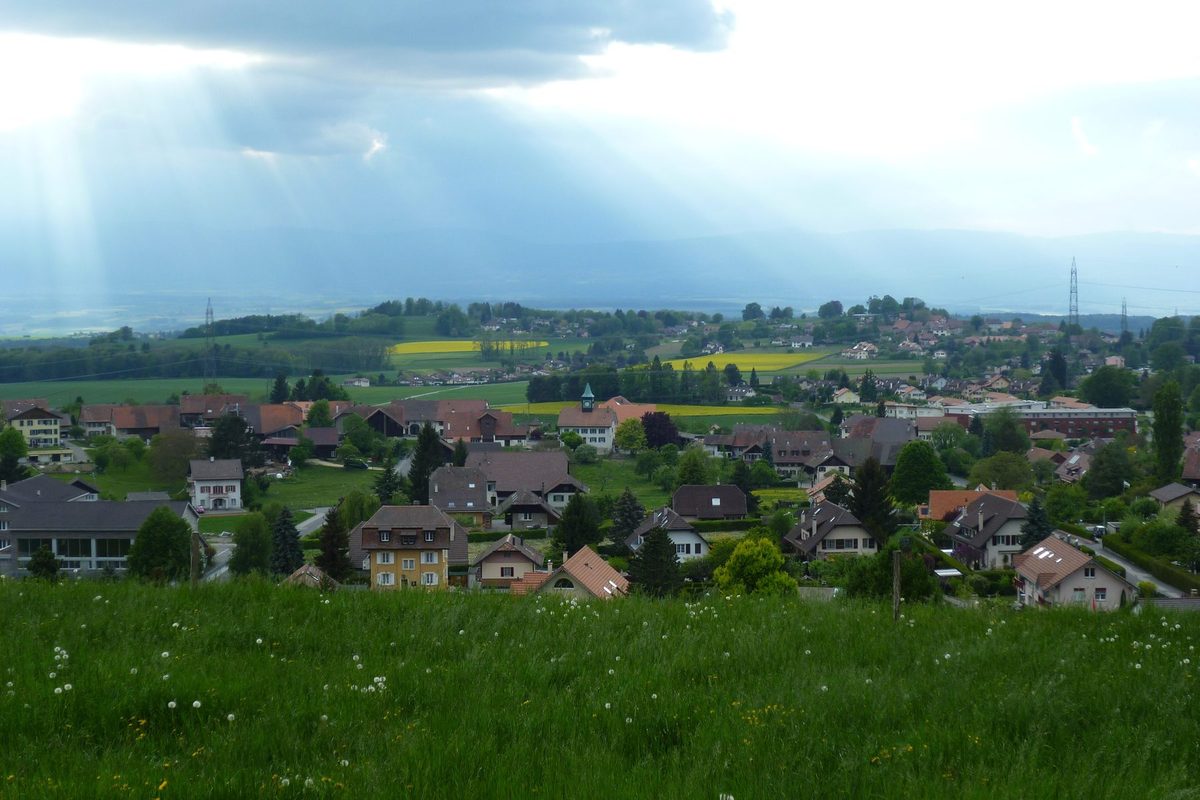
Cugy calls itself the «village at the middle of the world»: its waters flow both to the Mediterranean and to the North Sea.
Entry based on 7 sources · Our method · Reusable text (CC BY-SA)
Origin of the name Cugy
The place appears between 968 and 985 as «in villa Cuzziaco», then in 1147 as «Cusi». What «Cugy» means is still not known.[1][2]
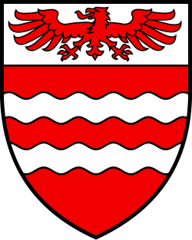
Coat of arms of Cugy
Gules, two bars wavy argent, on a chief of the second an eagle of the first. On a red field, two wavy white bands cross the shield. The top is white, with a red eagle. Adopted in 1923, the arms show through the two bands the streams that border the municipality, the Talent to the north and the Mèbre to the south. The red recalls Lausanne, since Cugy belonged to its military district in the time of the bishops. The eagle is the symbol of Saint John the Evangelist, patron of the village and of a chapel that has since disappeared.[5][6]
Founding of Cugy
From the second half of the 10th century the place existed as a «villa», that is, an estate. In the 12th century the Cistercian abbey of Montheron ran a grange there, a farm, and it long kept the village's tithe. When and by whom Cugy was founded is unknown.[1]
History of Cugy
968-985. First mention, in the form «in villa Cuzziaco».[1]
1147. The village is called «Cusi».[1][2]
1163. The grange of Cugy belongs to the abbey of Montheron.[1]
1394. Mention of a chapel of Saint-Jean-l'Evangéliste, a daughter chapel of the parish of Assens.[1]
1444. The abbot of Montheron owns the whole tithe.[1]
1545. The tithe passes to the Town of Lausanne.[1]
1536-1798. Under Bernese rule Cugy is part of the bailiwick of Lausanne and in civil matters falls under the court of the Town of Lausanne. From the Reformation the village belongs to the parish of Morrens (an annex of Montheron).
1798. Cugy is attached to the district of Echallens.[1][2]
1837. The school is built; it was converted into the communal house in 1974.[1][2]
1906. Cugy is connected to the Lausanne tramway network.[1][2]
1962. The «maison villageoise» (village hall) is built.[1][2]
1972. The sewage treatment plant goes into service.[1][2]
1974. The former school of 1837 is converted into the communal house.[1][2]
1976. The Chavanne school is built. The municipal council (Conseil communal) replaces the general council (Conseil général).[1][2]
1986. The ecumenical centre opens.[1][2]
2008. New Vaud districts: Cugy moves from the district of Echallens to the district of Gros-de-Vaud (1 January).[2][3][4]
Population of Cugy
Sources and references: [1][3]
| 1764 | 141 inhabitants |
| 1850 | 230 inhabitants |
| 1900 | 242 inhabitants |
| 1950 | 305 inhabitants |
| 1970 | 636 inhabitants |
| 1980 | 1'349 inhabitants |
| 2000 | 1'992 inhabitants |
| 2010 | 2'267 inhabitants (unconfirmed) |
| 2025 | 2'824 inhabitants |
Families of Cugy
Citizen families before 1800. Dégy, Delespinasse, Echaud, Gringet, Hennard, Marguerat and Vaney, without a precise date.[7]
From 1901 to 1962. Several families come from abroad: from Italy (Bariatti and Lorenzini in 1954). From Switzerland come the Hänggeli family from Mühleberg BE and the Roth family from Zetzwil AG (1956). The last registrations date from 1956 (Hänggeli and Roth).[7]
Economy of Cugy, past and present
Three farms. The municipality owns some thirty hectares of meadows and fields, leased to local farmers. Three farmers still work the land and sell their produce at the farm.[6]
Shops and care. Cugy has many shopkeepers and craftsmen, two restaurants, two bakeries, a butcher, a florist and a shopping centre with two large chains. Two medical practices, a dental practice and two pharmacies complete the list. The Fondation Echaud cares for adults with multiple disabilities there.[6]
Historic sites in Cugy
Communal house (former school of 1837). The school built in 1837 was converted into the communal house in 1974.[1][2]
Ecumenical centre (1986). In the Middle Ages Cugy had a chapel of Saint-Jean-l'Evangéliste (mentioned in 1394), a daughter chapel of Assens. After the Reformation the village belonged to the parish of Morrens. The ecumenical centre opened in 1986.[1][2]
Jorat woods. The village lies on the edge of the Jorat woods.[1]
Legends of Cugy
The «Boucs» (billy goats). According to tradition, the inhabitants of Cugy, the Cugiérans, are nicknamed the «Boucs» (billy goats). Where this nickname comes from is unknown.[2]
The «village in the middle of the world». The municipality presents itself as the «village du milieu du monde» (village in the middle of the world), because its waters flow both towards the Mediterranean and towards the North Sea, between the Rhône and Rhine basins.[2]
The coat of arms. According to the municipality, the two wavy silver bars of the coat of arms represent the Talent and Mèbre streams, and the eagle recalls Saint John the Evangelist, patron saint of the village.[2]
Sources
- François Béboux, « Cugy (VD) », Dictionnaire historique de la Suisse (DHS), version du 08.09.2005
- Commune de Cugy, page Vivre à Cugy
- Statistique Vaud, « Population résidante permanente au 31 décembre 2025 »
- État de Vaud, communiqué du 12.07.2007, « Organisation des préfectures et adaptation au nouveau découpage territorial »
- IPI, Swissreg, emblems database: coat of arms of Cugy (no. 101971)
- Official Gazette of the Canton of Vaud (FAO), "Alphabet des communes vaudoises: Cugy"
- Register of Swiss Surnames, 3rd edition (1989), search Commune "Cugy", Canton VD
Published by Sébastien Jörg ·
Other villages near Cugy
Missing information, or do you have a source? Suggest a correction or addition. Every submission is checked before it's published.
Suggest a change