Morrens
Abraham Davel was born in Morrens on 20 October 1670. The village, mentioned from 1147, became the lordship of the Saussure family, who had a castle built there in 1696.
Entry based on 11 sources · Our method · Reusable text (CC BY-SA)
Origin of the name Morrens
The village appears in 1147 as «Morrens». The name is said to be formed from a personal name, perhaps the Latin Maurus or a Germanic name in Maur-, and the Germanic suffix -ingōs, meaning the people of that person.[1][3]
Coat of arms of Morrens
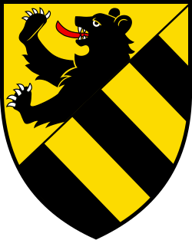
Per bend sinister, first Or a bear issuant sable langued gules, second bendy Or and sable. The shield is divided diagonally. At the top left, on a yellow field, a black bear with a red tongue rises from the dividing line. At the bottom right, yellow and black diagonal stripes alternate. Adopted only in 1927, the arms take their lower part from the arms of the de Saussure family, lords of the place. The bear recalls the villagers' nickname, "les Ours": according to tradition, a drunken villager mistook a large yellow dog for a bear.[8][3][9]
Founding of Morrens
Who founded Morrens, or when, is not known. The site was nevertheless occupied from Roman times, as shown by the Gallo-Roman villa of Le Buy and the ruins of a Roman settlement, and in the early Middle Ages, as graves attest. Morrens appears in written records in 1147. In the Middle Ages it was a fief of the bishop of Lausanne.[1][3]
History of Morrens
Roman period. At the place called Le Buy, straddling the territories of Cheseaux-sur-Lausanne and Morrens, stands a large Gallo-Roman villa with several buildings and a potter's kiln. Another Roman settlement lies within the municipality.[1]
Early Middle Ages. Several graves, slab-lined or cut into the molasse, attest occupation in this period. They were discovered in the 19th century.[1]
1147. First mention of the village, in the form «Morrens».[1][3]
1228. The church of Saint-Nicolas is mentioned. The parish depends on the chapter of Lausanne Cathedral.[1][3]
1453. The village has 13 hearths.[1][3]
early 16th century. Morrens, a fief of the bishop of Lausanne, is held by the nobles of Russin.[1]
1530 (or 1535). The lordship is enfeoffed to Jean Réal.[1][3]
1536-1798. Under Bernese rule, Morrens belongs to the bailiwick of Lausanne. Governed by the assembly of burghers, the village is the seat of a seigneurial court of justice.[1]
1538. At the Reformation, the hamlet of Montheron (now in the municipality of Lausanne) becomes an annex of the parish of Morrens.[1]
1594. The lordship passes to Daniel de Saussure. It remains in this family throughout the Ancien Régime.[1][3]
1670. Birth in Morrens, on 20 October, of Abraham Davel, son of a pastor, the future Major Davel (1670-1723).[2]
1696. A château is built for the Saussure family.[1]
1798. Morrens is assigned to the district of Echallens.[1]
1950s. Land consolidation.[1]
1970. Morrens is now part of the Lausanne agglomeration. Strong population growth begins and the former farming village becomes a residential municipality.[1]
1998. New excavations at the Gallo-Roman villa of Le Buy.[1]
1 January 2008. The new Vaud districts come into force (law of 30 May 2006): Morrens moves from the district of Echallens to the district of Gros-de-Vaud.[1][5][6]
Population of Morrens
Sources and references: [1][6]
| 1453 | 13 hearths (households) |
| 1764 | 41 hearths (households) |
| 1803 | 203 inhabitants |
| 1850 | 326 inhabitants |
| 1900 | 285 inhabitants |
| 1950 | 246 inhabitants |
| 1980 | 623 inhabitants (unconfirmed) |
| 2000 | 888 inhabitants |
| 2025 | 1'145 inhabitants |
Families of Morrens
de Saussure. A family from Saulxures in Lorraine, ennobled by the Duke of Lorraine in 1503. Its Vaud branch descends from Antoine (1514-1569), who took refuge in Lausanne and became a citizen in 1556. Daniel de Saussure acquired the lordship of Morrens in 1594, and the branch also held those of Vernand, Bercher, Bavois and Boussens. César (1677-1744) attended Major Davel on the scaffold, while the Geneva branch, descended from Élie (1602-1662), produced many scholars.[1][11]
Citizen families before 1800. Borgeaud, Chamot, Chevaley, Chevalley, Delisle, Freymond, Janin, Mermet, Potterat and Semoroz, with no precise date.[10]
In the 19th century. The Wullschleger, from Vordemwald AG, were admitted in 1805.[10]
Show more families (1)
From 1901 to 1962. The Borgnana, from Italy, were registered in 1916. The others arrived in the 1950s: Badertscher from Lauperswil BE and Kopp from Wiedlisbach BE (1956), Messerli from Oberwil im Simmental BE (1956 and 1958), Bariatti from Italy and Knopfli from Grossandelfingen ZH (1958).[10]
Notable people of Morrens
Jean Daniel Abraham Davel (1670-1723). The future Major Davel was born at the village parsonage in 1670. He was executed at Vidy on 24 April 1723.[9]
Marc Antoine de Saussure. As lord of Morrens, he had the village castle built.[9]
Economy of Morrens, past and present
The farms. Morrens was long a mainly agricultural village. In 2000 it had five farms. Four farmers still work the communal and private land.[1][9]
Businesses and shops. A general construction firm and a cabinet-making workshop are based in the village. Morrens has a bakery with a tea room, a grocery with catering, a hairdresser, a wellness centre, the Major Davel restaurant and more than 70 other businesses. Most residents work outside the commune.[1][9]
Disasters and major events in Morrens
The Burgundian army's camp in 1476. During the Burgundian Wars the army of Charles the Bold camped on Morrens territory from 27 May to 4 June 1476.[3]
Historic sites in Morrens
Château de Morrens. Centre of the lordship, owned by the de Saussure family from 1594 to the end of the Ancien Régime. The château was built in 1696.[1]
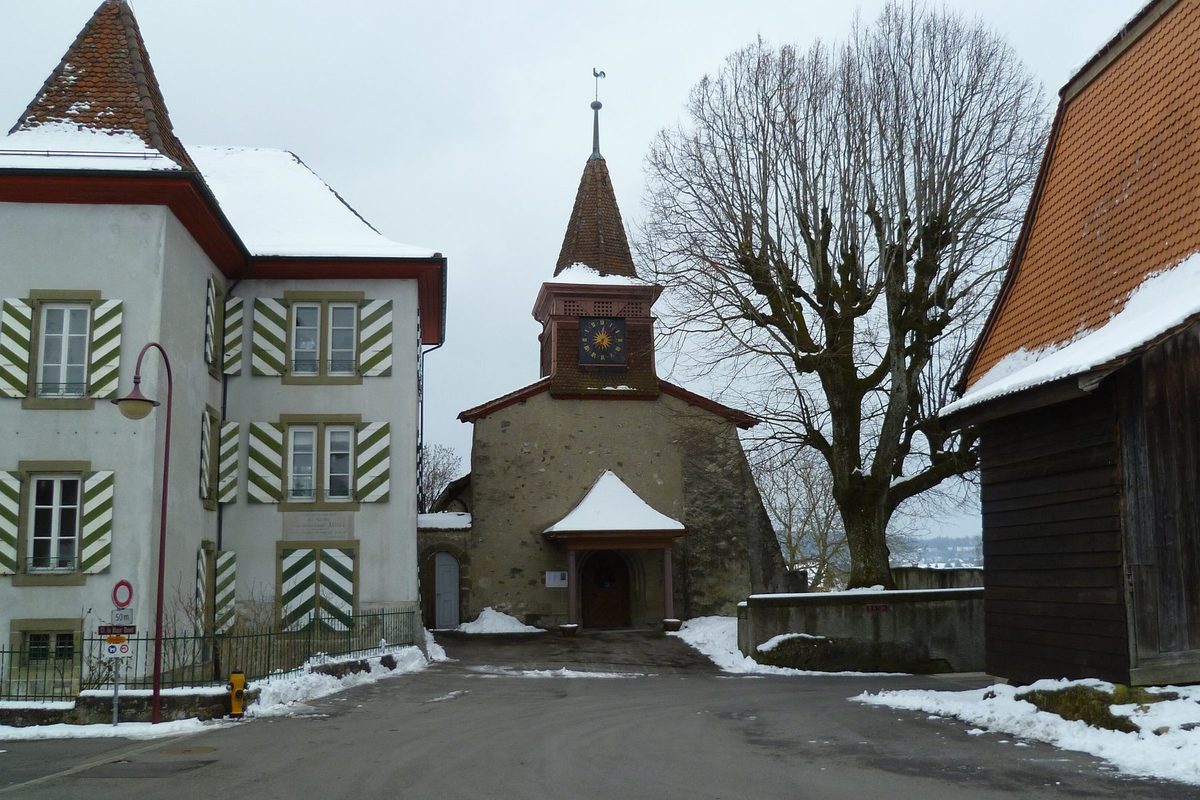
Church. Of medieval origin, the church of Saint-Nicolas is mentioned in 1228. Davel was baptised there in 1670. An inscription inside commemorates the tercentenary of his birth (1970). Cultural property of regional importance. It was reportedly altered by Gabriel Delagrange in the 18th century and restored in 1918, and is said to have a stained-glass window by Louis Rivier (1925).[1][3][4]
La Cure, birthplace of Major Davel. Jean Daniel Abraham Davel (1670-1723), Major Davel, son of the pastor François Davel, was born at the Morrens parsonage on 20 October 1670. A marble plaque placed on the façade in 1903 recalls his sacrifice. Cultural property of regional importance.[2][3][4]
Hamlet of Les Biolettes. Besides the village, the municipality includes the hamlet of Les Biolettes.[1]
Remains in Morrens
Gallo-Roman villa of Le Buy. Straddling Cheseaux-sur-Lausanne and Morrens, this large villa was excavated in the late 19th century and again in 1998. Finds include the foundations of several buildings, a potter's kiln and abundant material: coins, pottery, wall paintings and a mosaic, part of which is now in the Villa Mon-Repos in Lausanne.[1]
Roman settlement and early medieval graves. The ruins of a Roman settlement were identified in 1977. Several early medieval graves, slab-lined or cut into the molasse, had been discovered in the 19th century.[1]
Protected heritage in Morrens
Cultural property of regional significance (B objects)[7]
- Cure
- Eglise réformée Saint-Nicolas
- Maison de Commune
Legends of Morrens
The «Bears». According to tradition, the inhabitants of Morrens are nicknamed the «Bears». The story goes that a drunken villager fled from a supposed bear, which was in fact only a large yellow dog.[3]
Traditions and festivals in Morrens
New Year's pea soup. The firefighters' association serves its pea soup every New Year. It also organises raisinée and fondue evenings.[9]
The Fête de l'Orme. Every two years the village holds the Fête de l'Orme.[9]
The Course du Four. Every June the Arts et Loisirs society organises the Course du Four race.[9]
Sources
- Dictionnaire historique de la Suisse, « Morrens (VD) » (Marianne Stubenvoll)
- Dictionnaire historique de la Suisse, « Davel, Jean Daniel Abraham » (Gilbert Coutaz, version du 22.08.2005)
- Commune de Morrens, page « Historique »
- Office fédéral de la protection de la population, Inventaire PBC, liste du canton de Vaud (état au 1.1.2026)
- État de Vaud, communiqué du 12.07.2007, « Organisation des préfectures et adaptation au nouveau découpage territorial »
- Statistique Vaud, « Population résidante permanente au 31 décembre 2025 »
- Federal Office for Civil Protection (FOCP), Swiss Inventory of Cultural Property (PCP), list for the canton of Vaud (as of 1.1.2026)
- IPI, Swissreg, emblems database: coat of arms of Morrens (no. 101890)
- Official Gazette of the Canton of Vaud (FAO), "Alphabet des communes vaudoises: Morrens"
- Register of Swiss Surnames, 3rd edition (1989), search Commune "Morrens", Canton VD
- Historical Dictionary of Switzerland, « Saussure, de » (Martine Piguet, version of 23.02.2011)
Published by Sébastien Jörg ·
Other villages near Morrens
Missing information, or do you have a source? Suggest a correction or addition. Every submission is checked before it's published.
Suggest a change