Chevilly
The painter Charles Gleyre was born in 1806 in Chevilly, a lordship of the Gingins family until 1798, between the Venoge and the Veyron.
Entry based on 9 sources · Our method · Reusable text (CC BY-SA)
Origin of the name Chevilly
The place is called «Chivillier» in 1540. No earlier mention is known so far, and the origin of the name has not yet been explained.[1]
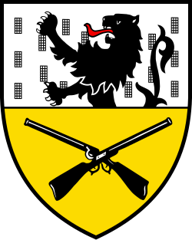
Coat of arms of Chevilly
Per fess, first argent semé of billets sable, a demi-lion of the same langued gules, second Or, two muskets in saltire sable. The shield is divided horizontally. At the top, on a white field scattered with small black rectangles, a black lion with a red tongue rises, only its upper body visible. At the bottom, two black muskets cross on a yellow field. Adopted in 1927, the arms take up in their upper part those of the Gingins family, lords of the place. The muskets come from an old flag of the village.[7][8]
Founding of Chevilly
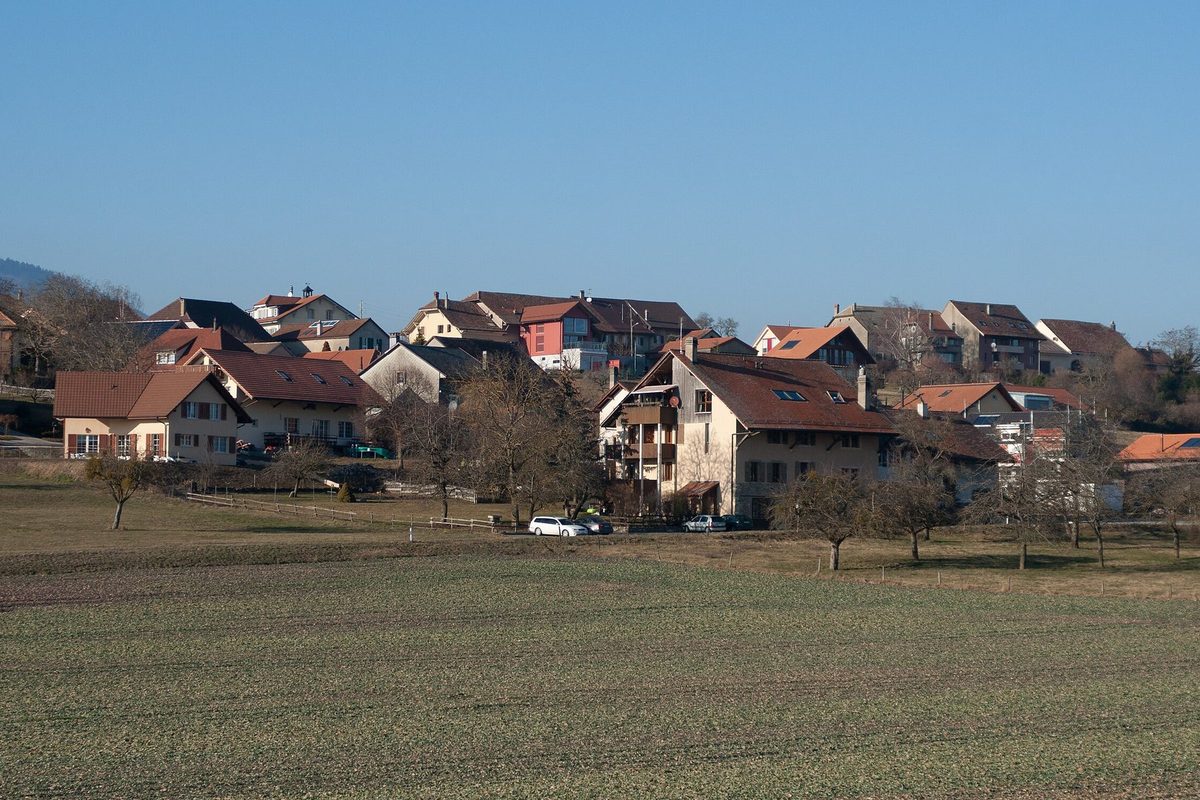
Nobody knows when or by whom Chevilly was founded. The village lies at the foot of the Jura, between the Venoge and the Veyron, upstream of their confluence at the Tine de Conflans. It belonged to the barony of La Sarraz. The barony passed to the de Gingins family, and Chevilly later became a lordship of that family in its own right.[1]
History of Chevilly
1536-1798. Bernese period: Chevilly comes under the bailiwick of Romainmôtier and is governed by a Council of Twelve.
1540. The place is called «Chivillier».[1]
1542. The barony of La Sarraz, to which Chevilly belongs, passes to the de Gingins family.[1]
16th century. A mill on the Veyron is recorded. It will operate until 1952.[1]
1623. In a partition, Chevilly goes to Joseph de Gingins-Chevilly. The lordship later passes to the Orny branch.[1]
1709-1798. Chevilly once again forms an independent lordship.[1]
1795. Wolfgang-Charles de Gingins, the last lord, is treasurer of the Pays romand. In 1797-1798 he tries in vain to calm tensions.[1]
1798. Chevilly is assigned to the district of Cossonay. In May the municipality petitions the legislature in Aarau for the abolition of feudal rights.[1]
1802. The Bourla-Papey, with Abram Gleyre among their leaders, occupy the castles of Orny and Eclépens.[1]
1806. Birth in Chevilly of the painter Charles Gleyre, on 2 May 1806. He died in Paris in 1874.[2]
1898. Restoration of the temple; the village belongs to the parish of Cuarnens.[1]
1952. End of operation of the mill on the Veyron.[1]
1970. The village has only 120 inhabitants. The decline is later reversed by the arrival of commuters.[1]
2008. Chevilly moves from the district of Cossonay to the new district of Morges.[4][5]
Population of Chevilly
Sources and references: [1][3]
| 1764 | 158 |
| 1798 | 263 |
| 1850 | 295 |
| 1900 | 221 |
| 1950 | 165 |
| 1970 | 120 |
| 2000 | 211 |
| 2025 | 345 |
Families of Chevilly
Citizen families before 1800. Gaudin, Gleyre and Lugeon, without a precise date.[9]
In the 19th century. Braissant, Bredaz, Landry and Ramel, without a precise date.[9]
From 1901 to 1962. Several families come from abroad: from Italy (Didero in 1953 and Antonioli in 1956) and from France (Corbex in 1954). From Switzerland come the Vaucher family from Fleurier NE (1952) and the Mingard family from Chapelle-sur-Moudon VD (1959). The last family registered, in 1959, is the Mingard family.[9]
Notable people of Chevilly
Charles Gleyre (Chevilly 1806 - Paris 1874). The painter born in the village is also buried there.[1][8]
Maurice Lugeon (1870-1953) and Hans Nussbaumer (1920-1985). The geologist and the artist also lie at Chevilly, alongside Charles Gleyre.[8]
Economy of Chevilly, past and present
Fields and mill. In the past, all the inhabitants live from farming. A mill turns on the Veyron from the 16th century until 1952. The population then falls steadily, until commuters come to settle.[1]
Craftsmen. Several craftsmen work in the village, far from the large centres. Some farmhouses have been turned into homes. The communal land use plan under revision provides neither a craft zone nor a new building zone.[8]
Historic sites in Chevilly
Temple. The temple of Chevilly, which belongs to the parish of Cuarnens, was restored in 1898.[1]
Veyron mill. Mill on the Veyron recorded from the 16th century, in operation until 1952.[1][3]
Tine de Conflans. Downstream of the village, the confluence of the Venoge and the Veyron at the Tine de Conflans bounds the territory between the two rivers.[1]
Protected heritage in Chevilly
Cultural property of regional significance (B objects)[6]
- Moulin de Veyron
Traditions and festivals in Chevilly
The Fouette-Grenouilles. The early history of Chevilly is tied to the Gingins family and their castle of La Sarraz. The villagers had to chase the noisy frogs out of the castle moats. Hence their nickname "Fouette-Grenouilles" (frog whippers).[8]
The Raisinée. Along with 1 August, the Raisinée is one of the municipality's events. The youth society, the only active society in the village, also hosts a few evenings.[8]
Sources
- Dictionnaire historique de la Suisse, « Chevilly »
- Dictionnaire historique de la Suisse, « Gleyre, Charles » (William Hauptman)
- Statistique Vaud, « Population résidante permanente au 31 décembre 2025 »
- Canton de Vaud, Loi sur le découpage territorial (LDecTer, RSV 132.15) du 30 mai 2006
- État de Vaud, communiqué du 12.07.2007, « Organisation des préfectures et adaptation au nouveau découpage territorial »
- Federal Office for Civil Protection (FOCP), Swiss Inventory of Cultural Property (PCP), list for the canton of Vaud (as of 1.1.2026)
- IPI, Swissreg, emblems database: coat of arms of Chevilly (no. 102134)
- Official Gazette of the Canton of Vaud (FAO), "Alphabet des communes vaudoises: Chevilly"
- Register of Swiss Surnames, 3rd edition (1989), search Commune "Chevilly", Canton VD
Published by Sébastien Jörg ·
Other villages near Chevilly
Missing information, or do you have a source? Suggest a correction or addition. Every submission is checked before it's published.
Suggest a change