Pompaples
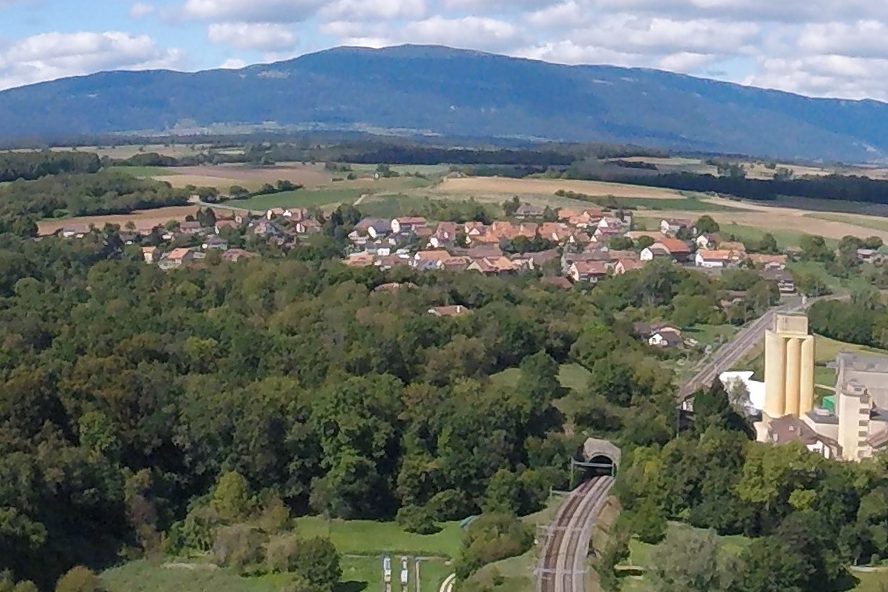
A village at the foot of the Jura nicknamed the «middle of the world», where the waters divide at the Bornu mill between the Rhine and the Rhône, and home to the Saint-Loup hospital.
Entry based on 13 sources · Our method · Reusable text (CC BY-SA)
Origin of the name Pompaples
The place is mentioned in 1049 in the form «Pons Papuli», then «Pompaploz» in the 14th century and «Pompapuli» at the end of the 15th century. The etymology remains uncertain: the name is linked either to Papulus, a 6th-century bishop, or to the nearby poplars.[2]
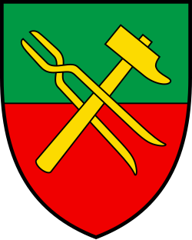
Coat of arms of Pompaples
Per fess vert and gules, a pair of pincers and a hammer Or in saltire overall. The top of the shield is green, the bottom red. Yellow pincers and a yellow hammer cross in an X over both colours. Adopted in 1923, these tools recall the former farriers and the ironwork long practised in the village alongside farming.[6][7][1]
Founding of Pompaples
Mentioned from 1049, Pompaples was in the Middle Ages a fief of the Grandson family and part of the barony of La Sarraz. It then passed to the Gingins, and the lordship, separated from the estate of Orny, became the appanage of a cadet branch of that house. The place owes much of its development to water: the building of a new Bornu mill, with a forge and a trip hammer, made Pompaples the «middle of the world». How Pompaples came into being is not known.
History of Pompaples
1049. First written mention, in the form «Pons Papuli».[2]
Middle Ages. Pompaples is a fief of the Grandson family and belongs to the barony of La Sarraz.
14th century. The name appears in the form «Pompaploz».[2]
1536-1798. Under Bernese rule, Pompaples belongs to the bailiwick of Romainmôtier.
1542. The fief passes to the Gingins. A new Bornu mill with a forge and a trip hammer is built, making Pompaples the «middle of the world».
1550. The village has 14 hearths.
1626. Break-up of the barony of La Sarraz.
1645. The lordship of Pompaples is separated from the estate of Orny and becomes the appanage of a cadet branch of the Gingins.
1658. Founding of the Abbaye des Maréchaux, a military society of the village.[2]
1697-1798. The lordship falls to officers in foreign service, for whom it provides a small landed income.
1743. Founding of the Abbaye verte, a second military society of the village.[2]
1791. The two societies adopt a common flag, which later inspires the municipal coat of arms.[2]
1798-2007. Pompaples belongs to the district of Cossonay, until the new Vaud districts came into force on 1 January 2008.
1923. Adoption of the coat of arms: golden pincers and hammer on a green and red field.[2]
1935-1948. The theologian Lydia von Auw is reportedly chaplain at the Saint-Loup hospital during these years.
2006. The Saint-Loup hospital is the largest employer in the former district of Cossonay.
2008. With the new territorial organisation of Vaud, Pompaples joins the district of Morges.
Population of Pompaples
Sources and references: [4]
| 1550 | 14 hearths (households) |
| 1764 | 180 |
| 1798 | 152 |
| 1850 | 309 |
| 1900 | 349 |
| 1950 | 550 |
| 2000 | 761 |
| 2025 | 917 |
Families of Pompaples
Citizen families before 1800. Chantran, Favey, Michaud and Pascal, with no precise date. The Exchaquet, from Savoy, are admitted as early as 1586 and the Bonzon in 1675.[8]
From 1901 to 1962. Sixteen registrations, none in the 19th century. The Nenninger (1926), the Jean-Petit-Matile (1930) and the Golay (1939) open the series, followed by the Napach, from the Soviet Union, in 1952 and the Chesaux in 1953. From 1956 to 1959 arrivals follow one another: Duplain of Undervelier JU, Hostettler of Wahlern BE, Layaz of Montet (Broye) FR and Thomazé, from France, in 1956, Küffer of Ins BE and Schenk of Signau BE in 1957, Gagnebin-de-Bons of Neuchâtel NE and Schlup of Wengi BE in 1958. In 1959 the Gerber of Röthenbach im Emmental BE, the Morisetti, from Italy, and the Weber of Seeberg BE close the list.[8]
Notable people of Pompaples
Georges Favey (1847-1919). Born in Pompaples, Georges Favey pursued a career as a magistrate and as professor of criminal law at the University of Lausanne, where he was rector from 1892 to 1894. A federal judge from 1900 to 1919, he presided over the Federal Supreme Court in 1913. He also co-founded the Société vaudoise d'histoire et d'archéologie in 1903.[9]
Georges Duplain (1914-1993). A journalist born in Pompaples, where he died, Georges Duplain was an editor at the Gazette de Lausanne and then a correspondent at the Federal Palace. He headed the Swiss News Agency in Bern from 1968 to 1979. He also wrote historical monographs and a biography of Charles Ferdinand Ramuz (1991).[10]
Louis Germond (1796-1868). A Vaud pastor, Louis Germond founded an institution of deaconesses at Echallens castle in 1842. The institution moved in 1852 to Saint-Loup, in the commune of Pompaples, where he died in 1868. Before that he was a pastor in Sainte-Croix, Yvonand and Echallens, then of the Free Church of Echallens.[11]
Louis Reymond (1874-1959). Born in Pompaples, Louis Reymond was a notary in Orbe from 1900 to 1924 and mayor of the town from 1906 to 1912. A Radical member of the Vaud Grand Council, he sat in the National Council from 1912 to 1919. He then headed the Crédit foncier vaudois from 1924 to 1944.[12]
Pierre Borgeaud (1934-2019). A mechanical engineer born in Pompaples, Pierre Borgeaud joined Sulzer Brothers in 1960 and became its chief executive (1975-1988), then chairman of the board (1988-2000). He also chaired the Vorort from 1987 to 1993 and sat on the council of the Swiss National Bank.[13]
Economy of Pompaples, past and present
The Bornu mill and iron. The village grows up around farming and the water power of the Nozon, which feeds the Bornu mill. The new mill of 1542, with its forge and tilt hammer, leads to the diversion of the Nozon's waters. In 1551 their division is made official: one part flows towards La Sarraz and the Rhône, the other towards Orny and the Rhine. One of the branches feeds a fish farm.[1][7][2]
Saint-Loup. In the 19th century the Deaconesses' Institution founded by pastor Louis Germond settles at Saint-Loup, a turning point in the municipality's history. In 2006 the Saint-Loup hospital is the largest employer in the former district of Cossonay. A merger has made it part of the Établissements hospitaliers du Nord vaudois (eHnv). A school of community care and health (ESSC) is under construction on the site.[1][7][2]
The municipal vineyard. The idea of replanting a vineyard arises in 1990. About 1'000 vines are planted in 1991 for the 700th anniversary of the Confederation. The municipality has made Pinot Noir since the first harvest in 1994 and offers part of the wine to residents by subscription.[2][7]
Historic sites in Pompaples
The middle of the world and the Bornu mill. Near the Bornu mill, about 300 metres from the village, a small pond forms a watershed: on one side the waters reach the North Sea via the Nozon, the Orbe and the Rhine. On the other, the Mediterranean via the Venoge, Lake Geneva and the Rhône. The new mill built in 1542, with a forge and a trip hammer, earned the place its nickname of «middle of the world».[2][3]
Saint-Loup hospital. Established by pastor Germond, the Saint-Loup hospital, together with the deaconess institution, has deeply shaped the life of the municipality. It is now part of the Établissements hospitaliers du Nord vaudois and in 2006 was the largest employer in the former district of Cossonay.[2]
Protected heritage in Pompaples
Cultural property of regional significance (B objects)[5]
- Ancien moulin Bornu
Traditions and festivals in Pompaples
The bread oven. The village bread oven comes back to life four times a year for a baking day. For one of them, all the proceeds of the sale go to the Téléthon. A local society, the Association du four à pain, is devoted to it.[7]
Sources
- Dictionnaire historique de la Suisse, « Pompaples »
- Commune de Pompaples, « Présentation »
- Texte et image, « Le Milieu du monde (Pompaples) »
- Statistique Vaud, « Population résidante permanente au 31 décembre 2025 »
- Federal Office for Civil Protection (FOCP), Swiss Inventory of Cultural Property (PCP), list for the canton of Vaud (as of 1.1.2026)
- IPI, Swissreg, emblems database: coat of arms of Pompaples (no. 101421)
- Official Gazette of the Canton of Vaud (FAO), "Alphabet des communes vaudoises: Pompaples", issue of 25 August 2026
- Register of Swiss Surnames, 3rd edition (1989), search Commune "Pompaples", Canton VD
- Dictionnaire historique de la Suisse, « Favey, Georges », version du 04.11.2024
- Dictionnaire historique de la Suisse, « Duplain, Georges », version du 26.08.2004
- Dictionnaire historique de la Suisse, « Germond, Louis », version du 14.11.2005
- Dictionnaire historique de la Suisse, « Reymond, Louis », version du 07.09.2009
- Dictionnaire historique de la Suisse, « Borgeaud, Pierre », version du 19.07.2019
Published by Sébastien Jörg ·
Other villages near Pompaples
Missing information, or do you have a source? Suggest a correction or addition. Every submission is checked before it's published.
Suggest a change